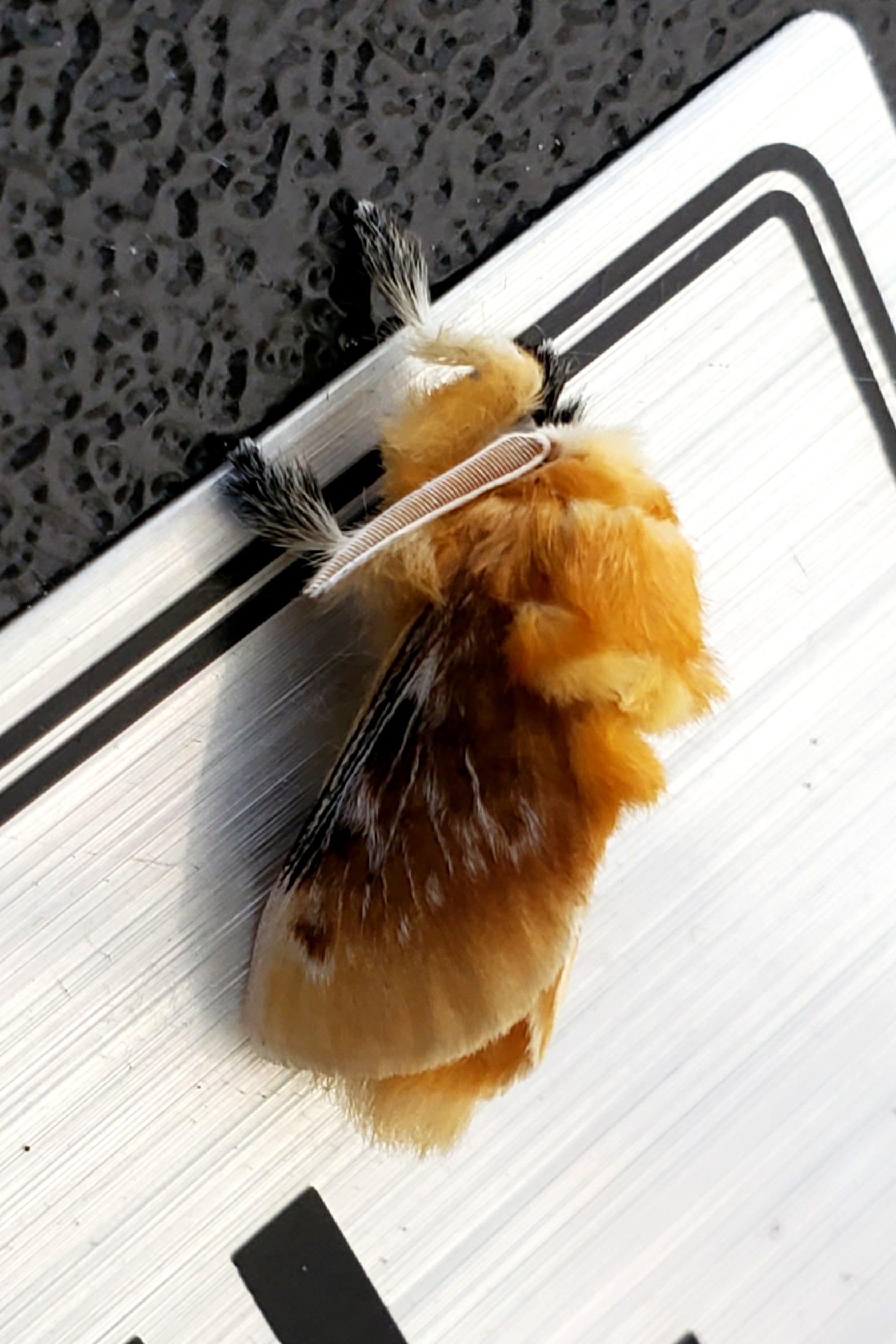
As my biography will tell you, I have always been an advocate for the less lovable creatures in nature. So I thought it would be fitting to start my blog with some of my favorite insects and arachnids. I’ll start with what those words mean. We all know the term “insect”, having heard from a young age that these are the six-legged bugs, differentiated from the eight-legged “arachnids”. These terms are probably just a natural part of your vocabulary, likely without a second thought as to where those words came from. The word “insect” comes from the Latin word insectum which literally means “one with a notched or divided body”. The term “arachnid”, on the other hand, is derived from Roman mythology. Arachne was a weaver who challenged Athena, the goddess of crafts, to a weaving contest. When Athena could find no flaws is Arachne’s product, she became enraged and beat Arachne until she was so scared and ashamed that she hanged herself. Athena then cast a spell on her that brought her back to life as a spider.
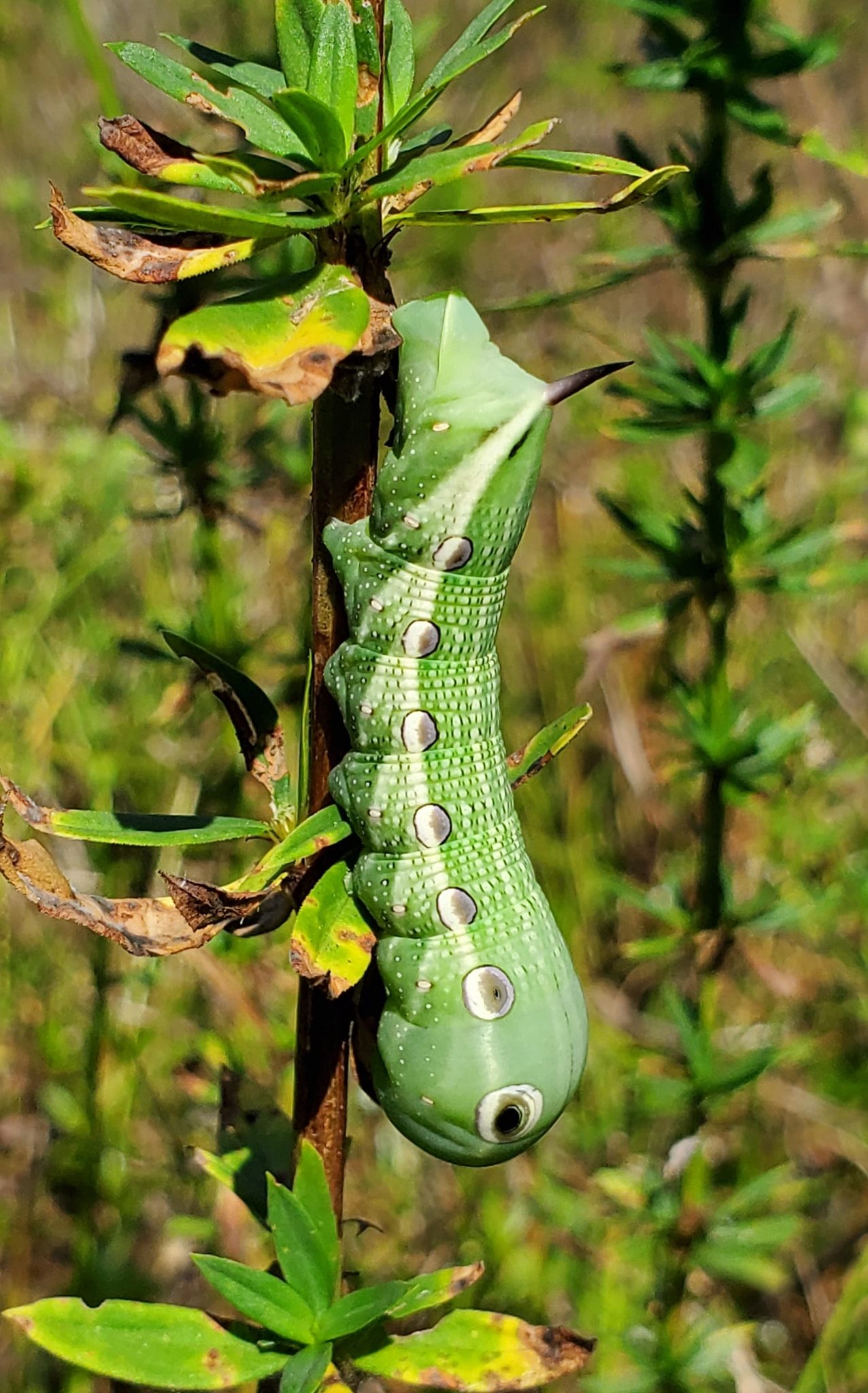
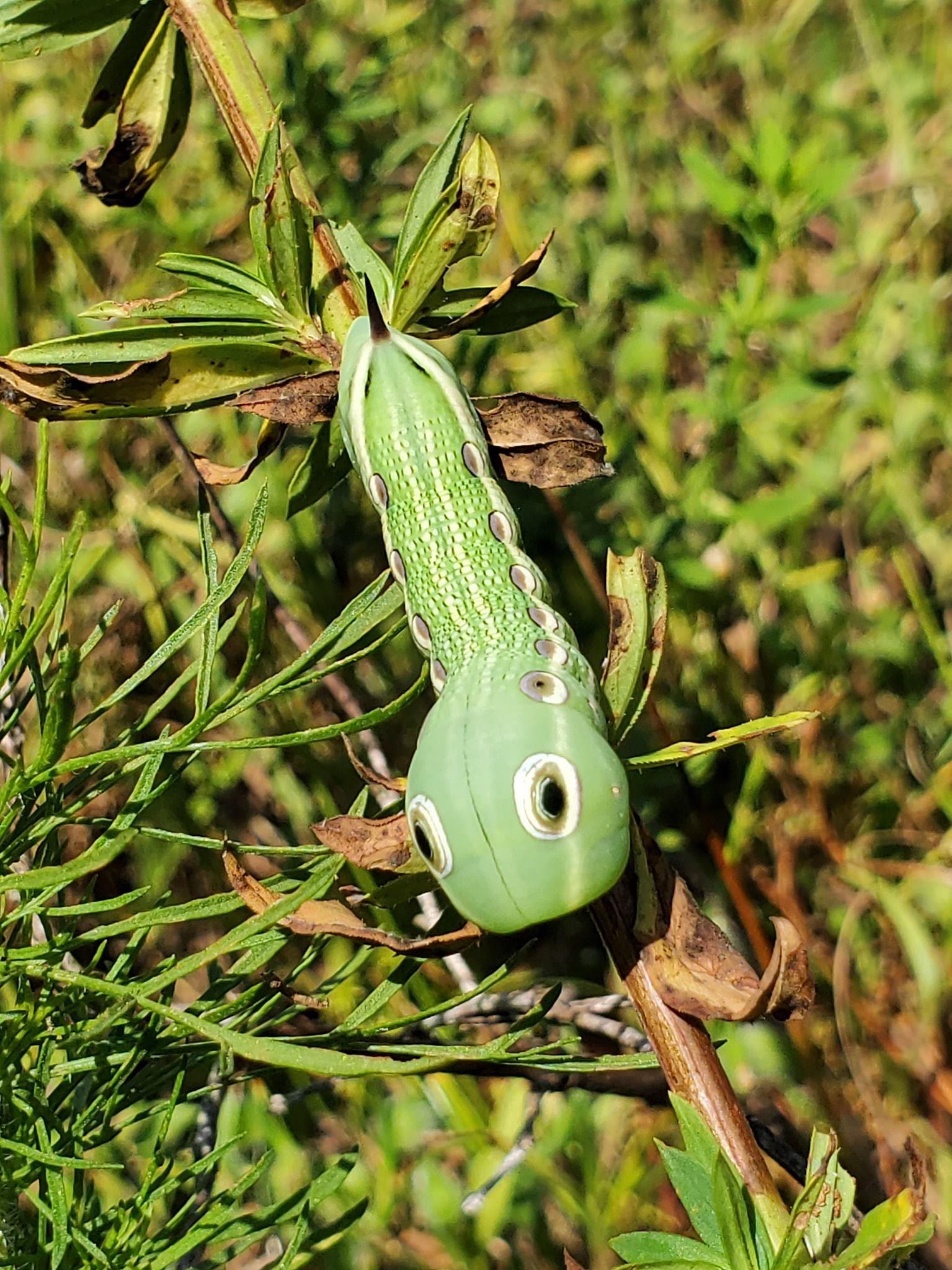
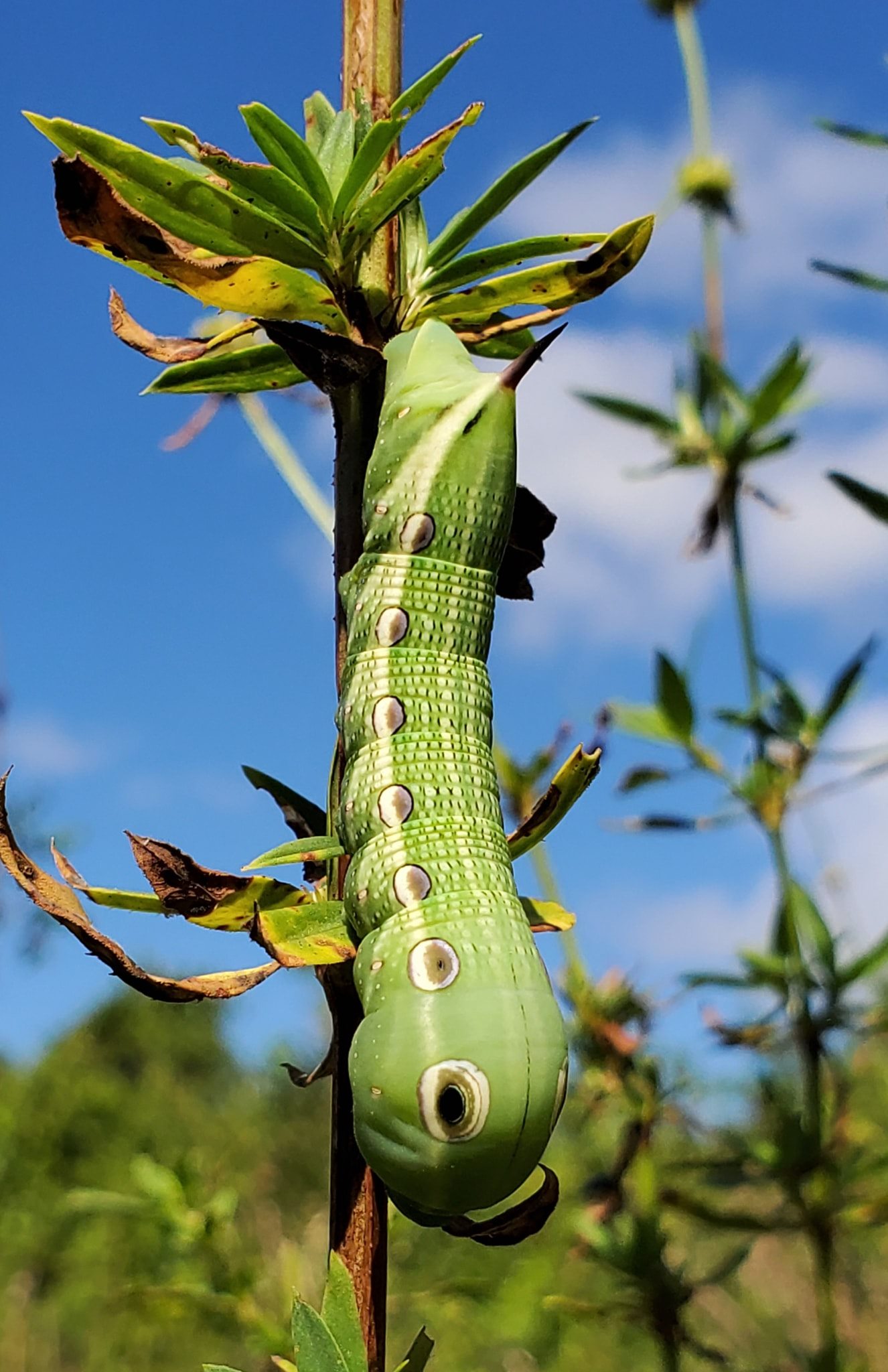
Now that you know the stories of the names of these lovely creatures, I hope to inspire some admiration by showing you some rather unique insects and arachnids, as well as some of their unique behaviors and characteristics. I’ll start with one of my favorite caterpillars. At first glance, I thought this was the caterpillar of the spicebush swallowtail butterfly, noticing of course the large false eyes. To a potential predator, such as a bird, these eyes on the enlarged portion of the body might be interpreted as a snake’s head, thereby deterring the possible threat. The head and the true legs (the six actual legs of the insect, as opposed to the prolegs which are the softer legs along the rest of the body) are tucked under that large false head. The small spike at the other end led me to believe this is the caterpillar of a Tersa sphinx moth (Xylophanes tersa). The genus Xylophanes is a combination of the Greek words xylon, meaning wood, and phanes, meaning to appear. So species in this genus literally “appear to be wood”. The species tersa seems to be from the Latin tersa, meaning burnished, a type of treatment that makes wood look shiny. So the full scientific name basically means “appearing to be shiny wood”.
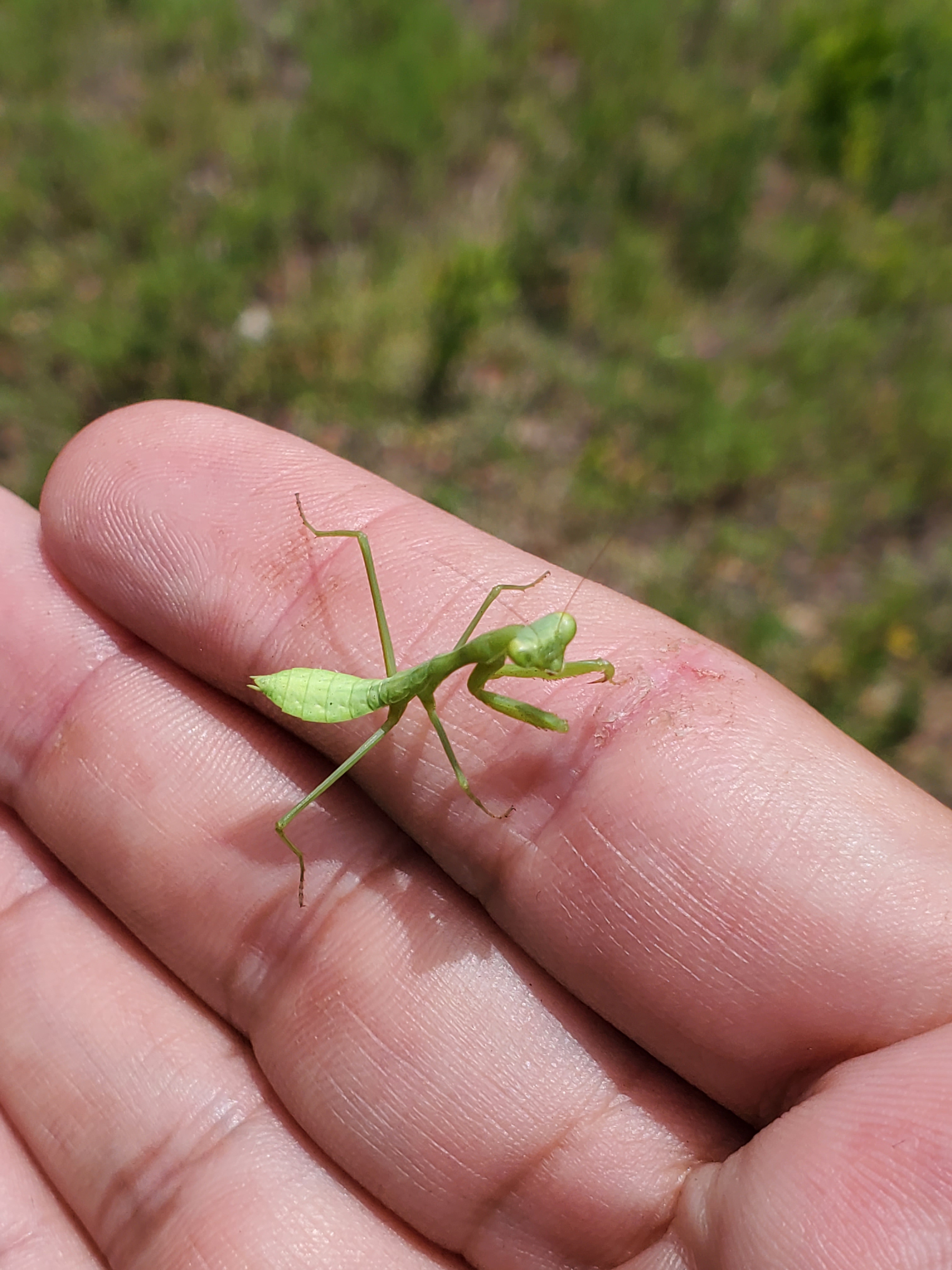
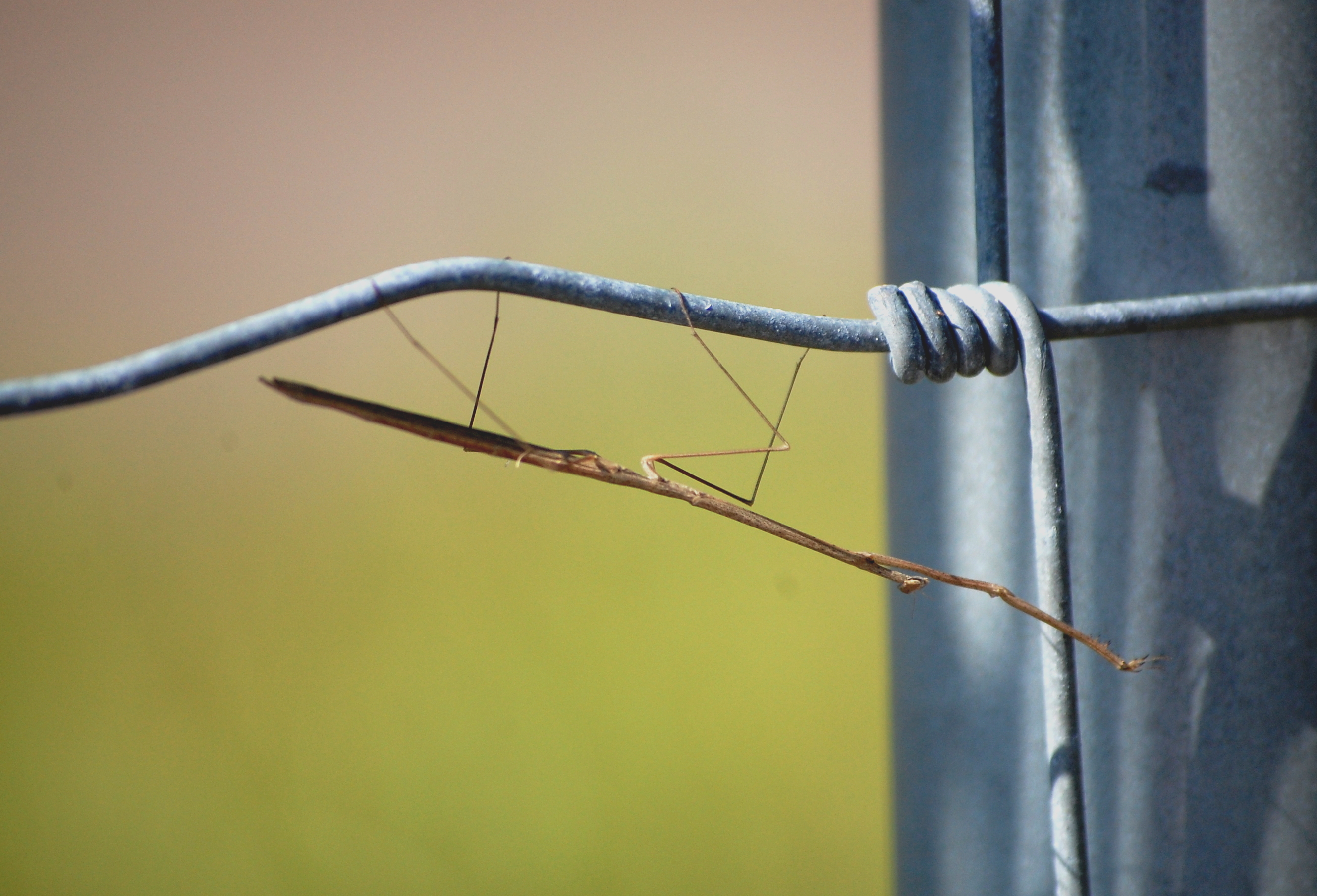
Another of my favorite types of insects are the mantids, also known as praying mantises. I always consider myself lucky to be able to see one of these. Most are very cryptic, either in size, shape, or color, making them difficult to see even when you aren’t looking for them. One of the most unique characteristics of mantids are the long front legs which have been adapted to grab prey. These are known as “raptorial appendages”. This is derived from the Latin rapio meaning “to seize or take by force”. The first mantis was a bit hard for me to identify. My best guess is that it is a young Carolina mantis (Stagmomantis carolina). We found this one during a gopher tortoise dig. I always like to show animals in their natural habitat, but I went ahead and included the one of me carrying it since it is a bit hard to see on the ground. The other is a much longer and thinner mantis known as the grass-like mantis (Thesprotia graminis). The grass-like mantis can reproduce either sexually or parthenogenetically (without fertilization from a male – literally means “virgin creation”), whereas the Carolina mantis reproduces sexually. And yes, some of these mating rituals do result in sexual cannibalism where the female devours the male. Another interesting thing about the Carolina mantis is that they can choose their color based on the environment. They don’t do this one the fly like a chameleon. Rather they can change color with each molt.

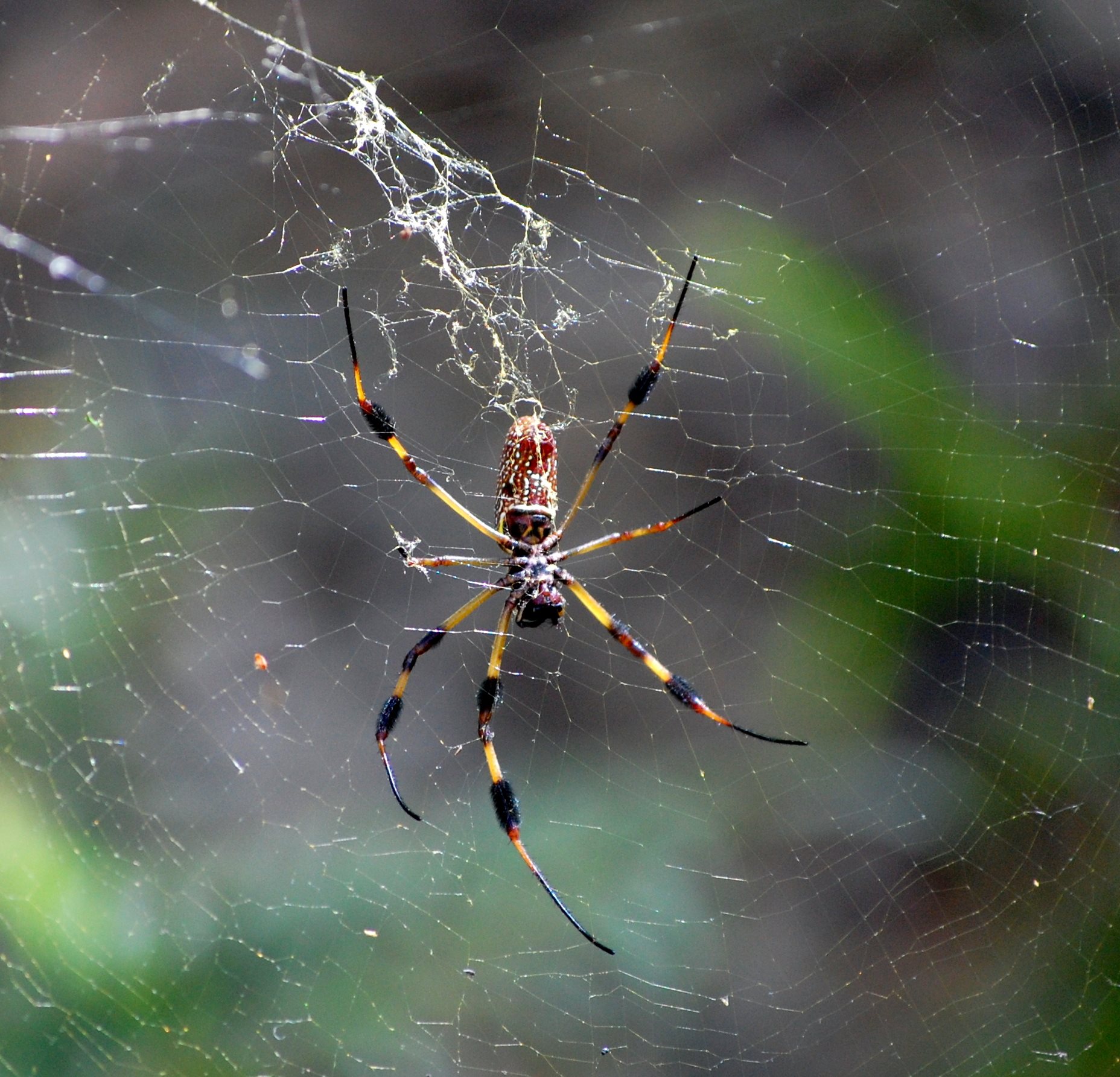
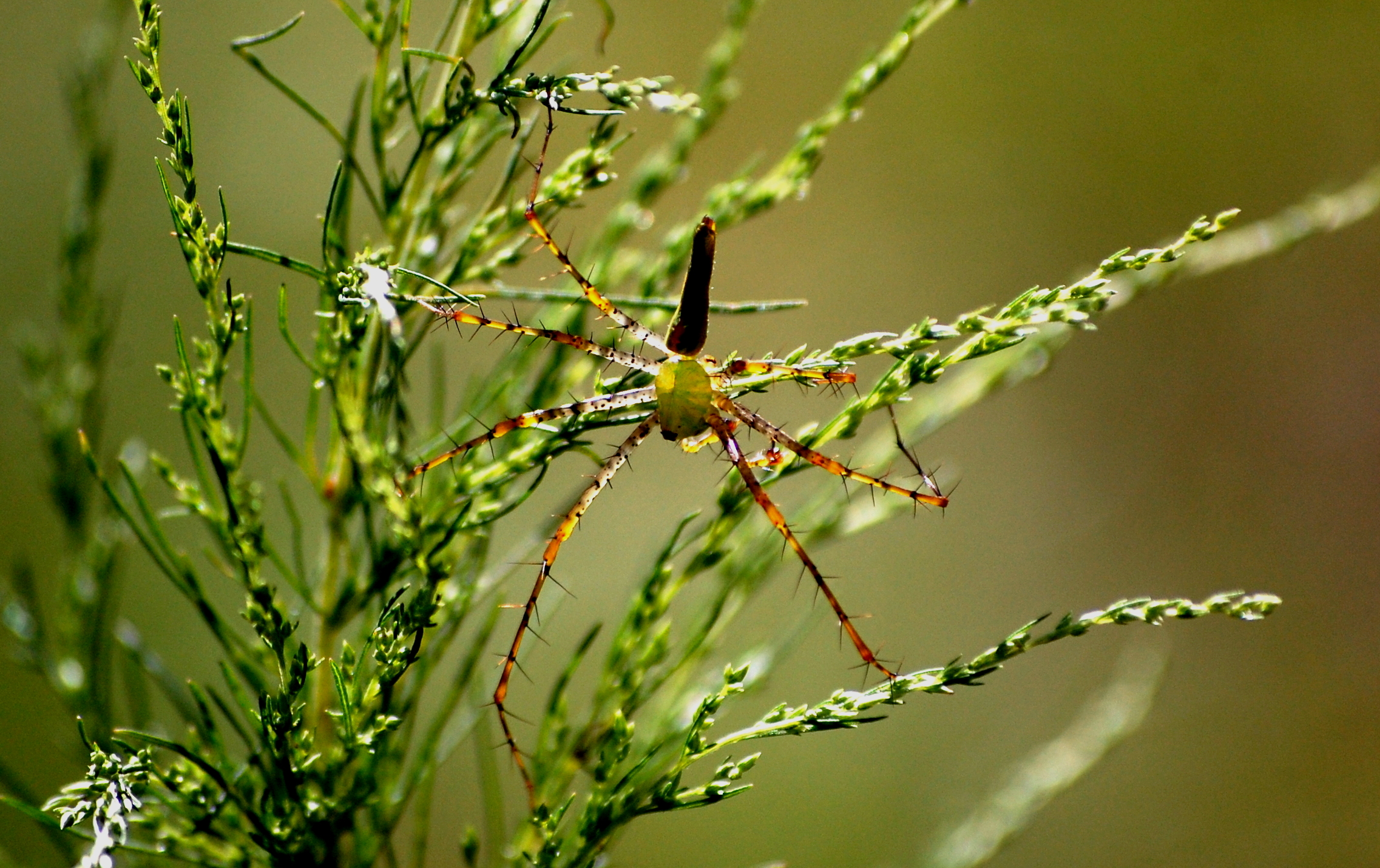
I started out with some of the more innocuous species, but of course the world of insects and arachnids is filled with those that are considered more creepy, and some can even be dangerous. So, as a bit of a disclaimer, the rest of this post may get a bit creepy. Let’s take a break from insects for a bit and talk about arachnids. Those of us in Florida will be very familiar with this next one. Most people refer to them as banana spiders. They are also known as golden silk orb-weavers (Trichonephila clavipes). From what I could gather, the genus seems to be a mix of tricho, meaning “hair”, and nephila, meaning “fond of weaving”. The species name comes from the Latin clava, meaning “knotted staff” and pes, meaning “pertaining to the foot”. It is thought that the species name refers to the tufts of hair on the legs. One of the most amazing things about this species is the strength of their silk which has been tested to be around eight times the strength of steel and has been shown to be an excellent heat conductor. The other I believe to be a green lynx spider (Peucetia viridans). The genus may refer to the Peucetian tribes of southeastern Italy, perhaps where these genus was first discovered (this is just a personal guess). The species viridans is Latin for “becoming green”. One of the more interesting things about this species is that the female will guard her egg sac by hanging upside down and spitting venom at anything that gets near it. It’s worth mentioning that, despite their scary looks, a bite from either of these spiders may be a little painful but is not deadly. They are also very important to the ecosystem as a means of pest control. So there is no need to harm them if they are encountered.
Another very interesting spider we have here is the jumping spider. These look a bit like tiny tarantulas. The one I see most commonly is the regal jumping spider (Phidippus regius). The one shown below is a female as indicated by the grey and orange markings (males are black and white). This one in particular caught my eye just for the shear size. Typically, jumping spiders are about the size of a dime. This one was closer to the size of a nickel. It’s also pretty impressive that she was able to take down a full size cricket, something that would ordinarily be rather large for this species to try to take on. Unlike other spiders, jumping spiders don’t use a web to capture their prey. As the name suggests, they jump to pounce on their prey instead. With a soft abdomen, this can be dangerous (think of them like a tiny water balloon), so they do anchor themselves with silk prior to jumping, in case they miss.
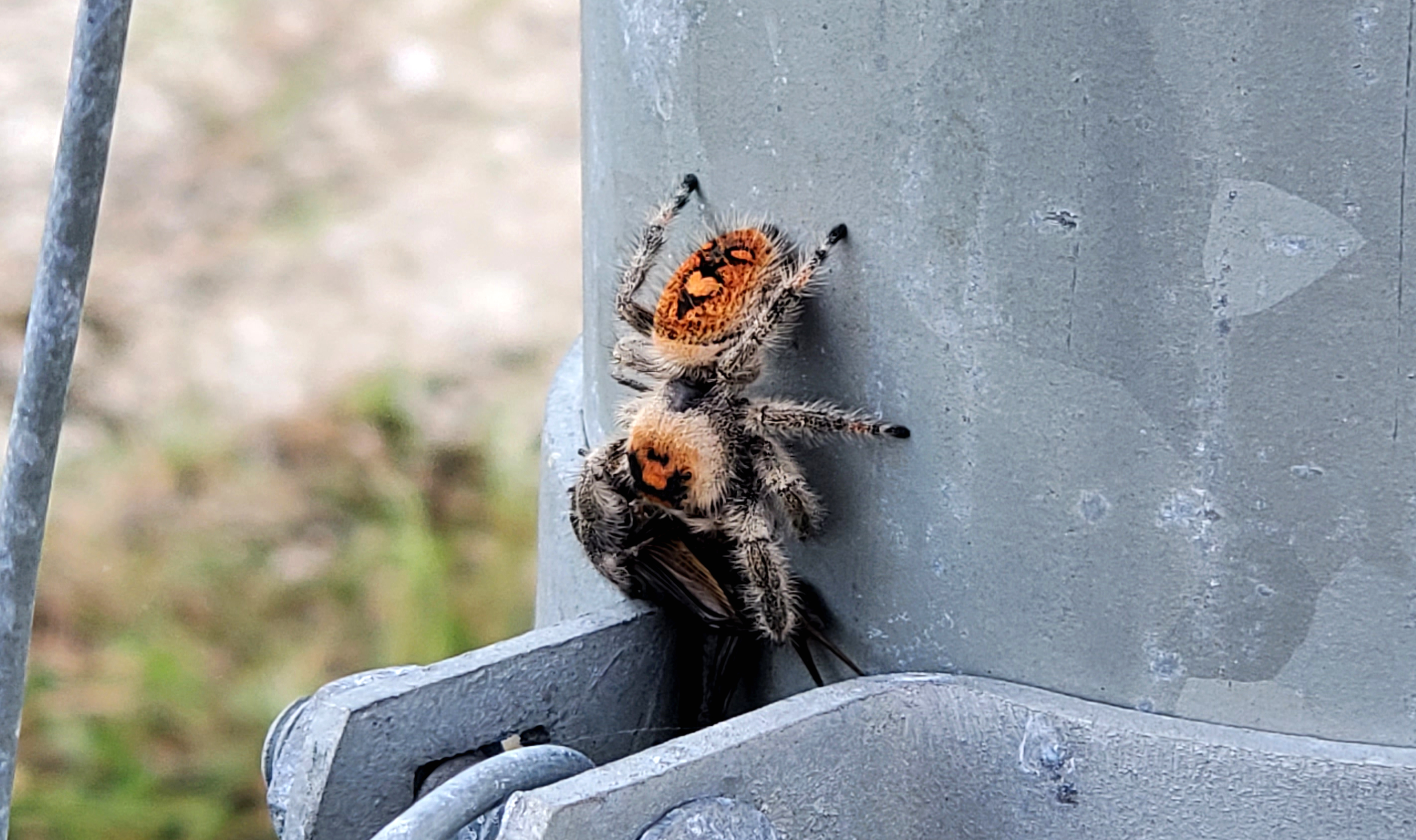
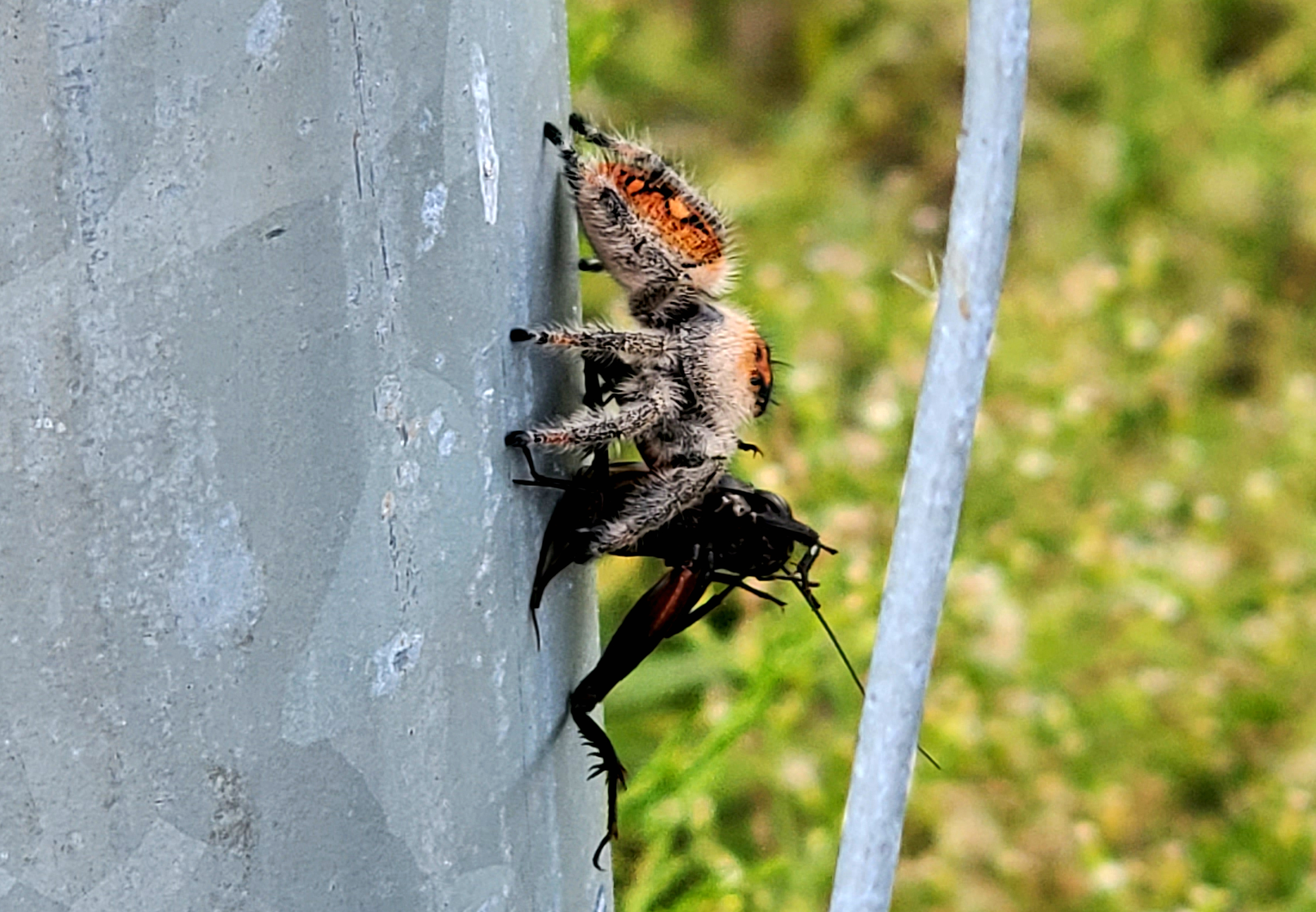

One of the most interesting facts about jumping spiders is their mating ritual. The male is smaller than the female and must woo her literally through a song and dance. The dance consists of dropping the abdomen to the ground and waving the front legs in the air. The “song” is a series of scrapes, clicks, and buzzes send through the ground. It’s very important to the male that the female is impressed for two reasons. One, of course, is that he needs to find a mate. Secondly, if she is unimpressed with his song and dance…she may eat him. I did have the pleasure of seeing one doing the mating dance on the hood of a work truck. I got my phone out and was able to record a small portion of this dance before I was noticed, at which point I got to see why they are called “jumping” spiders.
We all know that nature isn’t always pretty when it comes to predator/prey relationships and some of the awful things the prey may go through. That was certainly the case here with this great golden digger wasp (Sphex ichneumoneus). This female has caught her prey and stung it several times. This doesn’t kill the prey, but rather just paralyzes it. Then she will take it to her burrow where she will drag the prey item inside to be eaten alive by her larvae. Before feeding her young, she will leave the prey outside and inspect the burrow. Studies have shown that, if they prey item is moved, she will find it and bring it back to the burrow, only to inspect the burrow again as if her behavior has been reset. Despite the gruesome treatment of prey, this species is not aggressive. In fact, males don’t even have stingers, although they will hover around you intimidatingly if you get near their burrows.


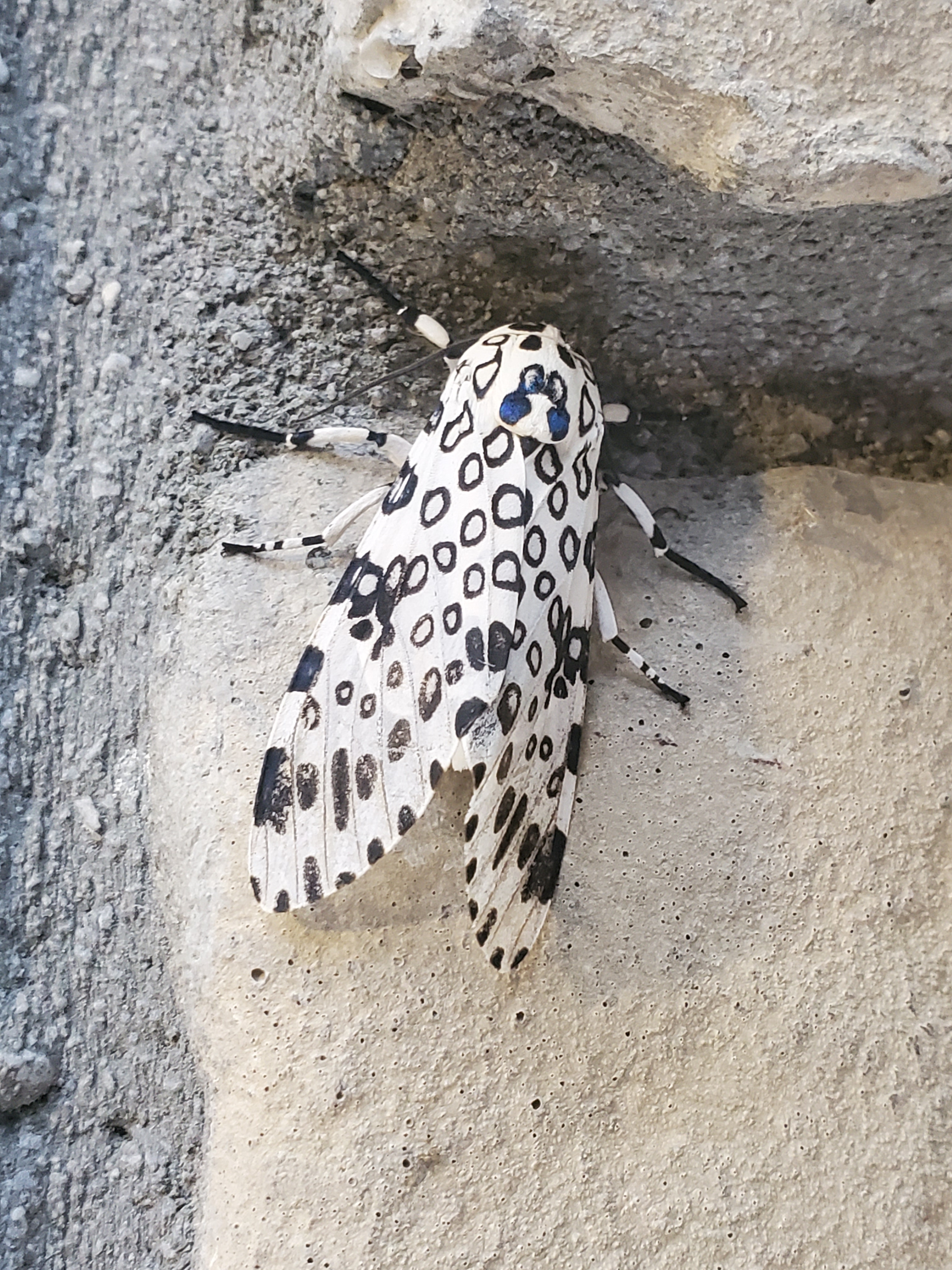
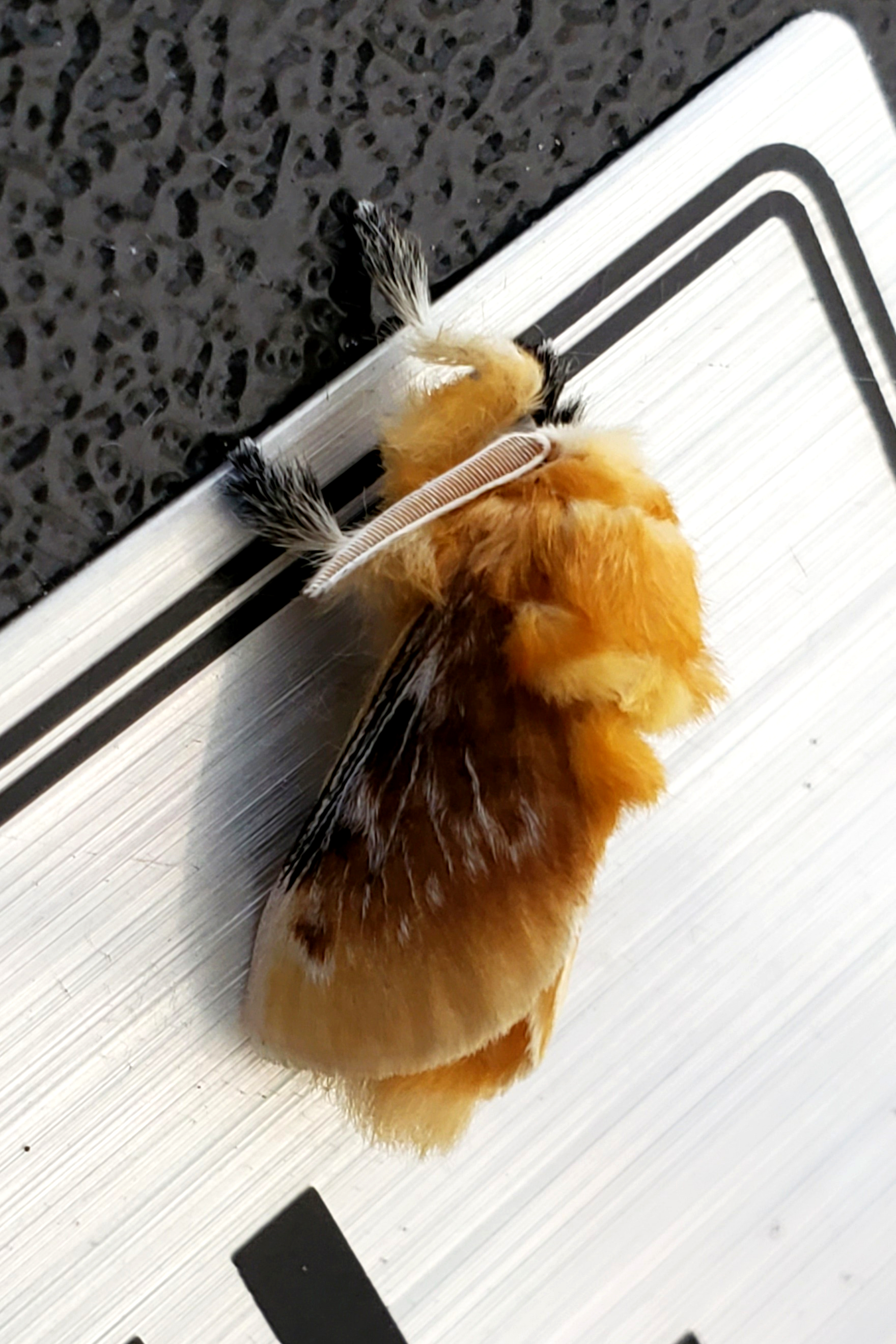
There is a multitude of moth species out there. Most are a bit drab and not very interesting to look at. However, some are quite beautiful if you look closely enough. They can also be very easy to photograph as most are nocturnal. While they do not sleep in the traditional sense, they enter a state of “torpor”. This is where the body temperature and metabolic rates drop, leaving the animal more or less temporarily comatose. Below are a few of the most interesting moths I have seen in this area. The black and white one is a giant leopard moth (Hypercompe scribonia). If you look closely, you’ll see two iridescent blue spots which, to my knowledge, serve an unknown purpose. Their caterpillars are called “woolly bears” due to their black, fuzzy look. Despite their intimidating look, the bristles on this caterpillar are not dangerous. However, the same can not be said about the southern flannel moth (Megalopyge opercularis), or at least of its larvae. The caterpillar of the southern flannel moth looks like a ball of fur and has several common names including puss (because the hair looks like a cat) and asp (because the sting feels like a snake bite). The hairs have venomous spines that are very dangerous. Not only will the venom cause localized extreme pain (some liken it to being set on fire) but also cause systemic problems, such as nausea, chest pain, and even shock-like symptoms. As always, however, there is no reason to harm these animals as they are not aggressive. Finally, there is the very beautiful and impressive Polyphemus moth (Antheraea polyphemus). The name comes from the cyclops Polyphemus from Greek mythology due to the large eye spots on the wings (I talk more about Polyphemus when describing the gopher tortoise in my post about native herps). Due to the large plumose antennae (the large, bushy antennae seen in some moths), I believe this one was a male as those are larger in the males since they sense the female pheromones. Confession time: Of all the animals I come in contact with, I have a phobia for large moths. I know they won’t hurt me (their only defense is the large eye spots meant to look like a predator), so it makes no sense. But my heart was racing when I took this photo. It was in an unprotected area and I could see someone being equally afraid and killing it, so I took it to safety (it already had an injured right hindwing). I hope to see another one some day and have the fortitude to get a better photo to show how beautiful it really is.

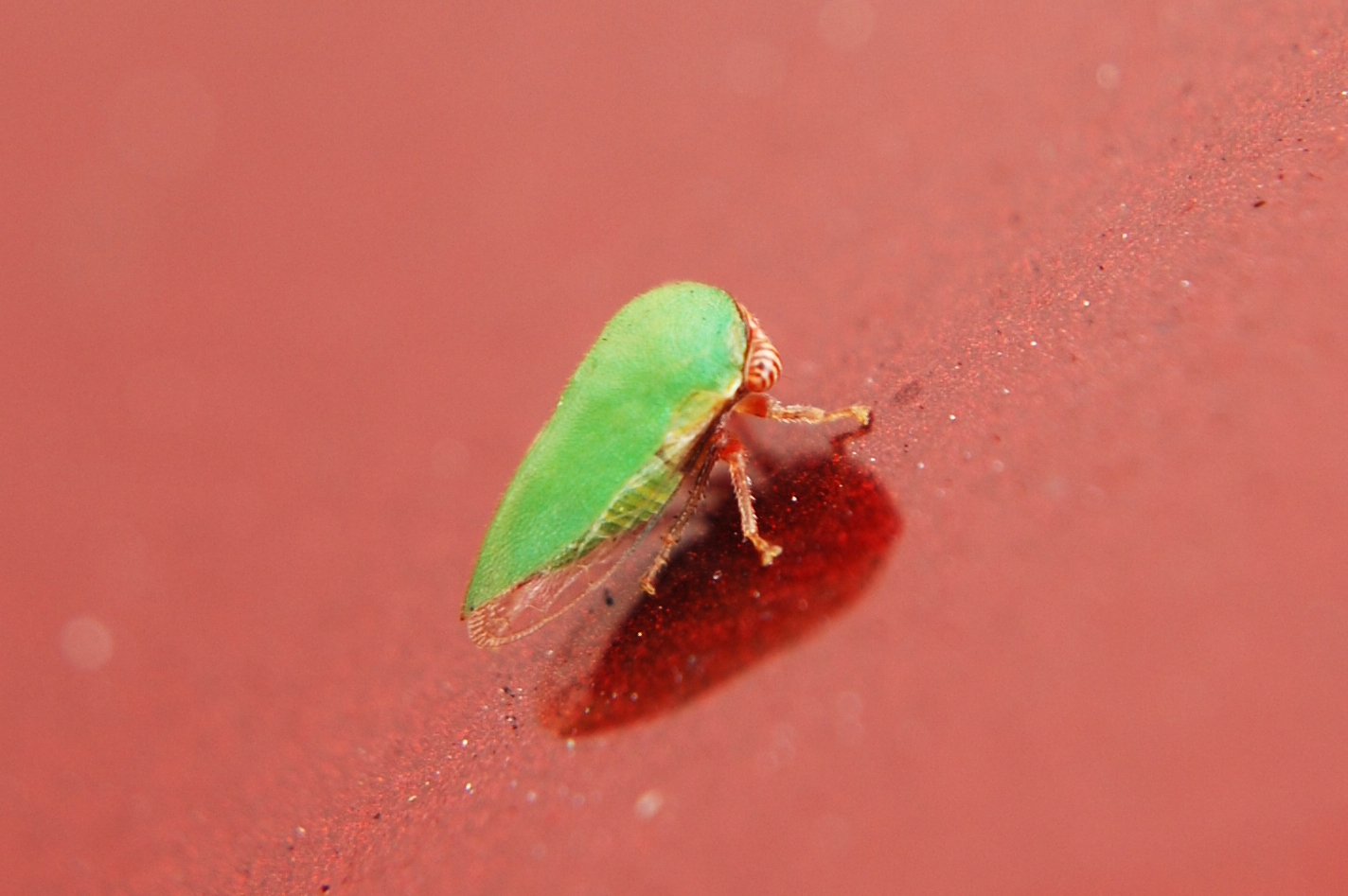
It’s easy to find the beauty in larger insects, such as the Polyphemus moth. However, if you look closely, there are some amazing smaller insects out there as well. A rather rare sight in Florida is a tiny insect known as a treehopper. There are around 3,200 species of treehoppers out there. Many have elaborate markings and adornments (check out the Brazillian treehopper (Bocydium globulare). This simple one I believe to be Ophiderma evelyna (as far as I can tell, there is no common name). Specifically, this one is a female as the male has a brown and yellow pattern. Treehoppers feed by piercing the stems of plants and drinking the sap. The females of most treehopper species have a saw-like appendage called an ovipositor which they will use to cut into these stems to lay her eggs. The photo below was taken with a macro lens making it appear larger. However, in reality this treehopper was smaller than a grain of rice.
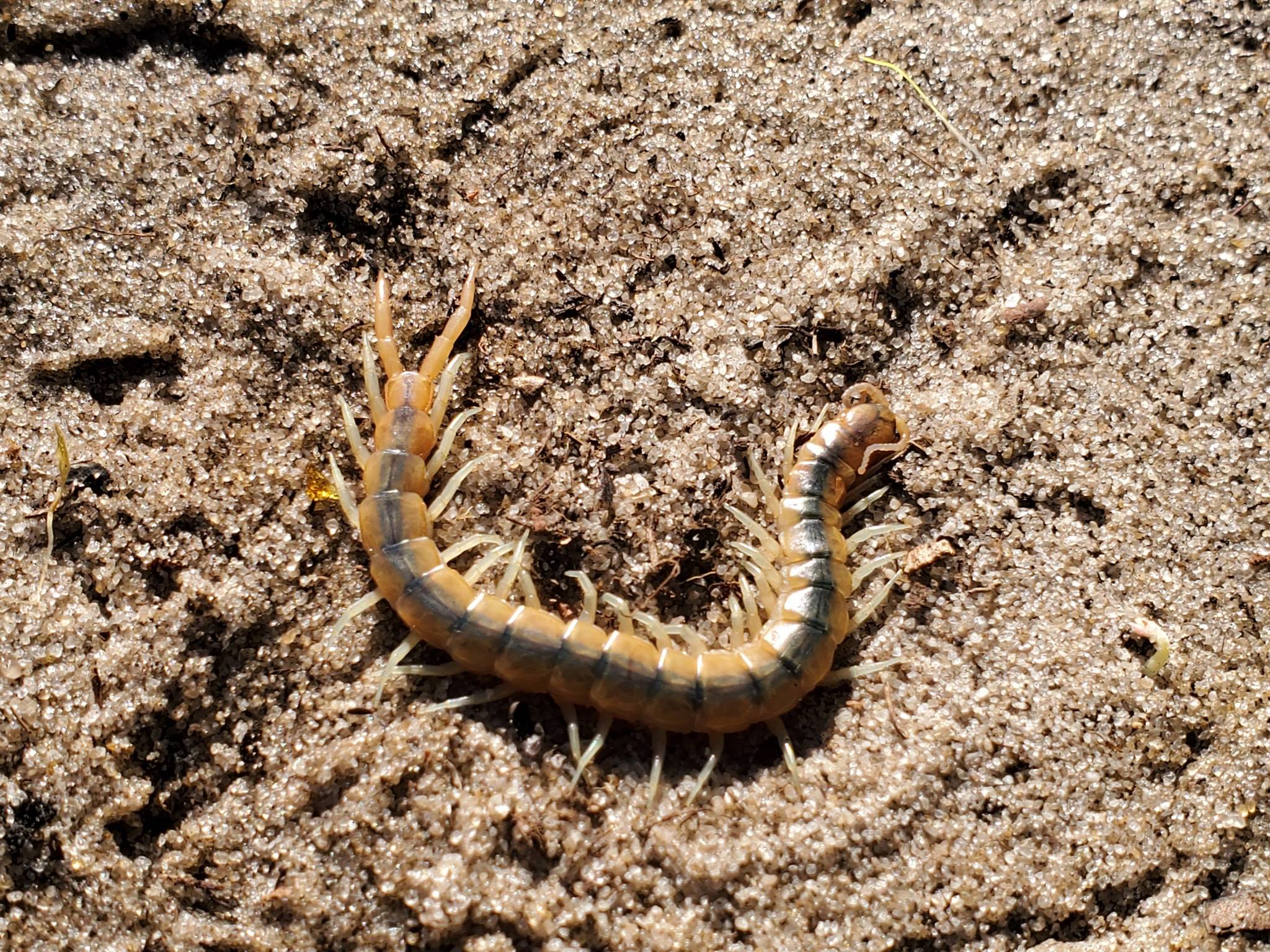
In finishing off this post, I’ll share what is actually neither an insect nor an arachnid, but seemed to fit in this world of bugs. Centipedes are actually what are known as chilopods. From the Greek kheilos, meaning lip, and poda, meaning foot, the name refers to the forcipules. These are the two pincher-like appendeges near the mouth that inject the venom. One of the most impressive centipedes we have here is the Florida blue centipede (Hemiscolopendra marginata). Named for the bluish tint, this is not something that you want to come in contact with in any form. Not only does it pack a powerful bite, it also has toxins at the base of each leg. It can scratch with it’s sharp legs and deliver the toxins to the wound. However, you aren’t likely to come across these in everyday life as they tend to hide in dark spaces, under debris. This one I found under a board first thing in the morning. Like the moths, it was in torpor. So I was able to safely get a close look at it. However, when the morning sun hit it and warmed it up, it started to move. So I put the board back down and let it be.
 BJ Quinton