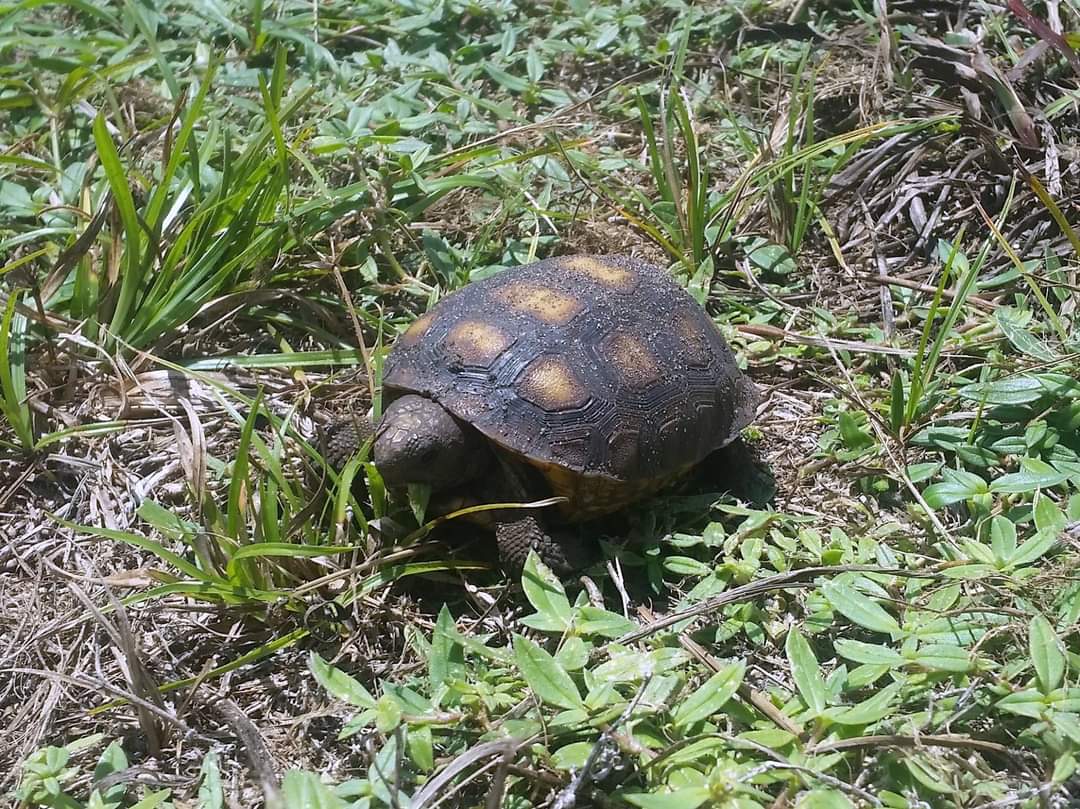
In addition to the interesting yet detrimental invasive species, Florida is also home to an array of native species that are not only beautiful in their own way, but also play a valuable role in our ecosystem. Sometimes when I start these pages, I struggle to find a starting point. But deciding which native reptile to start with for this post was no competition.
They have evolved to live underground to protect themselves during wildfires, which are an important part of the management of their habitat. Their burrows are homes to at least 360 other species, many of which are protected both at the state and federal levels. Their burrows can be tens of feet long and are sometimes dug through soil so hard and compact that shovels and machinery can struggle through it. And, as much as I try to remain a scientist and shy away form this sort of thing, let’s face it . . . the old man faces are adorable. Of course I’m talking about the one and only gopher tortoise (Gopherus polyphemus).
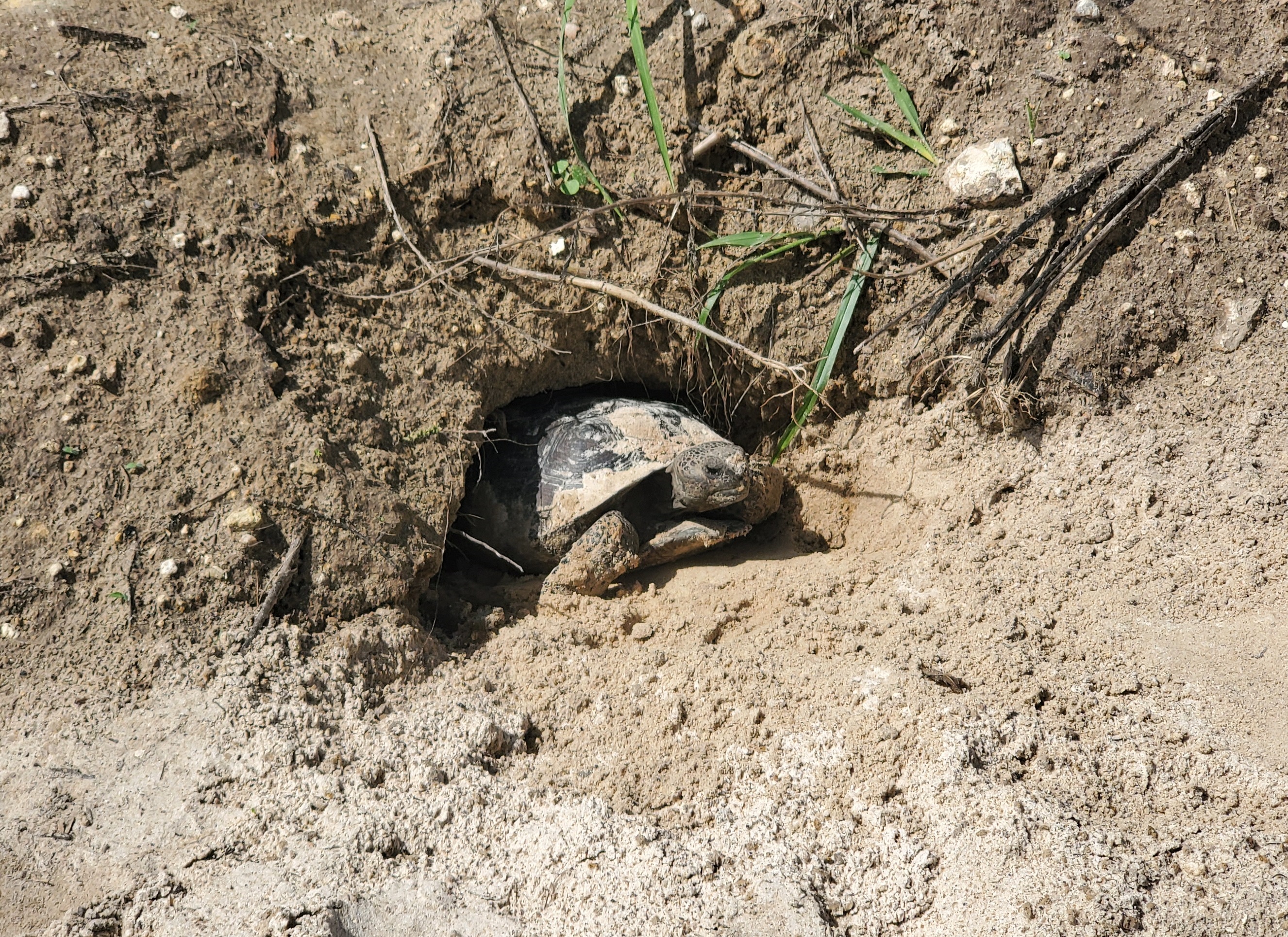
Polyphemus is a character in Greek mythology that lived in a cave, which is where the species name comes from. However, that is where the similarities end. Polyphemus was a giant cyclops, portrayed by some authors as a savage cannibal who kept humans captive in his cave by placing a large rock at the entrance, and eating some of them from time to time. In contrast, gopher tortoises are rather small, gentle creatures whose most intimidating behavior may be the deep hisses that can sound rather powerful when coming from within the burrow. While males may occasionally fight by ramming into each other, sometimes flipping each other over, they are usually more defensive in nature, pulling their heads into their shells and protecting them with their thick, scale-armored legs.
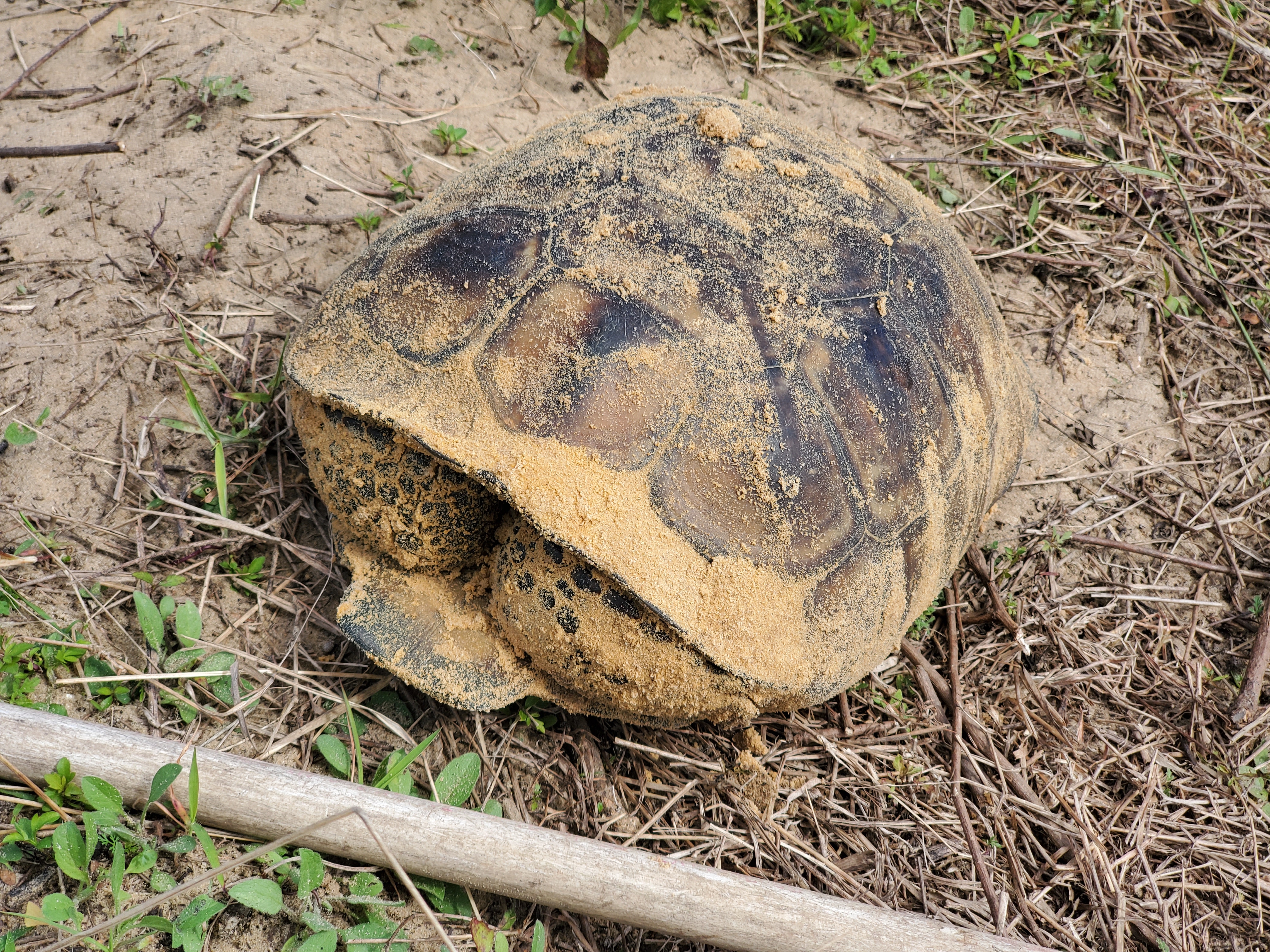
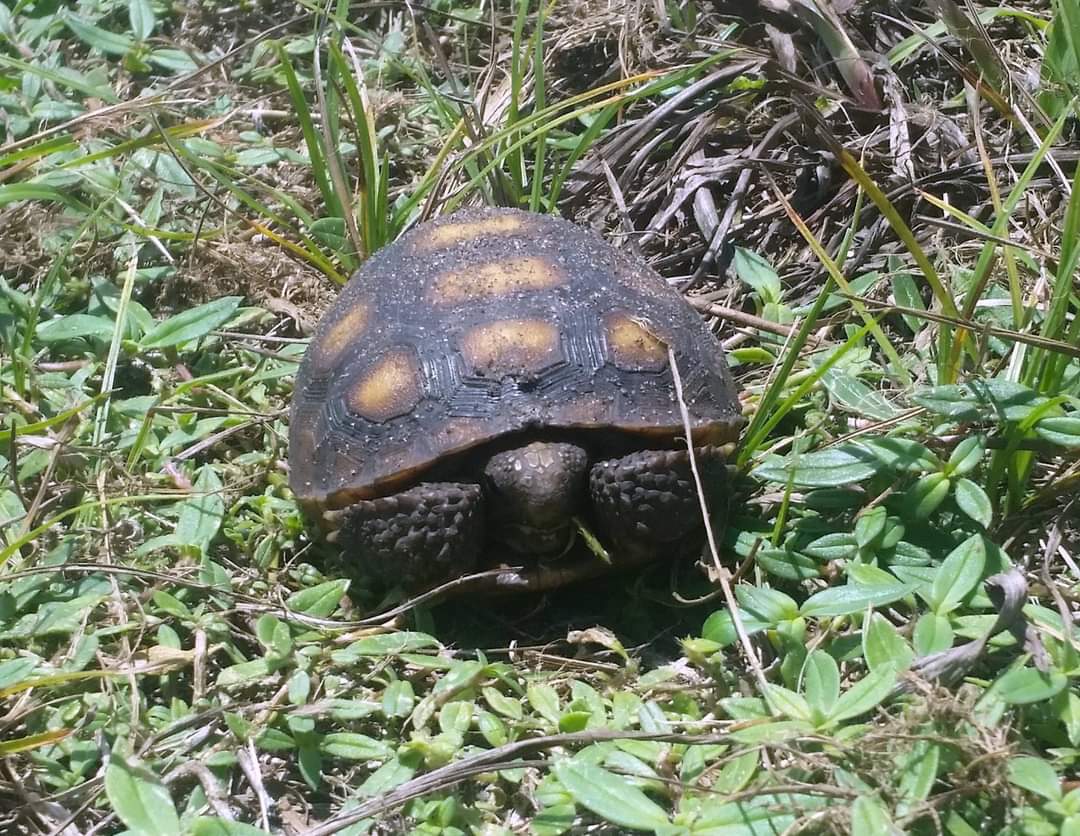
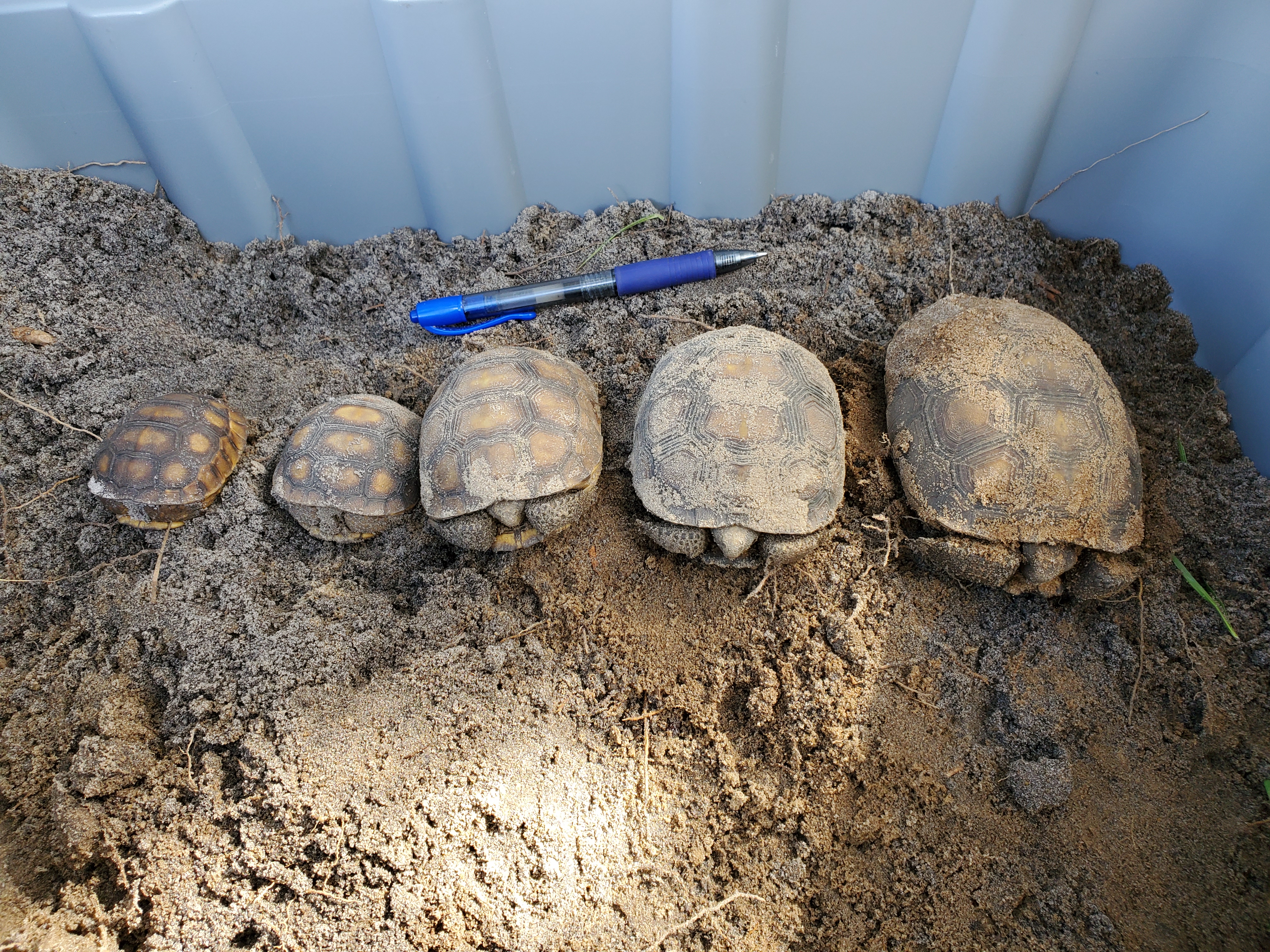
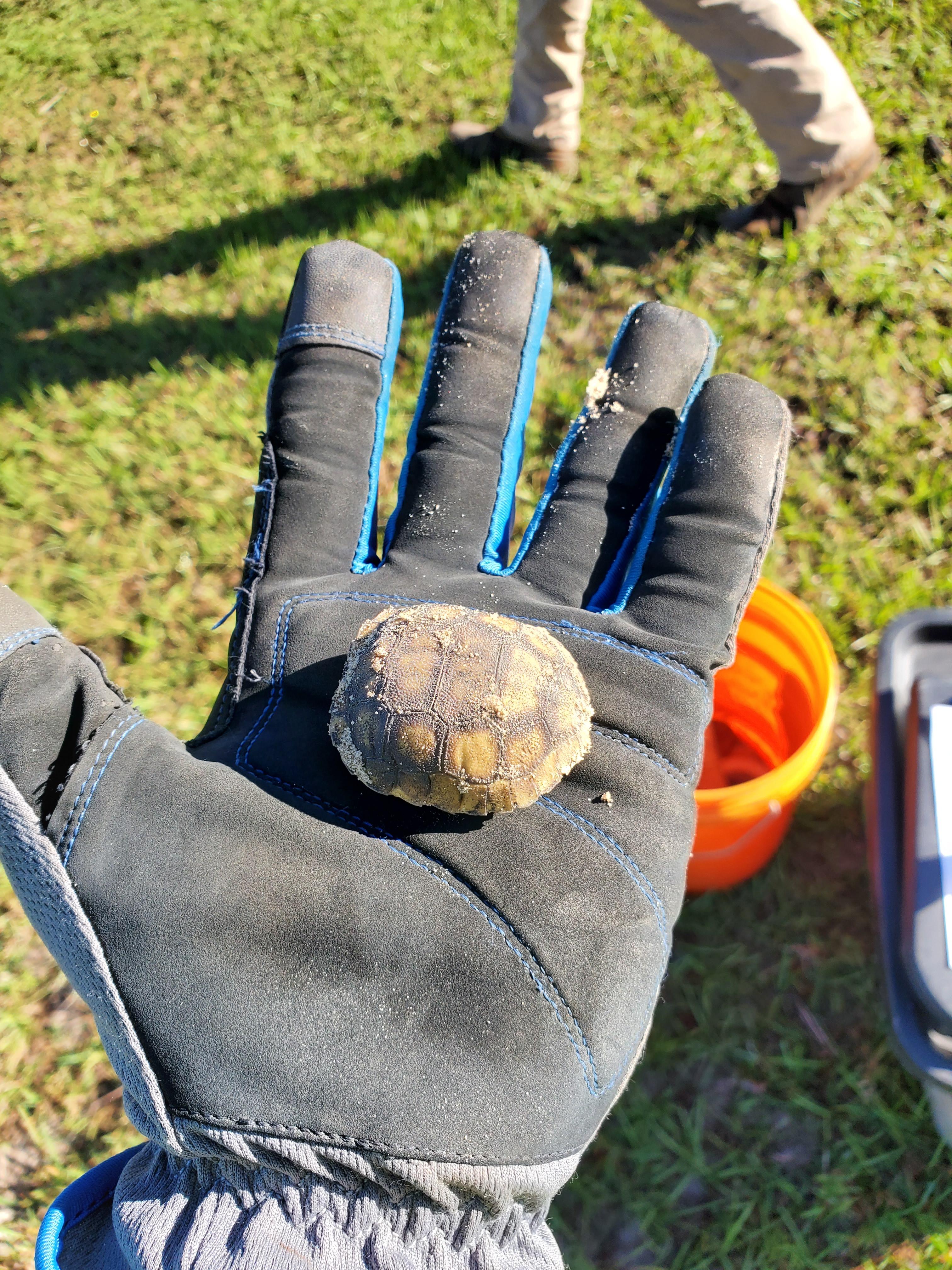
Gopher tortoises lay their eggs at the mouth of the burrow. The temperature that the eggs experience during incubation is actually what determines the sex of the individual, with anything under 85 degrees producing a male and anything over 85 degrees producing a female. When the eggs hatch, the babies are on their own and can either use an adult burrow or create a burrow of their own. They are the most vulnerable during the early stages of development. Their shells are more yellow and soft, growing increasingly harder and darker, turning more of a dark brown or gray. The last two photos are of the smallest tortoise that I have personally dug in my career. It is not much larger than they are when they first hatch (between 1.5 and 2 inches). It was actually in a larger burrow and had embedded itself in the side wall of the burrow’s terminus. This is way it is very important for us to check every inch of a burrow before we consider it empty.


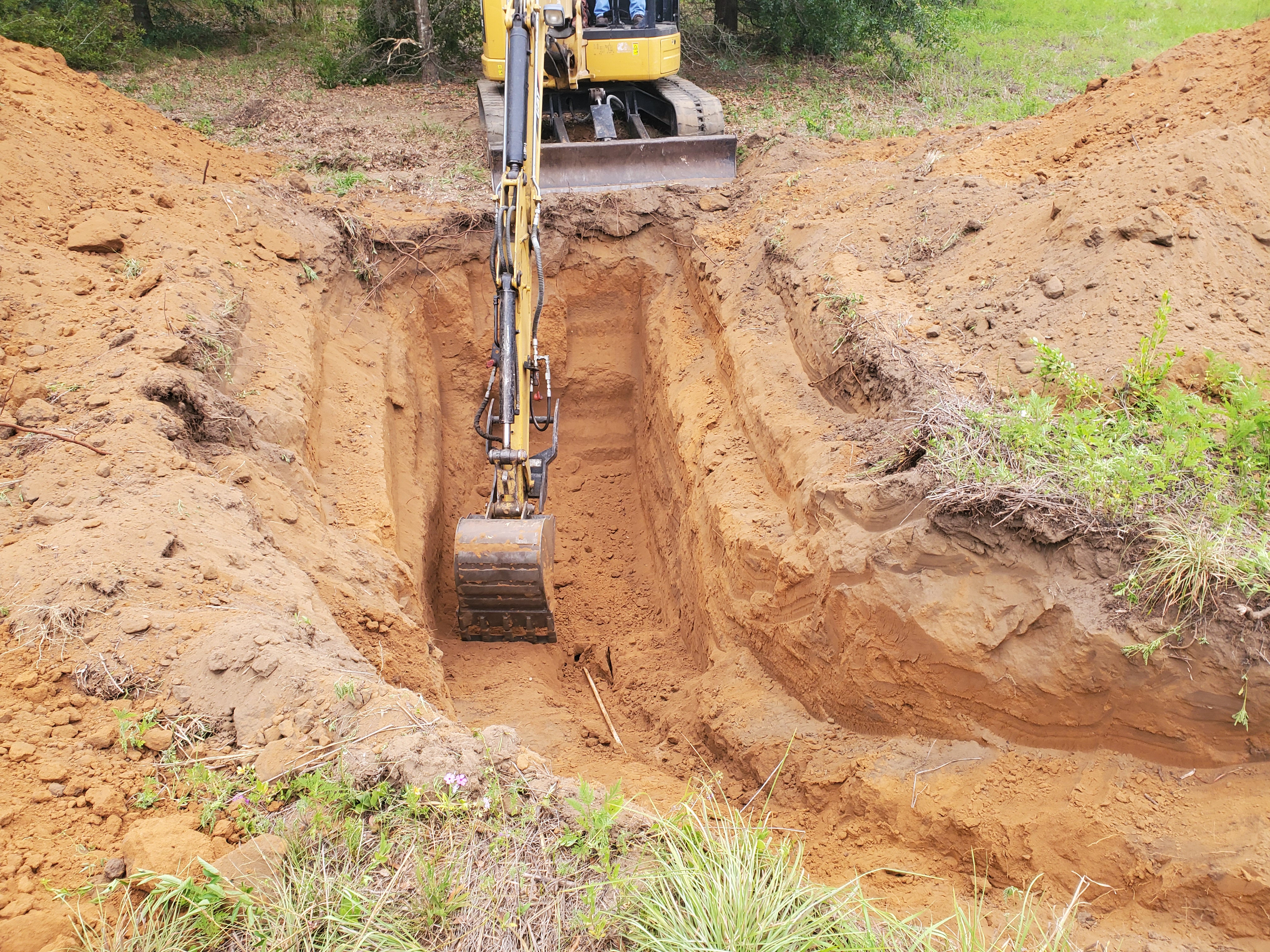
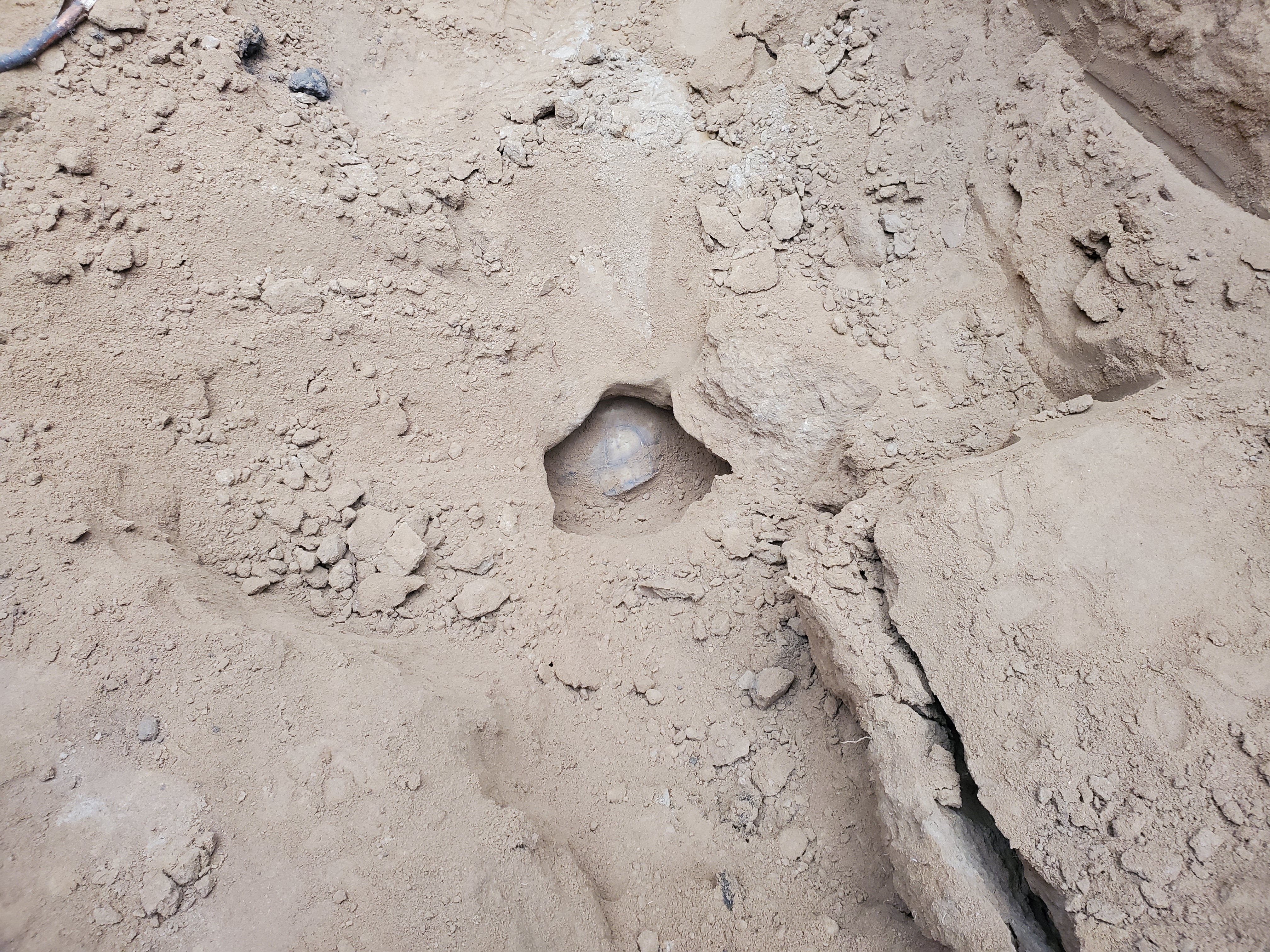
During development activities, it used to be legal to pave over burrows, entombing the tortoises inside. Thankfully, this is no longer the case. Except for very specific emergency situations, any development over or near gopher tortoise burrows requires excavation of the burrow and relocation of any tortoises recovered. Not only is a relocation permit required for the site, but at least one of the biologists doing the excavation has to obtain a permit for themselves which authorizes them to do the excavation and relocation. The process of excavating a burrow and removing a tortoise is a slow and methodical one. The machine takes the large layers of dirt from the top, at which point lots of hand digging is required. Some tortoises are more stubborn than others also. They will lock themselves in with their strong front legs and can take a lot of digging and physical effort to get them loose. Once removed, they are taken to a recipient site. Recipient sites also need a permit, must be maintained with proper habitat, and can only take a certain number of tortoises to maintain the proper density. The conditions at recipient sites are almost always significantly better than the area set to be developed. So it can be said they they literally are “on their way to greener pastures”.
As stated earlier, hundreds of other species make their homes in gopher tortoise burrows, a fact that deems the tortoise what we call a “keystone species” because its presence is crucial for the survival of other species. Many snake species are fairly common in gopher tortoise burrows. One of the rarest, and one I have yet to see in the wild myself, is the federally protected eastern indigo snake (Drymarchon couperi). The genus is a combination of the Greek drymos meaning forest and archon meaning lord or ruler, translating roughly to “ruler of the forest”. The species name is homage to James Hamilton Couper, the plantation owner who first discovered it.
While I haven’t had the pleasure of finding an indigo, I have found several other snake species in gopher tortoise burrows, including the state listed Florida pine snake (Pituophis melanoleucus mugitus). You may notice the scientific name has three parts. The genus and species Pituophis melanoleucus refers to pine snakes in general. The third name mugitus is what’s known as a subspecies and separates the Florida pine snake from the other two subspecies – the black pine snake, which is mainly found in Louisiana and Alabama, and the northern pine snake, which can also be found in Florida but has a much more distinct pattern than the Florida pine snake. This particular snake was found living in a tortoise burrow that we were excavating. Per the guidance in place at the time of the excavation, it was allowed to escape on its own and moved to some nearby habitat not associated with the project for which we were excavating.
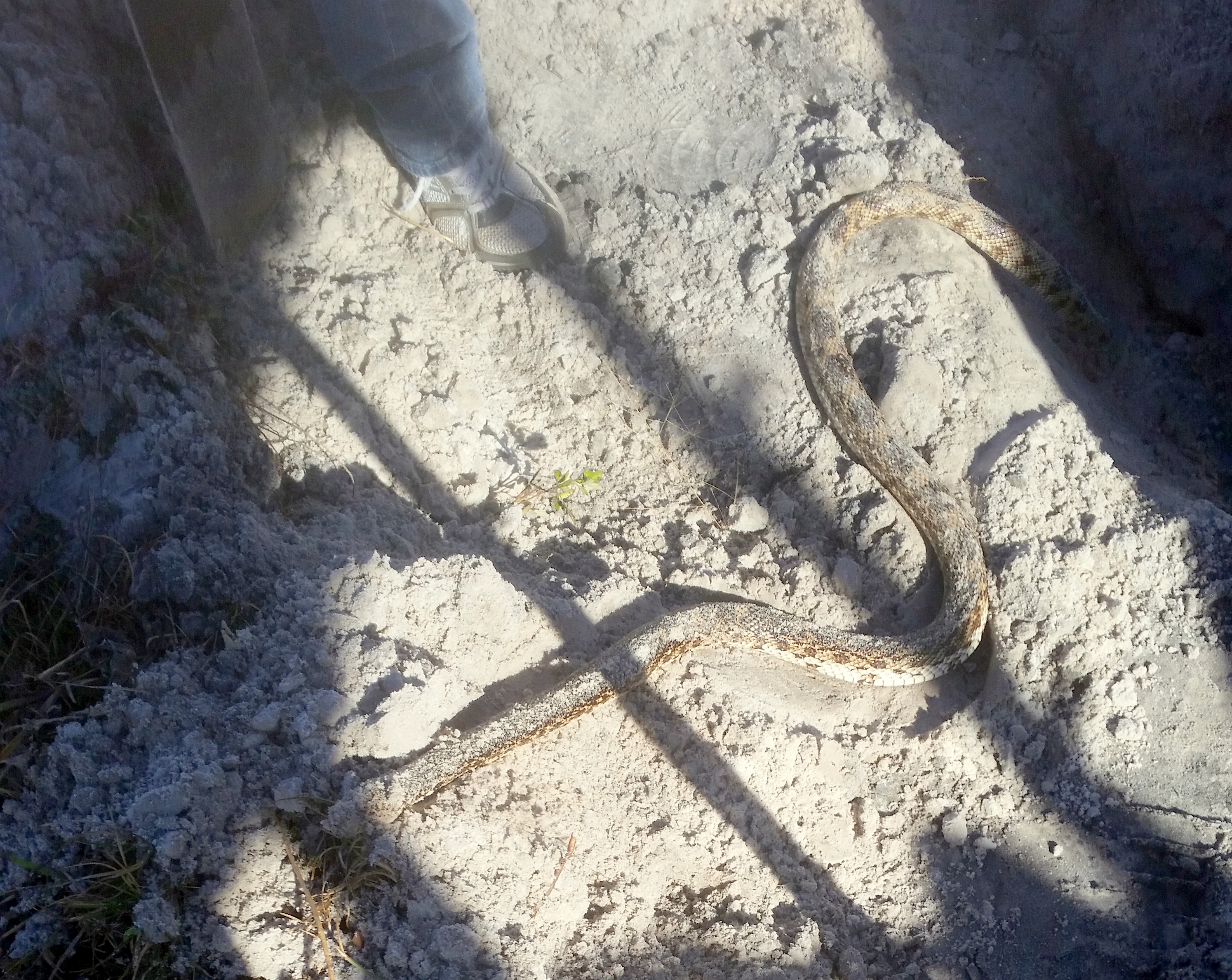
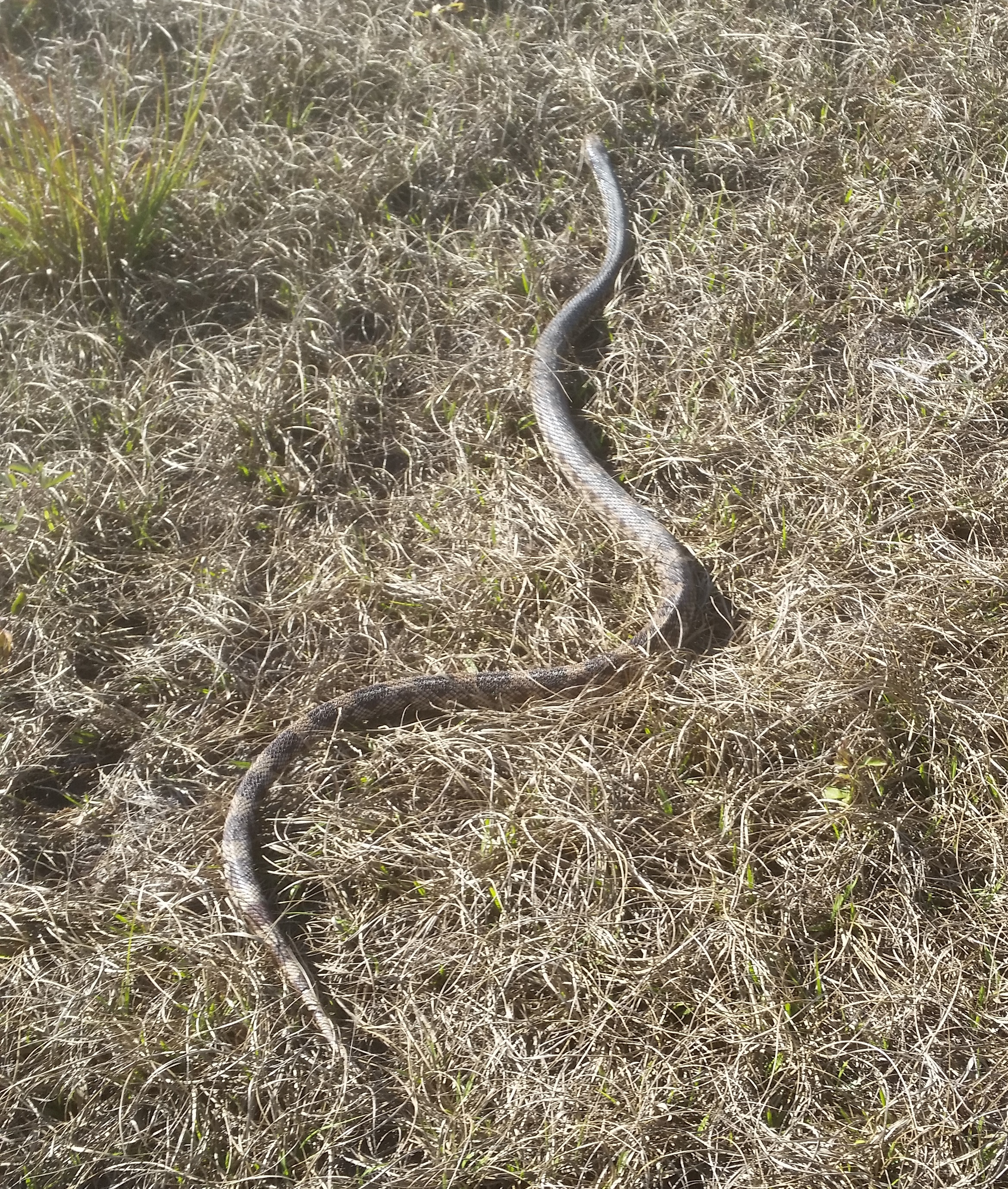
Some other snakes that can be found in and around gopher tortoise burrows include the venomous eastern diamondback (Crotalus adamanteus) and pygmy rattlesnakes (Sistrurus miliarius), and the nonvenomous coachwhip (Masticophis flagellum) and common garter snake (Thamnophis sirtalis) pictured below. The coachwhip, named for its similarity in appearance to a brown whip with a black handle, subdues its prey, which consists mainly of lizards and rodents with the occasional small bird, by grasping and holding the prey in their powerful jaws, not through constriction like many other nonvenomous snakes.
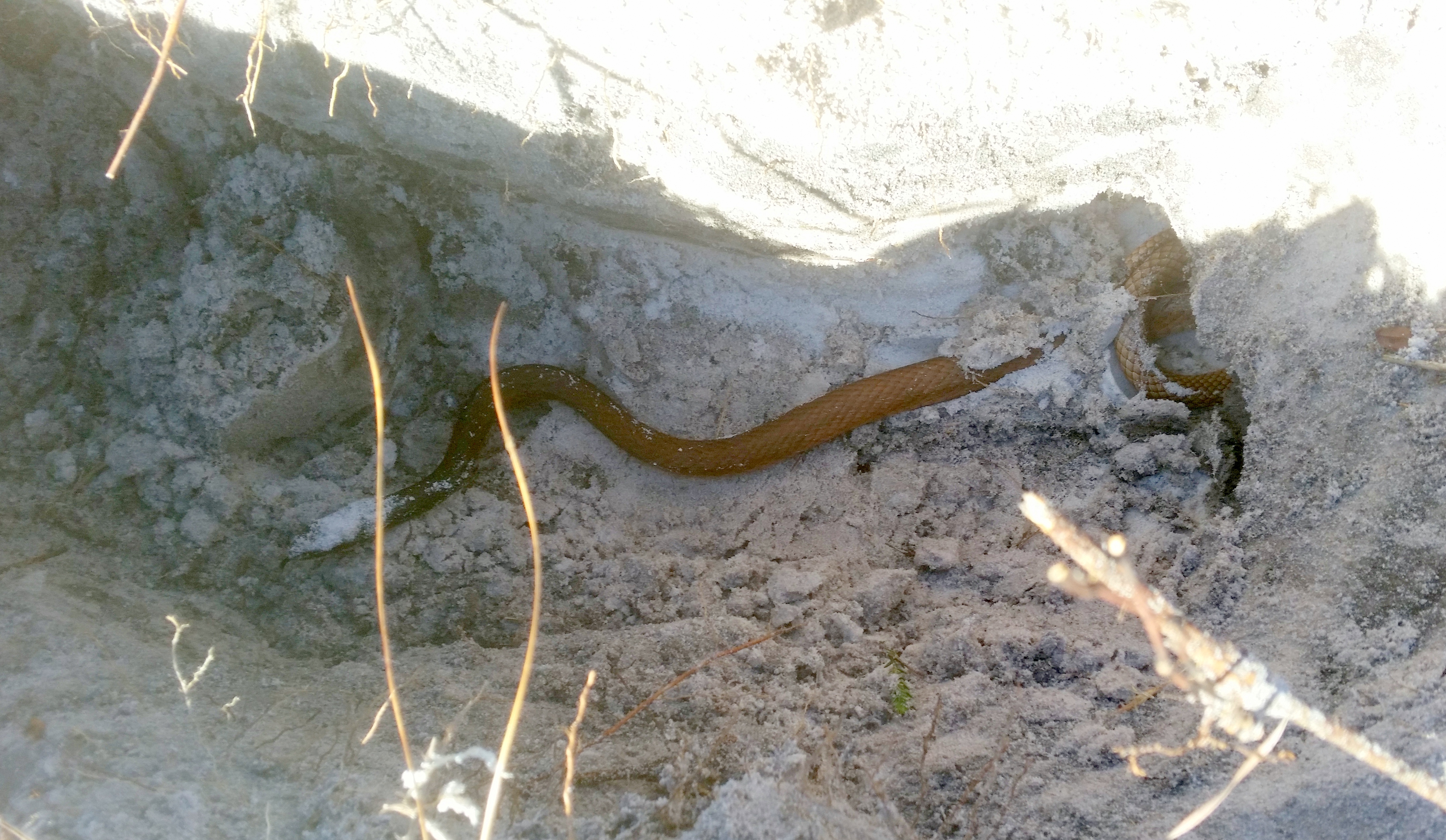
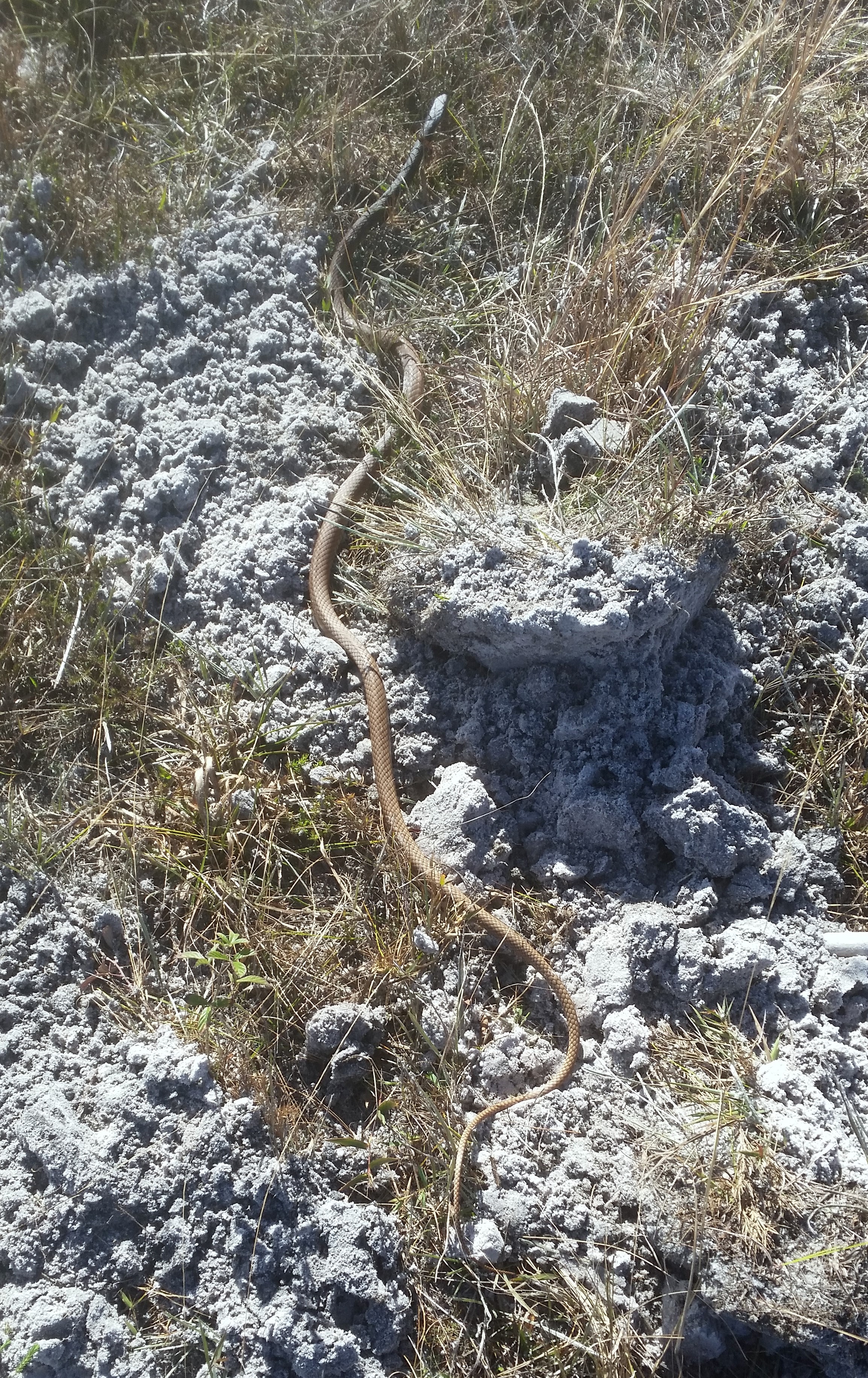
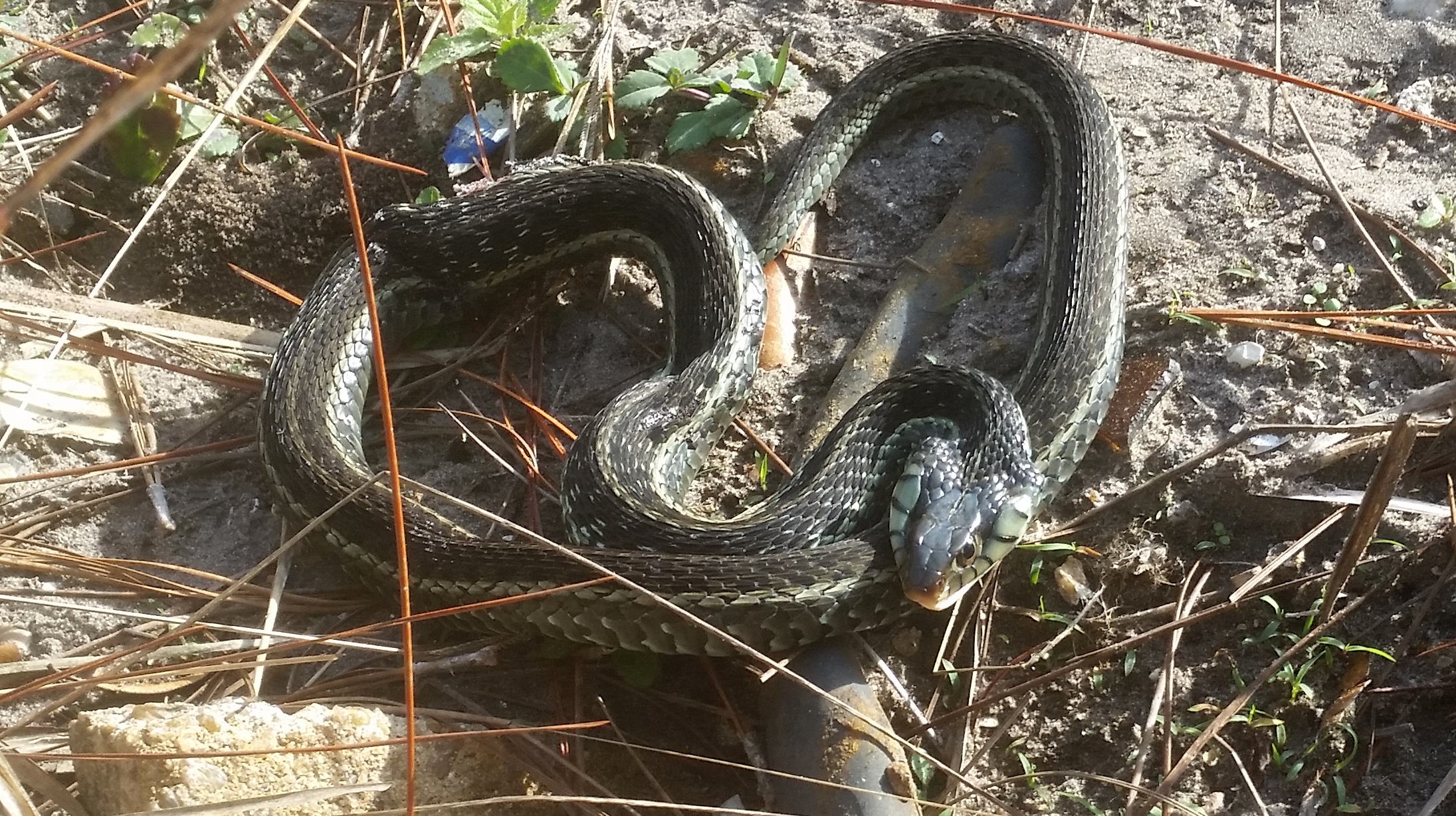
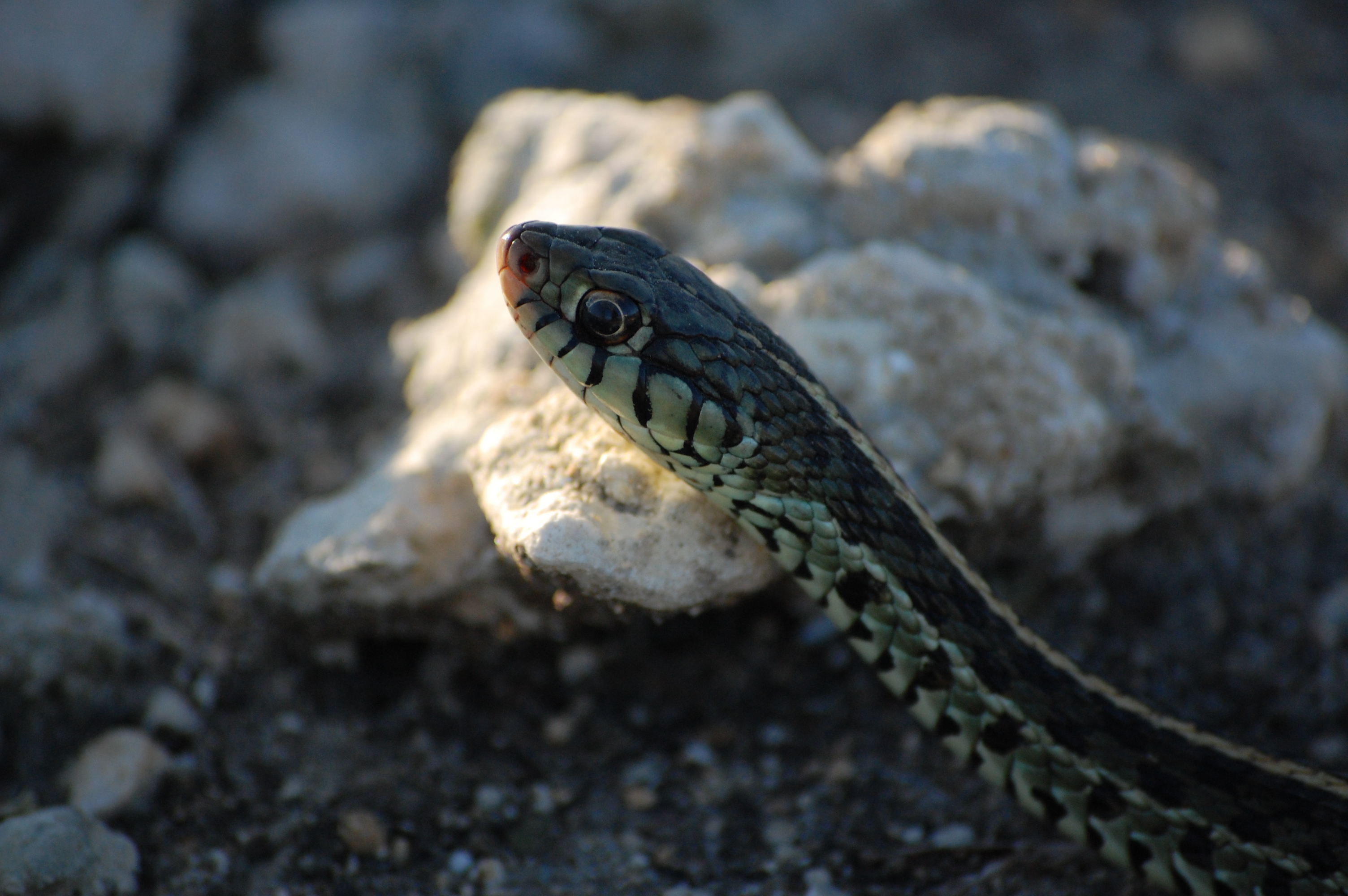
To call the garter snake nonvenomous isn’t 100% accurate. They do have a mild venom that can subdue small animals but is mostly harmless to humans, other than possibly causing some mild irritation. This garter snake happened to have an injury and went into a defensive pose. Due to predators being the main source of mortality throughout this species’ life history, they have developed a behavior known as morphology where they will actually change shape to look more intimidating. Here you see the snake flattening its head to take on a more triangular shape which is common among venomous snakes in the area and starting to curl into a striking pose. Below that is a photo of a different garter snake from a different area, showing the normal body shape. As a side note, it was determined that the injury was not severe enough to warrant capturing the snake and it was removed from the area and placed in nearby habitat, out of harm’s way.
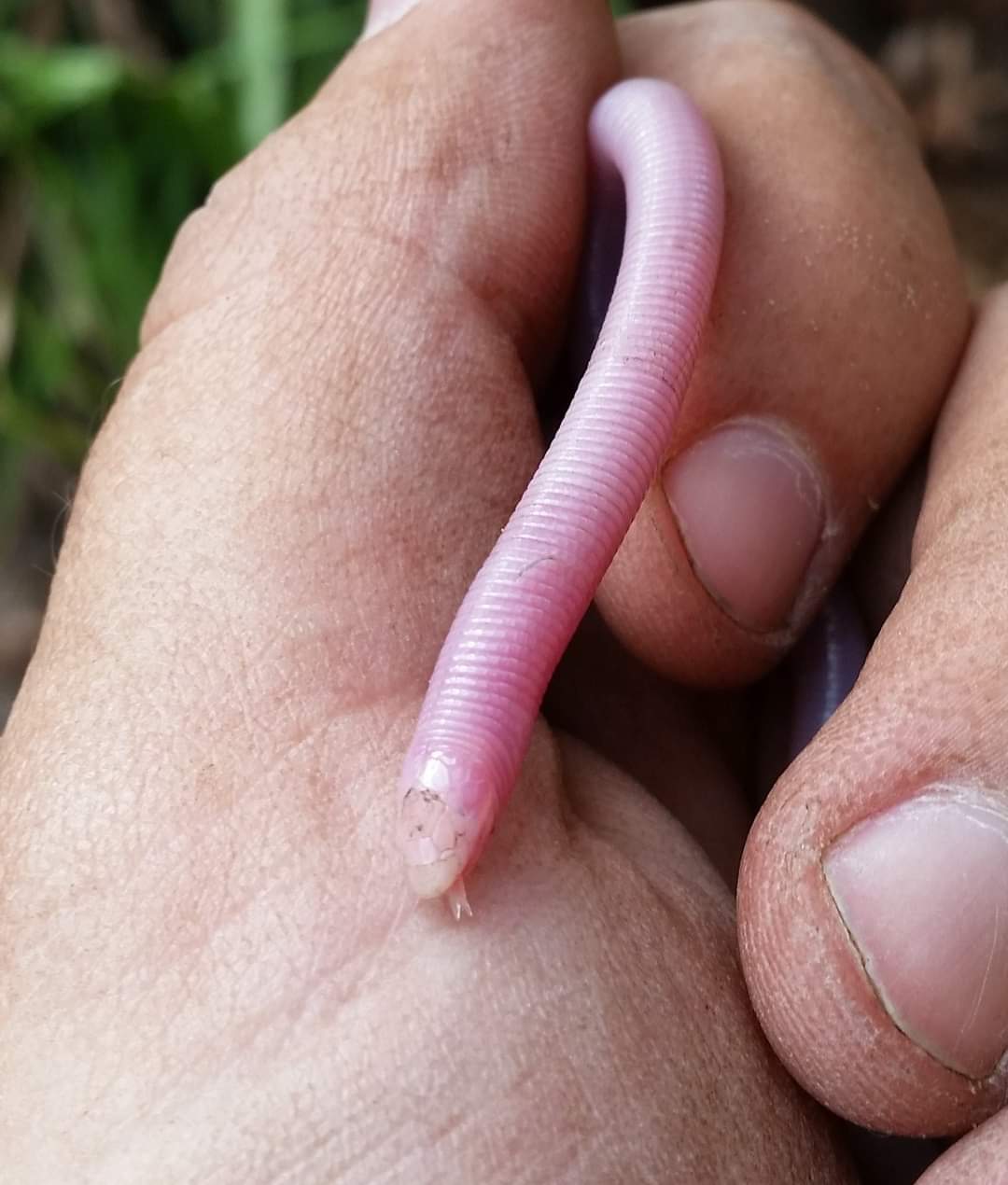
By far the most interesting species I have found in a gopher tortoise burrow is commonly known as the worm lizard (Rhineura floridana). It looks more like an earthworm or a small snake. However, it’s actually not a worm or a lizard or even a snake. It’s what’s known as an amphisbaenian, a term derived from the mythical creature Amphisbaena. Amphisbaena is a creature in Greek mythology with a head on each end of the body. The name was given to this group of reptiles due to the truncated tails looking like a second head. To understand what an amphisbaenian is, we have to go up the taxonomic ladder before genus and species, and even before family, to the order Squamata (Latin for “having scales”). Squamata has three suborders dividing it into lizards, snakes, and worm lizards (amphisbaenians). There is a variety of characteristics that separate the worm lizards from snakes. One of the most significant and interesting of these is that, in snakes, the left lung is greatly reduced in order to fit into the slender body. In worm lizards, it is the right lung that is reduced. They also have more primative eyes and move differently, compressing and extending the body like an accordion, rather than moving in a serpentine motion. This is also how it pushes itself through the soil, living most of its life underground, feeding on insects, spiders, and earthworms. In the close-up, I was lucky enough to catch something they have that is similar to snakes – the forked tongue.

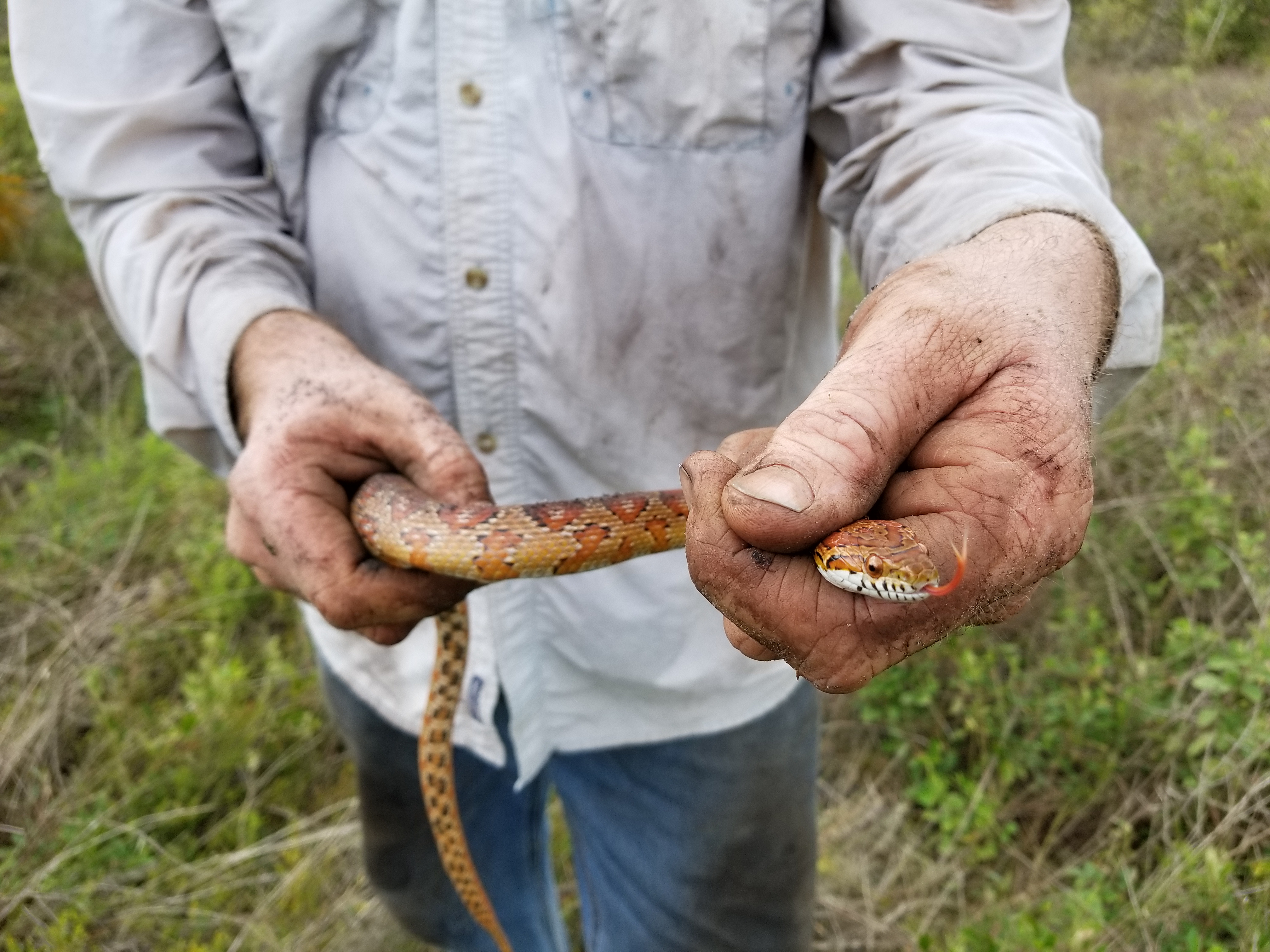
Another one of the more common snakes we see in gopher tortoise burrows is the red rat or corn snake (Pantherophis guttatus). The term “corn” snake refers to the various red, orange, and yellow scales on the underside of the snake which resemble corn kernels. This is one of the snakes that does, in fact, use constriction as a means of killing its prey before consumption. The photo below is of one that was removed from a gopher tortoise burrow and, as always, relocated to a safe area with suitable habitat. In this photo, you can see its forked tongue waving through the air. It is usually said that the snake is “tasting” the air as an alternative to smelling it. However, this isn’t entirely true. What many people don’t realize is that the waving of the tongue is only part of the behavior. What it’s actually doing is waving it through the air to gather the scent particles. Then the tongue is pulled back into the mouth and touched against something called the vomeronasal organ, which is the organ that contains the scent receptors.
Another common snake in Florida is the southern black racer (Coluber constrictor priapus). Despite the species name, this snake is another that is not a constrictor, but rather pins it’s prey down and generally swallows it alive. This is another species that is actually a subspecies (notice the three names). Understanding the name requires discussions of some rather explicit aspects of Greek mythology and some delicate parts of a snake’s anatomy. In a male snake, there are actually two reproductive organs, one on either side of the body, called hemipenes. These are inverted inside the body until it is time to mate. In the southern subspecies of the black racer, these hemipenes have hooks that are rather large. Priapus was a fertility god who protected, among other things, male genitalia. He is often depicted with a member that is comically oversized (much like the hooks on the hemipenes), and which is permanently aroused. While this species is frequently found hiding in sheds, tall grass, and yes, even gopher tortoise burrows, I had the privilege of seeing this one sunning itself on a fence post early in the morning.

On a different day, I saw one slither under a board that was laying flat on the ground. Out of curiosity, I lifted the board and found there were actually two under there. One was hiding, and with good reason. It was in a state that we refer to as “opaque”. When a snake sheds its skin (a process known as “ecdysis”), new skin forms under the old skin and fluid from the lymphatic system fills the space between the two skin layers. Snakes have scales called spectacles that cover their eyes, rather than eyelids. So when this fluid gets between the two scales, it looks cloudy. This obviously impedes vision so snakes preparing for ecdysis will often seek shelter, go without food, and become lethargic (notice the difference in posture of the two in the first photo). After a quick photo, I carefully placed the board back and left this snake alone. A couple days later, the fluid would be reabsorbed and the now separated skin would shed.


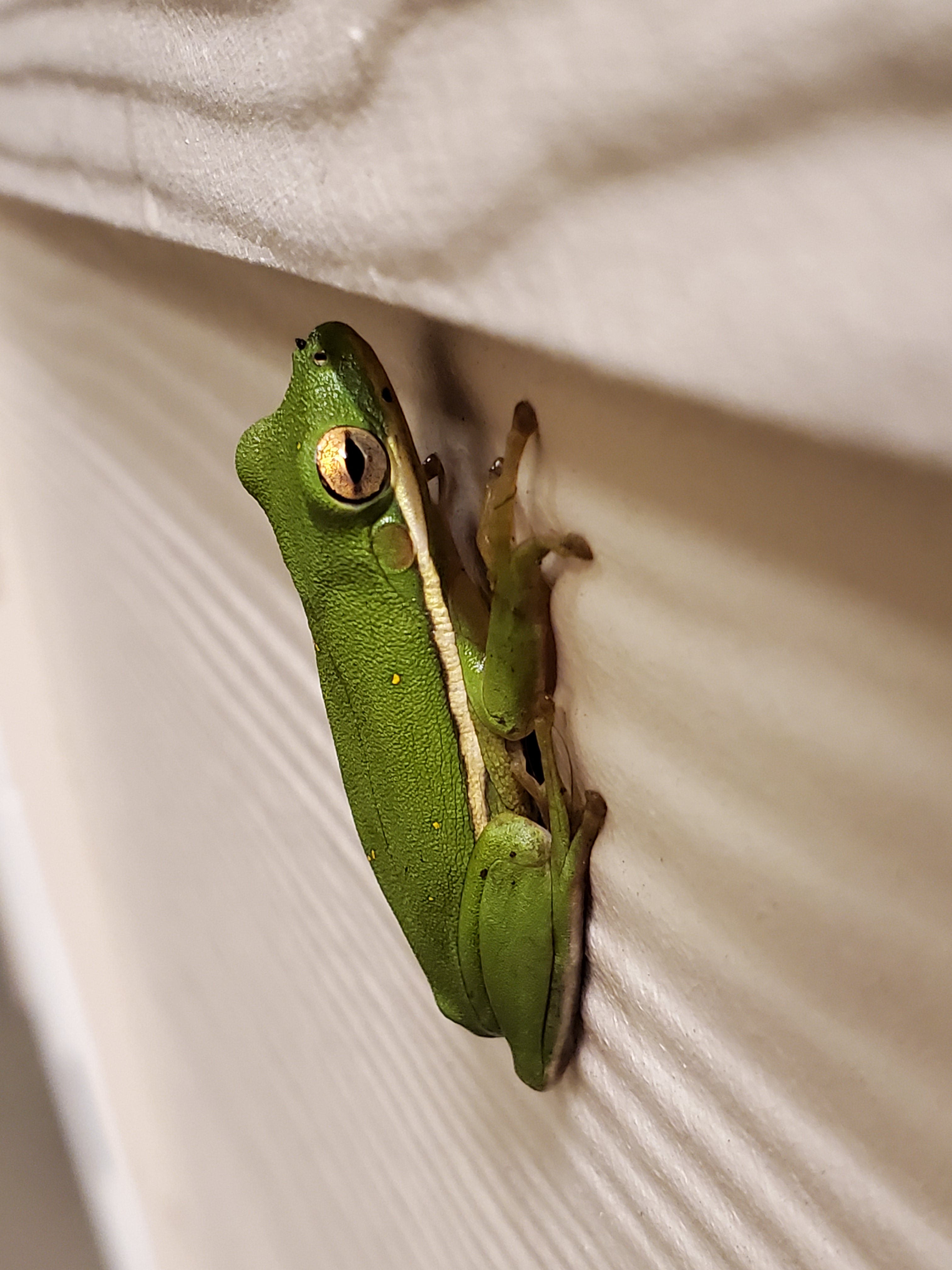
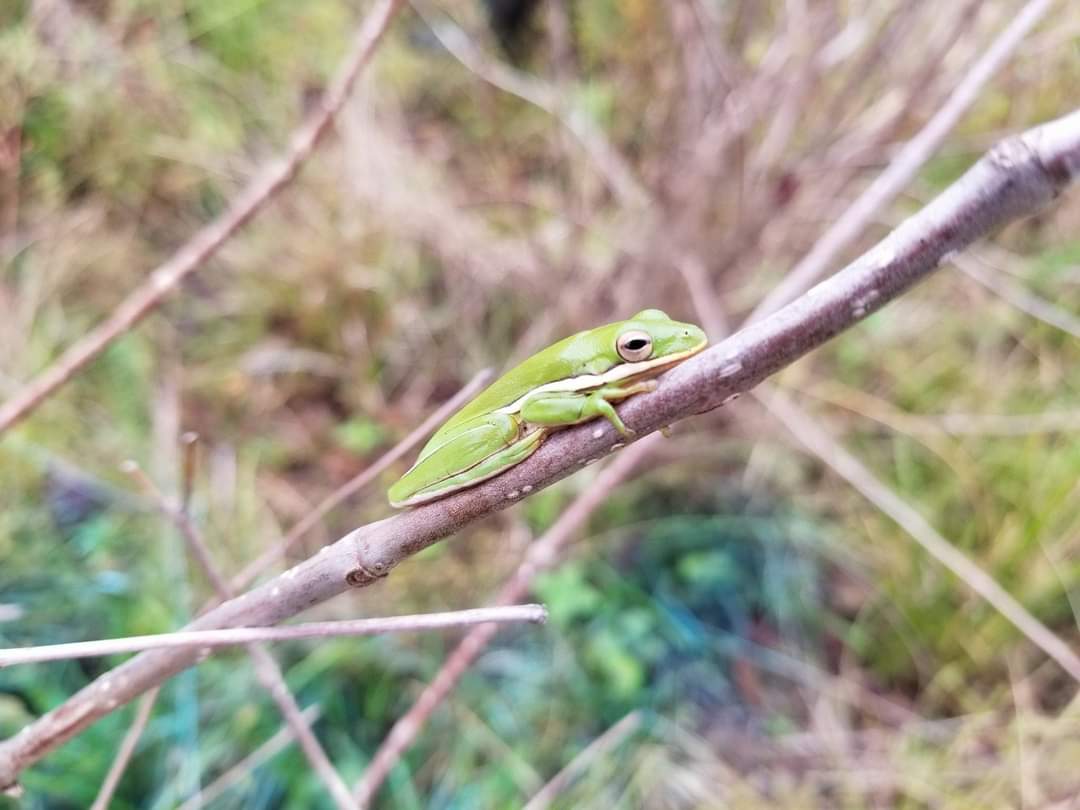
One of the most common frogs that you will see, and mostly hear, in Florida is the green treefrog (Dryophytes cinereus). You may sometimes see the scientific name listed as Hyla cinerea. While Dryophytes and Hyla are similar genera, the latter describes species found in the Old World. The geographic separation is the only thing separating these two species (they are genetically identical). The call is raspy and quick, easily recognizable after a heavy rain event. When at rest, green treefrogs can often be found on the side of buildings or on vegetation. Many times they may be lighter in color and nearly motionless, especially at night or when temperatures are low as they enter a state of torpor. Torpor refers to a state of reduced metabolism and activity. The deepest form of torpor is what we know as “hibernation”. Seeing a frog in this state is a welcome sight, as they can be approached very closely without being startled. However, it is very important not to disturb them during this time as it causes undue stress at a time when their bodies aren’t prepared to handle it.
One of the most misunderstood behaviors of frogs is when you see one on the back of the other. Most will say they are mating. That’s not entirely true, depending on your definition of mating. It is part of the reproductive process, but no reproductive activities are happening at the time. Rather, what you are seeing is something called “amplexus” (Latin for “embrace”). There are many types, or positions of amplexus. The two more common types are axillary, where the male holds on to the female behind the forelimbs, and inguinal, where the male holds her around the waist. Though it is hard to see due to the turbid water, the green treefrog uses axillary amplexus. So what is really going on during amplexus? Basically, the male is hitching a ride until the female is ready to lay her eggs. Fertilization occurs externally. The female releases her eggs into the water and the male fertilizes them at the same time. The ideal place and time for egg laying may not be the same place and time as mate selection. Amplexus allows the female to find a suitable mate, then take the time to find a suitable place to lay the eggs. Since this can take anywhere from a few hours to several days, it is also important not to disturb frogs seen in amplexus. The female is carrying extra weight and many times the male has not eaten for quite some time.

While I started with one of the most important reptiles in Florida’s ecosystem, I had to end this post with what is arguably its most impressive – the American alligator (Alligator mississippiensis). Said to have remained unchanged for millions of years, alligators are literally modern day dinosaurs. The outer skin of an alligator is actually supported underneath by bony deposits known as osteoderms, giving them a thick sort of armor against the elements. Their powerful jaws can clamp down on their prey with a force approaching 3,000 PSI and yet, despite being nearly impossible to force open, the opening muscles are very weak and the jaw can easily be held shut. While their large size makes their presence obvious in open areas, they frequently bask on and near the edges of water bodies, sometimes covered in vegetation. They will stay motionless and silent, which is why it is very important to be watchful for them when around any body of water in Florida.

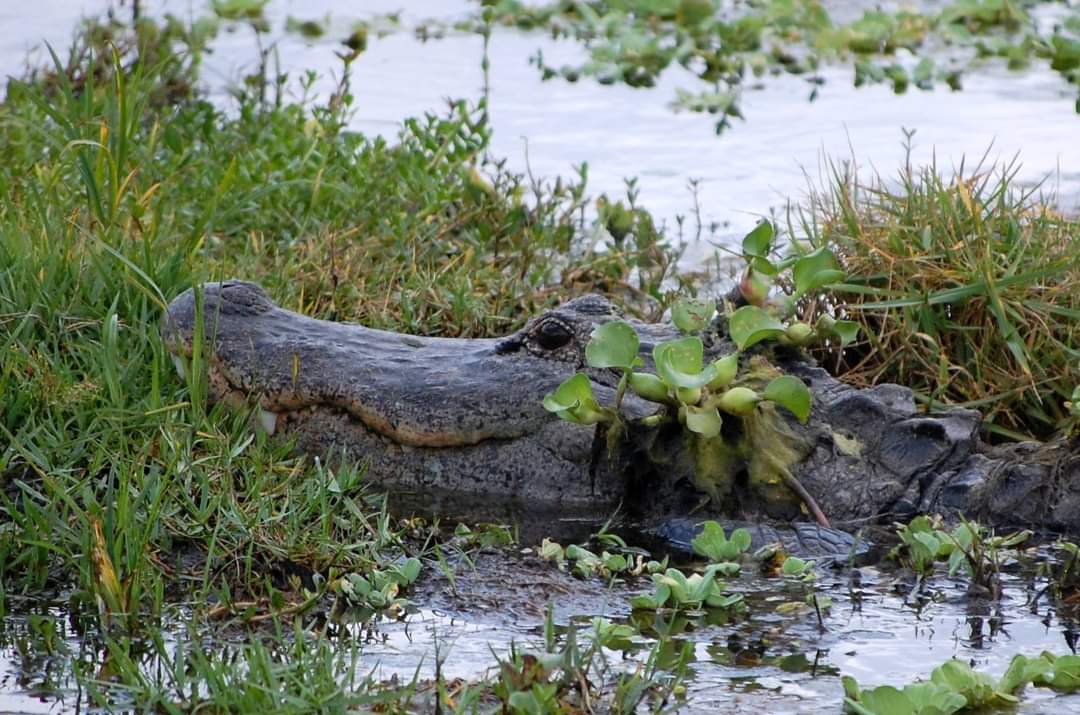
Aside from them being extremely dangerous, alligators should not be approached as they are federally protected. I’ve been asked several times why the alligator is protected when there are clearly so many of them to be found in Florida. They are protected as a threatened species under something known as “Similarity of Appearance”. The alligator is not biologically threatened. That is to say their numbers and habitat have not decreased to a level where they would be considered threatened by themselves. However, the American crocodile does meet these factors making them biologically threatened. Since the appearance of the two species is so similar that many might not be able to tell them apart, they are afforded the same protection to ensure no harm comes to the crocodile when it is mistaken for an alligator. The main differences in a crocodile is that the skin is a grayish green rather than black, the fourth tooth on the lower jaw is exposed when the mouth is shut (only the top teeth show in the alligator), and the snout is narrow and tapered unlike the alligator shown below.

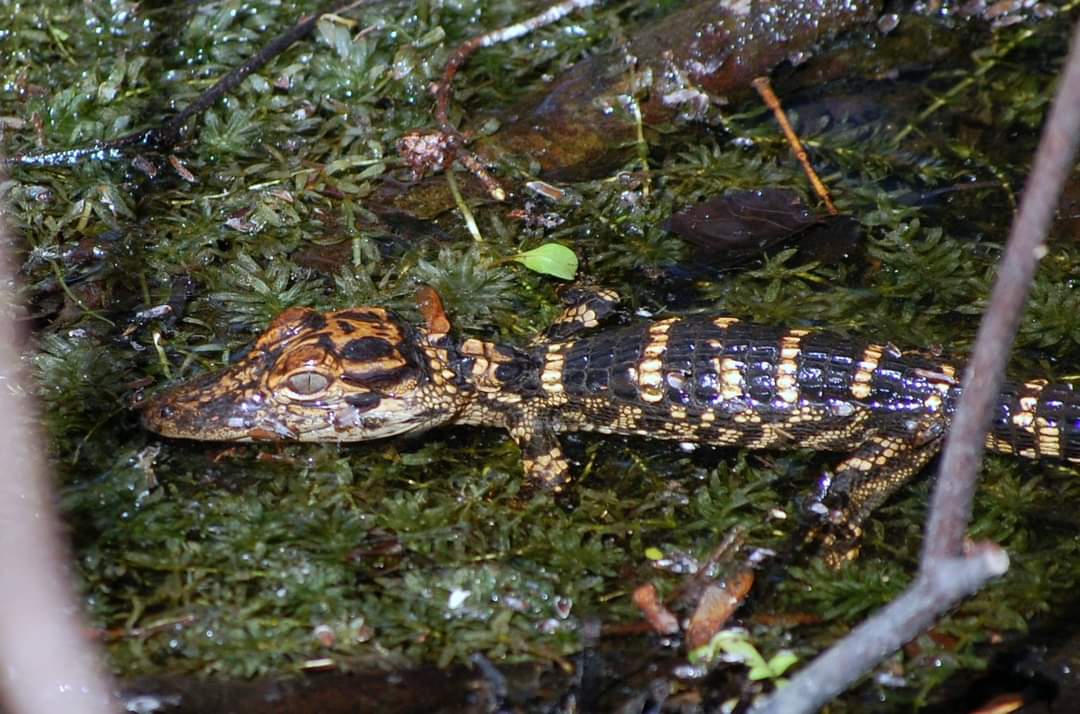
Alligators aren’t born with the dark skin. They have yellow stripes, which fade with age. However, they are otherwise small duplicates of the adults. Female alligators are protective of their young. If you ever encounter small alligators like these, or hear their calls to the mother, it is recommended that you leave the area immediately. That said, if you ever do find yourself running from an alligator, do not believe the myth of running in a zigzag pattern. An alligator will only chase you for a very short distance. So just run as fast as you can in one direction. You’ll go much farther away from the threat than if you were to zigzag back and forth.

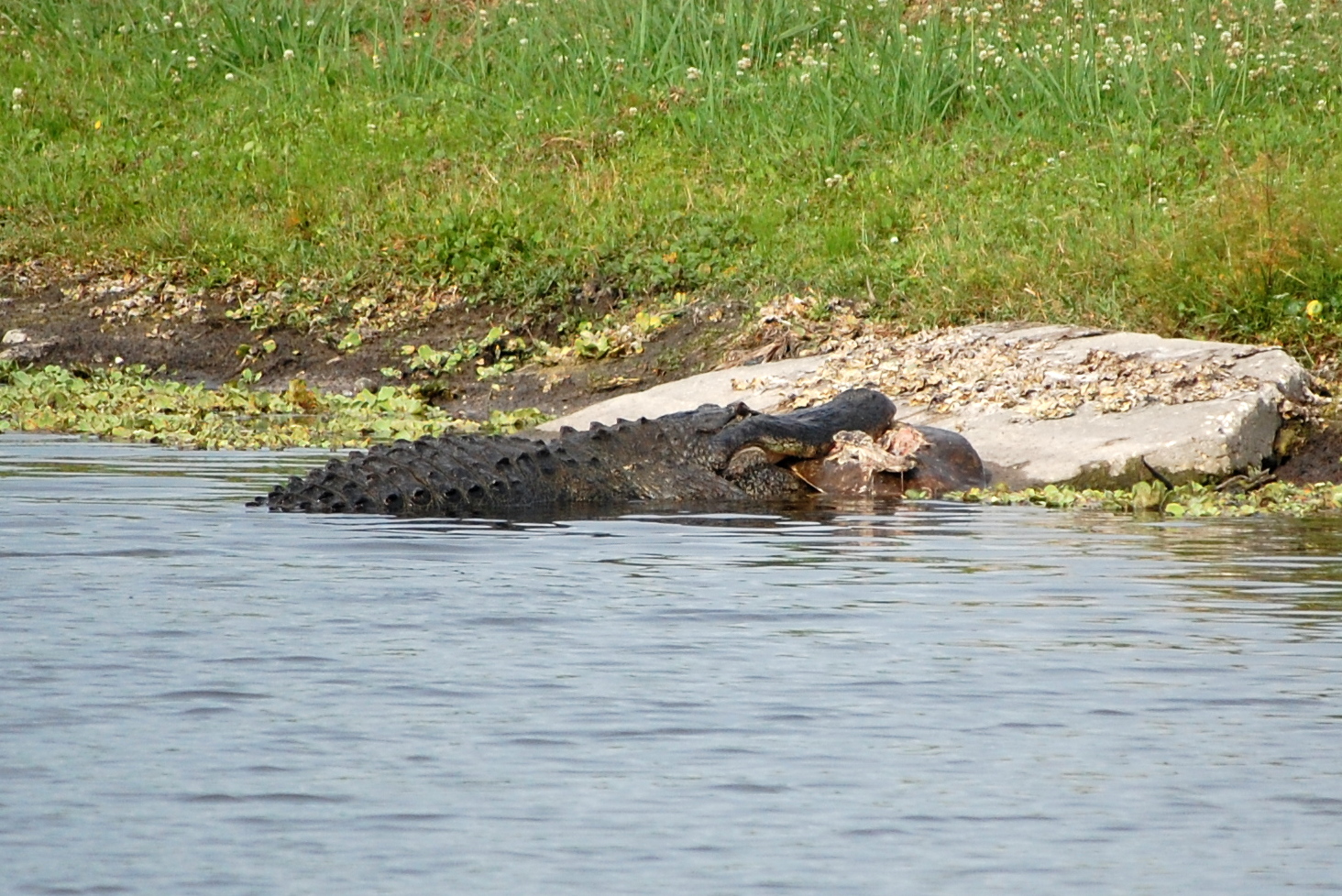
Finally, alligators are known as an “apex predator”. This is defined as a predator that is at the top of the food chain, with no natural predators once reaching adult age. Like most wildlife, unfortunately humans are a main source of alligator fatality. Furthermore, there are pythons in south Florida that have gotten so large, they have also been found to consume adult alligators. However, in an untouched ecosystem free of invasive species and human interactions, the alligator would not have any predators. In the photo below, the alligator caught a soft shell turtle (Apalone ferox). One disadvantage the alligator has is that the jaws are designed for capturing and holding prey, not for tearing flesh. As a result, the prey are usually swallowed whole. I didn’t stick around to see how it went, but I would imagine this large turtle was a tough swallow.
 BJ Quinton