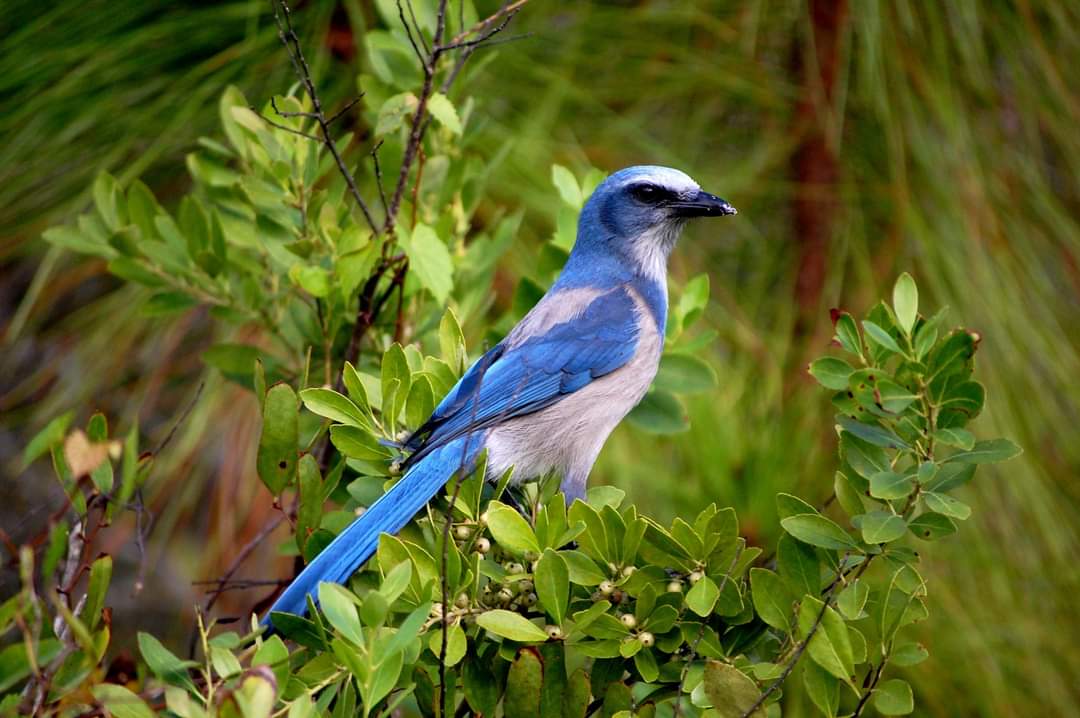
The Florida scrub jay (Aphelocoma coerulescens) is one of the most interesting birds we have here in Florida. It is one of four species of scrub jay in North America. The others include the Woodhouse’s scrub jay (Aphelocoma woodhouseii), which is found in the desert southwest, from Nevada to the southwestern mortions of Texas and into Mexico, the California scrub jay (Aphelocoma californica), whose range includes the entire west coast of the US and into the Baha peninsula, and the Island scrub jay (Aphelocoma insularis), which is exclusively found on the Santa Cruz Island off the coast of southern California.


The genus comes from the Greek apheles, meaning “simple”, and kome, meaning “hair”. It’s believed this is due to the feathers mostly lacking bands or stripes that are found on the feathers of other jay species. The species name is Latin for “becoming blue”, likely because this species is a lighter blue than many of the other jays.
One of the interesting behaviors of this species is their use of caching. This is where they will find a food item and store it in the ground. I had the pleasure of watching this one find food, then cache it is the ground, first by twisting it into the soil, then hammering it in like a woodpecker.


One of my personal favorite behaviors of this bird is their two unique distress calls. Where most birds have one distress call that warns of an arbitrary threat, these birds have specific distress calls to warn whether there is an aerial threat, which would incite them to hide under cover, or a terrestrial threat which, under some circumstances, would rally the family together to attack the threat.

Possibly the most unique behavior of this species is the use of “dummy nests”. Potential predators will watch these birds as they make their nests. They will remember where they are and, when the time comes, they will prey upon the eggs inside. Florida Scrub Jays will build extra nests on the outer portions of their territories to trick would be predators. There were two clues that told us this was a dummy nest. First, it was placed on the outside of the territory, where the active nest would be more towards the center. Additionally, this nest is made solely of twigs. While this provides the base structure of the nest, an active nest will have palm fibers and even some chest feathers plucked from the parent, providing a softer, more stable nesting bed.


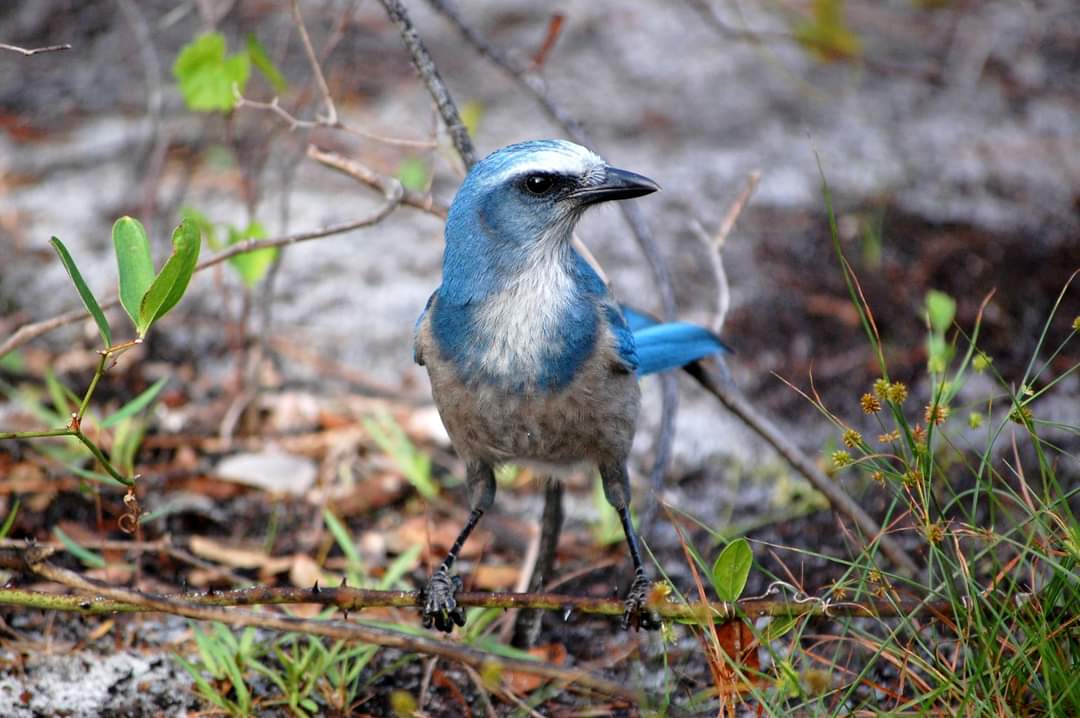
You may be wondering how we can know where the outer limits of the territories are. Scrub jays are federally protected due to loss of habitat. They have very strict habitat requirements and the suitable habitat is dwindling as it is frequently the same type of land that is desired by developers. Part of the management of this species is to track and monitor the various populations The populations and individuals are distinguished by colored bands that are placed on their legs. These bands are designed and placed by licensed individuals and in no way affect the birds’ comfort or behavior. In this photo, look closely and you can see the colored bands around the legs.

We had the opportunity to follow one of these professional bird banders and observe how they go about identifying these individuals. We were in an area where they were monitoring known populations and had found some new, unbanded individuals nearby. We went to an area where they had been seen, set up a trap with peanuts as bait, and played their calls to attract them to the area. Please keep in mind, trapping and handling these birds without a permit is a federal offense. These activities were performed by a licensed, professional bander for the purposes of studying this species to enhance its conservation.


While it didn’t take long for one to show interest, getting it to actually visit the trap was a bit of a challenge. There was a lot of inspection around the trap itself. It even tried grabbing the bait through the mesh a few times. If you are wondering how the trap works, it is 100% safe for the bird. It is similar to the have-a-heart traps that some people use to relocate squirrels or raccoons. Basically, the door is held in place by a bar connected to a plate inside. When the bird steps on the plate (far away from the door itself), the door shuts. While the bird may be temporarily startled, it isn’t harmed in any way.
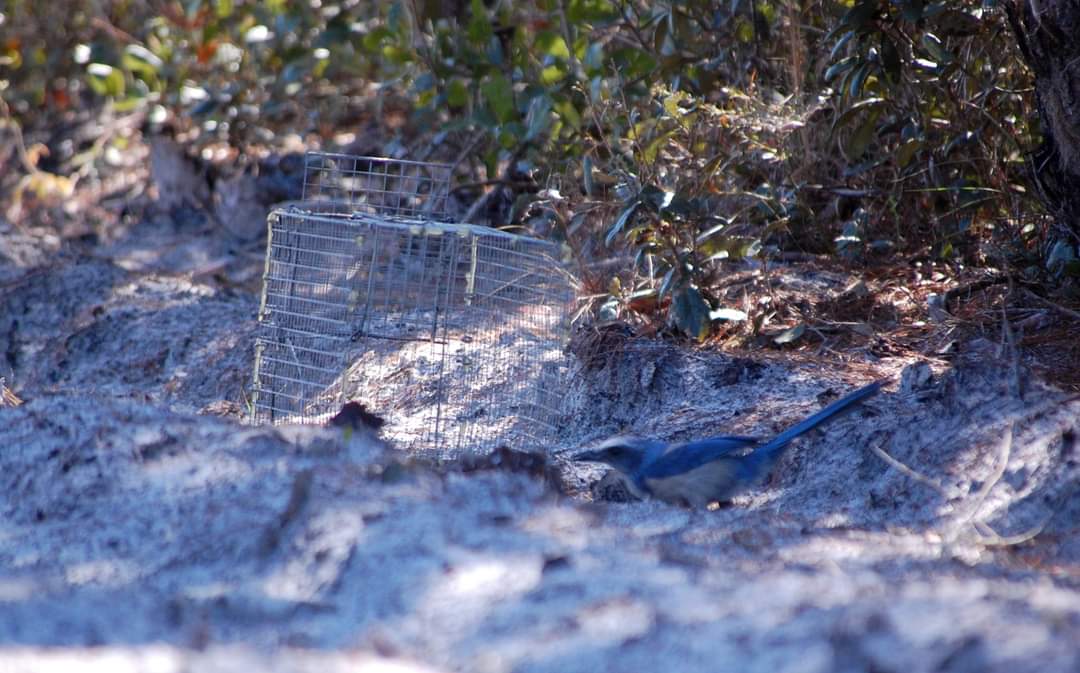

After what felt like an eternity, our patience paid off and the bird took to the trap. Notice two things in this first photo. First, this bird is unbanded. Florida scrub jays are social birds that aggressively defend their territories. Therefore, their groups do not mix and the presence of new individuals indicates the suitable habitat has expanded enough to allow for new groups. This is known as a “biological indicator” and is evidence that the hard work put into habitat management in this area has been successful! Another thing you’ll notice in this photo is that the bird is holding on to a twig. This was given to the bird as another means of making it feel as comfortable as possible. Perching birds are used to having their feet wrapped around branches. Holding on to the twig feels more natural and is calming for this bird (you can even see how the other foot is in the same position, despite having missed the twig). This is just another part of conditioning the birds to be more comfortable with the banding and monitoring process, while still keeping them from becoming imprinted (comfortable to the point of becoming dependent) on humans.

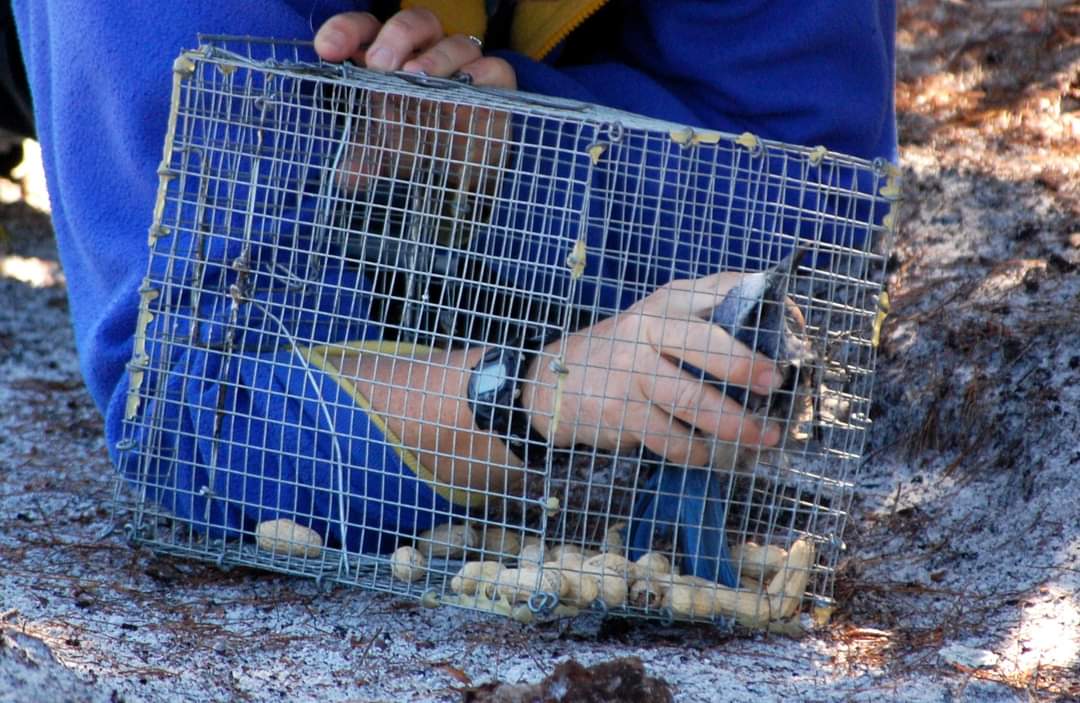

The covert feathers (smaller feathers at the bend of the wing, near the handler’s thumb) can hint at the approximate age of younger birds. These feathers do not grow in completely during the first year. Not only was this a younger bird, but it was the first attempt at capturing an individual from this group. Since this is only the beginning of the conditioning that will be necessary for monitoring this group, no banding was done. After being released and thrown a couple of unshelled peanuts (an added bonus since the bird doesn’t have to expend the extra energy to get its food), the bird has learned that the trap holds a prize, the trap and the handling aren’t dangerous, and there is a nice reward at the end. These experiences will make the bird more apt to return to the trap, while at the same time avoiding human contact as the handling is not worth it without the reward.


 BJ Quinton