Woodpeckers are a very interesting group of birds for several reasons. The most obvious reason would be their ability to basically smack their heads into the sides of trees to create the cavities in which they feed and build their nests. When they do this, their heads are subject to 1,000 times the force of gravity. So how do they keep from rattling their brains? There are a few adaptations. One is their large neck muscles that absorb some of the shock. Another is that they have small brains housed tightly within skull tissue that has a more spongy consistency, and their brains are oriented such that more surface area takes the impact. Another, more behavioral than anatomical, is that they close their eyes with every strike. Then there is one more lesser known adaptation that is as incredible as it is hard to describe. We humans have a u-shaped hyoid bone in our necks that provide support for tongue and larynx. The hyoid bone in woodpeckers actually starts at the right nostril, splits and goes over the top and around the back of the skull, looping underneath and attaching to the tongue in the mouth. During pecking, the tongue is thrust forward (still in the beak) which pulls the bones taught against the skull. This provides a sort of “seat belt” that keeps the skull from whipping back after impact. Like I said, this is all a bit hard to describe in words. Thankfully, someone out there made this video that explains it very well, and has a nice video showing a woodpecker striking a piece of wood in slow motion.
Another thing that makes woodpeckers interesting is their flight pattern. They use what’s known as a “bounding” flight pattern where they will flap their wings a couple of times, then tuck their wings in and sort of free fall for a very short period of time, then flap again. This causes them to rise an fall during their flights. They aren’t the only birds that use this pattern. However, they are some of the largest which makes it more pronounced and obvious from farther away. If you are wondering, the other flight pattern of flapping and then gliding with the wings open is known as “undulating”.
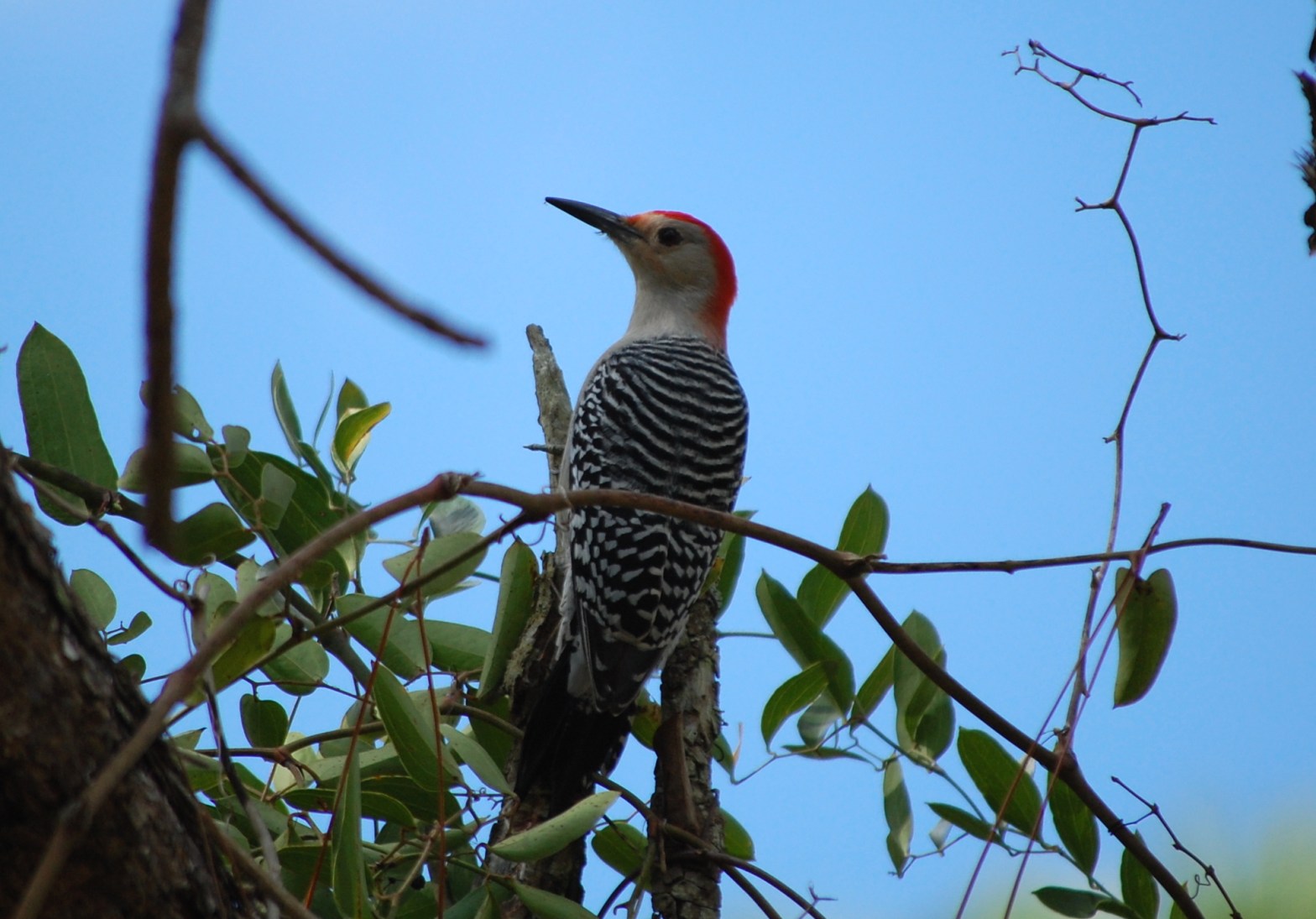
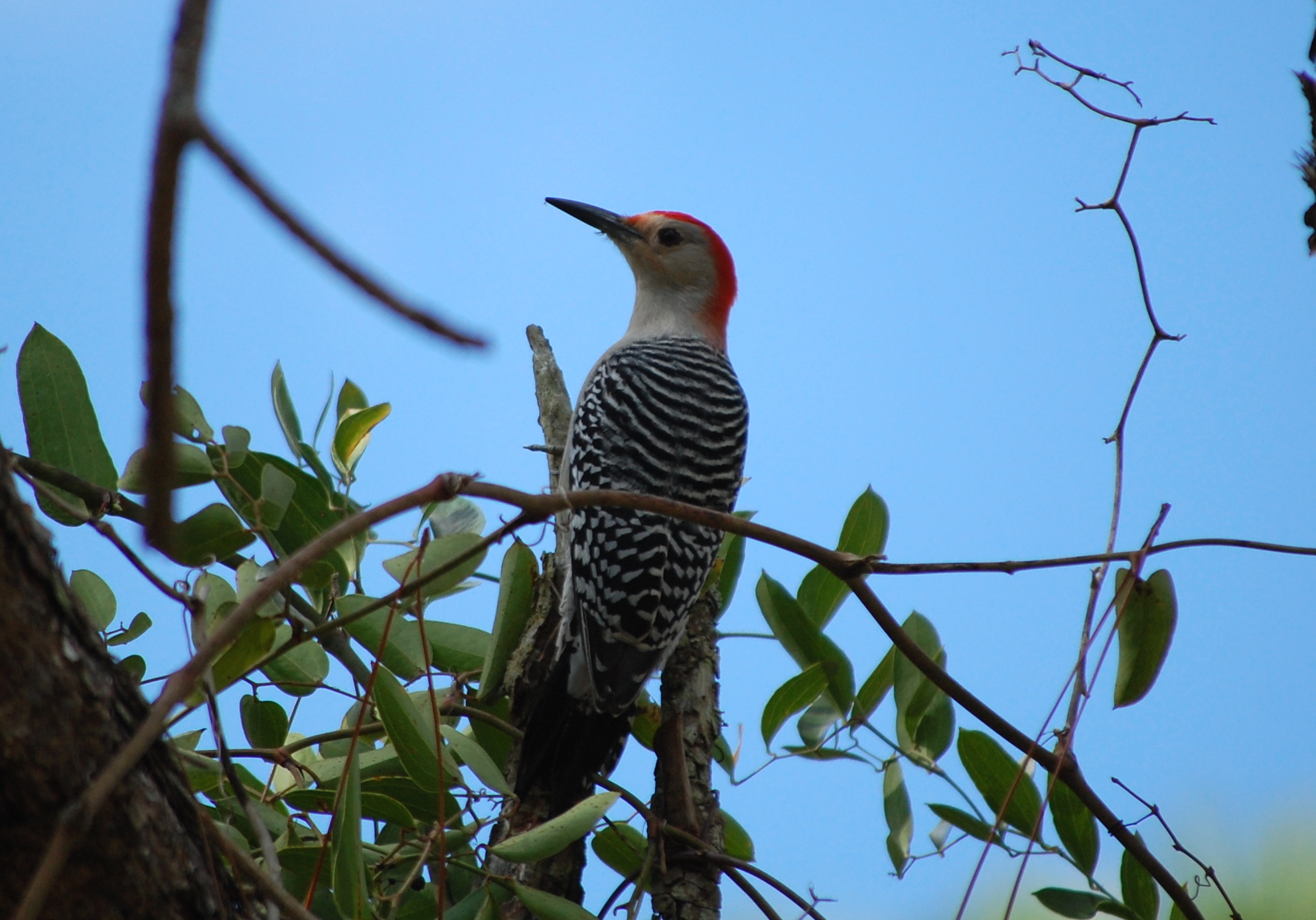
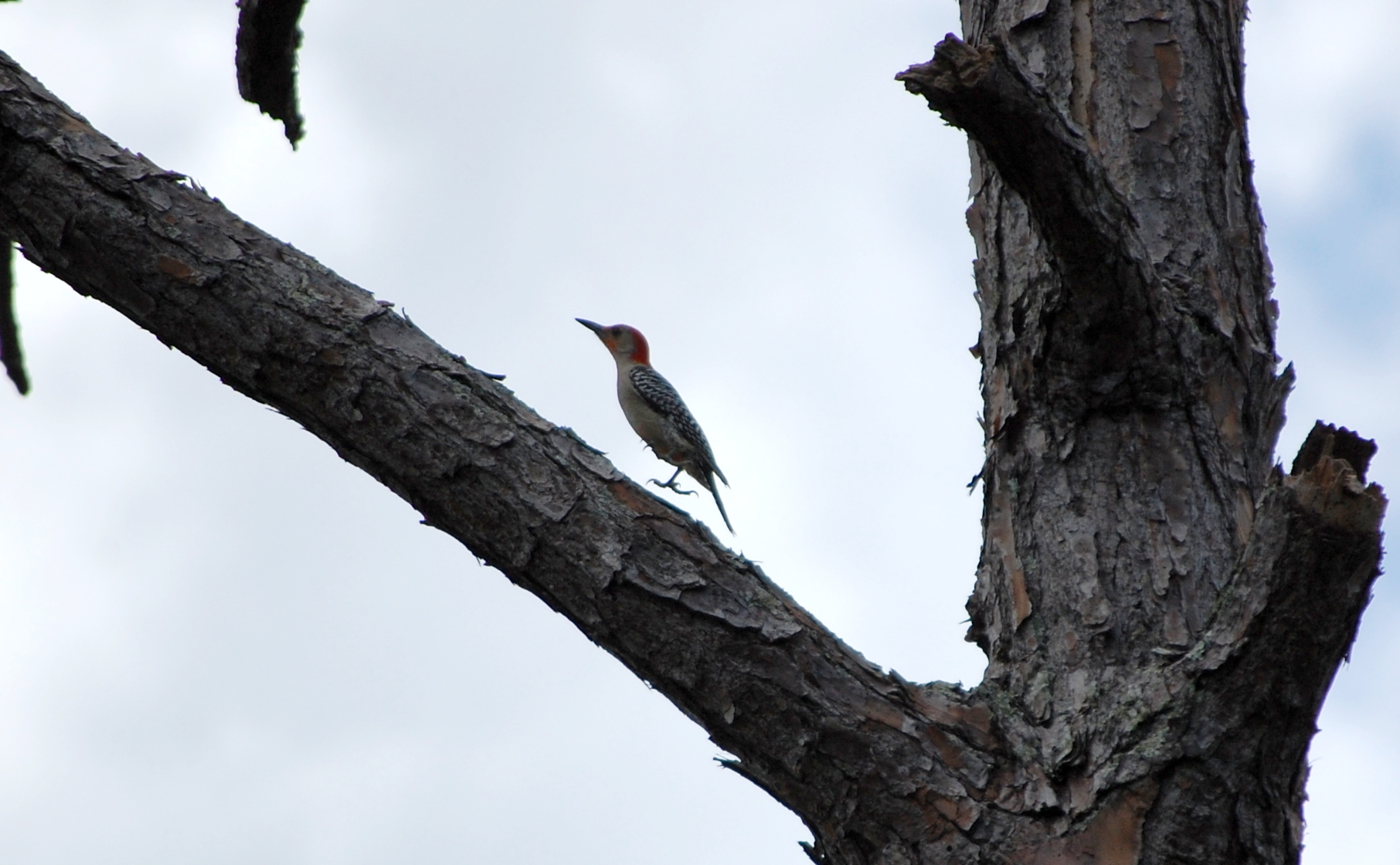
I’ll start this group with a bird that is quickly becoming my favorite the more I get to observe it. That would be the red-bellied woodpecker (Melanerpes carolinus). The genus is a combination of the Greek milas meaning “black” and herpes meaning “creeper”, presumably because of how this bird “creeps” around tree trunks by hopping around on them, mainly silent except for their upbeat little chirps that they often let out during this behavior. You can probably guess that the species name is derived from Carolina, specifically South Carolina where it was first described. I mention in my bio that I’m not here to show off my photography skills. But I have to admit, I do really like this one.
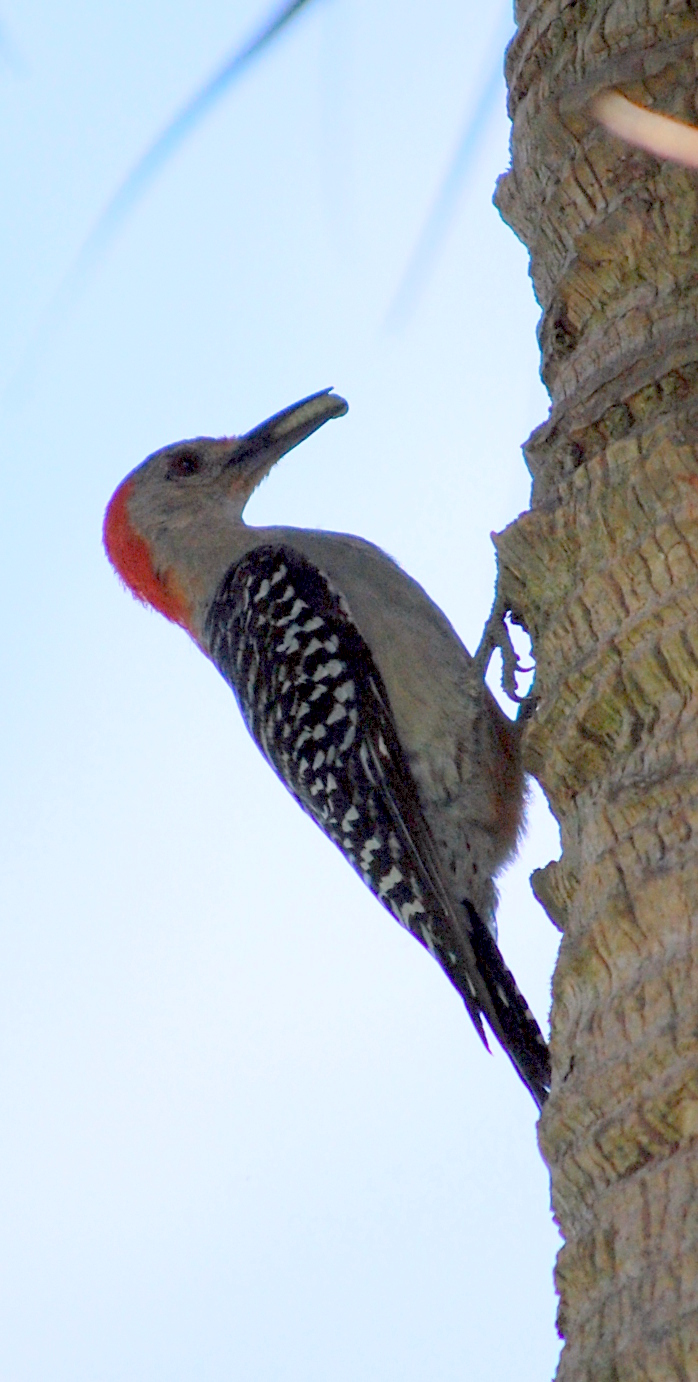
I mentioned the upbeat chirps that this bird exhibits while feeding and during other behaviors. Another reason they are one of my favorite birds is because of a sort of “t-w-r-r-r” call that they have. Many of their other vocalizations are similar to other woodpeckers, but this one is unmistakable.
When they are “creeping” along the tree trunks, they are often foraging for grubs within the bark. The tongue of the red-bellied woodpecker can extend about two inches past its bill and is barbed. So, one method of feeding is to drill holes in the bark of a tree and sticking that long, barbed tongue into the hole and grabbing the grubs with those barbs, as this one has done. If you look under the feet, you can also see the red patch on the belly that gives this bird its common name. These birds have also been observed placing nuts into crevices in tree trunks and hammering them to break them into smaller, more manageable pieces. They’ve also been known to tap food items into the crevices, and even spaces in wood fences, to store them (much like the scrub jays tapped their food items into the ground in my previous post).
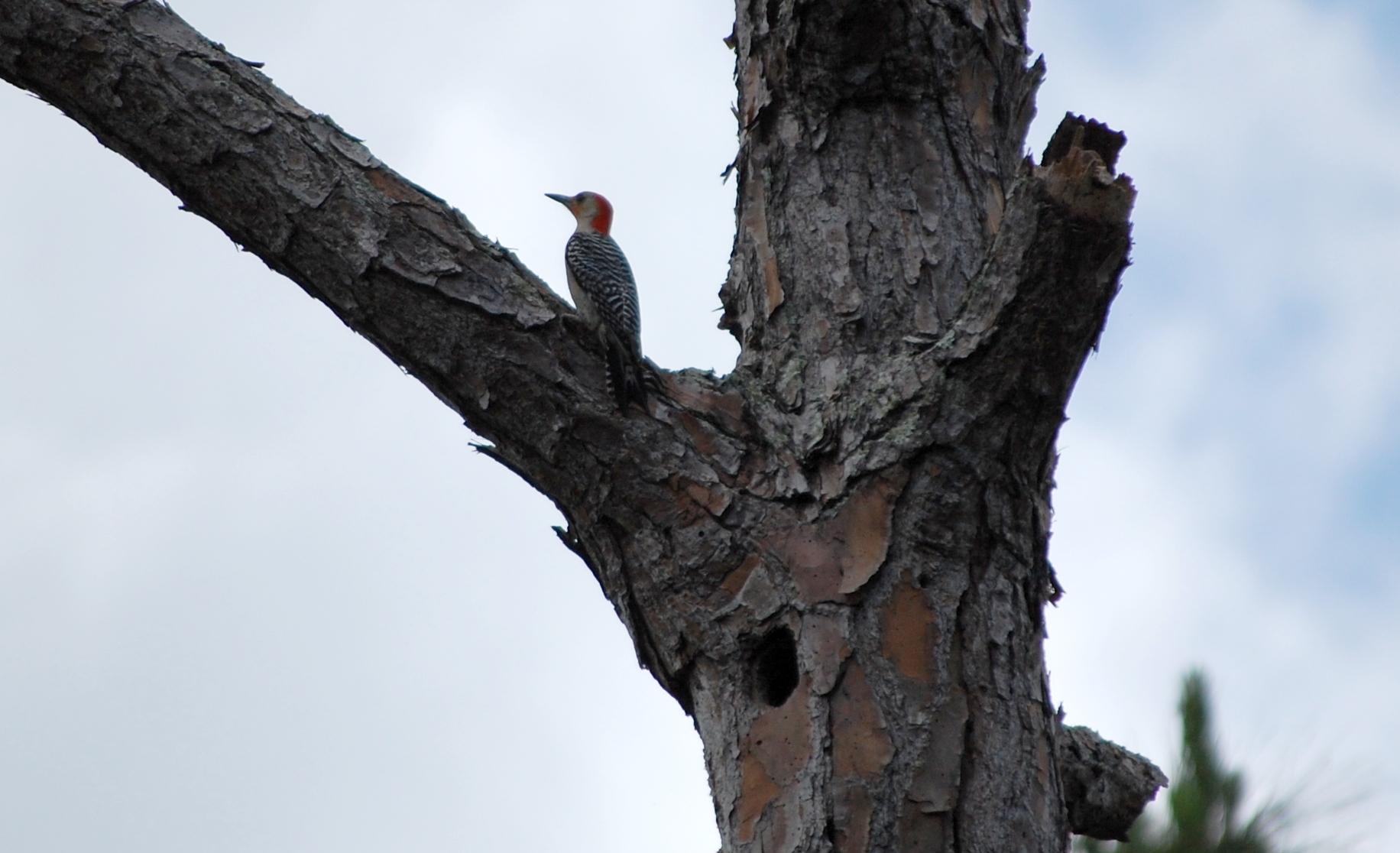
Like all woodpeckers in Florida (except for the red-cockaded, which I hope to talk more about in a future post), red-bellied woodpeckers nest in cavities that they create in dead trees, also known as “snags”. I had already decided to write this post today when I went on a hike and almost caught this one coming out of it’s cavity just the the bottom right of it. Shortly thereafter, I had another lucky shot. I mentioned how they hop around on trees. They do this effortlessly, without extending their wings at all. I managed to catch this one mid hop, making it look as though it is hovering in thin air.
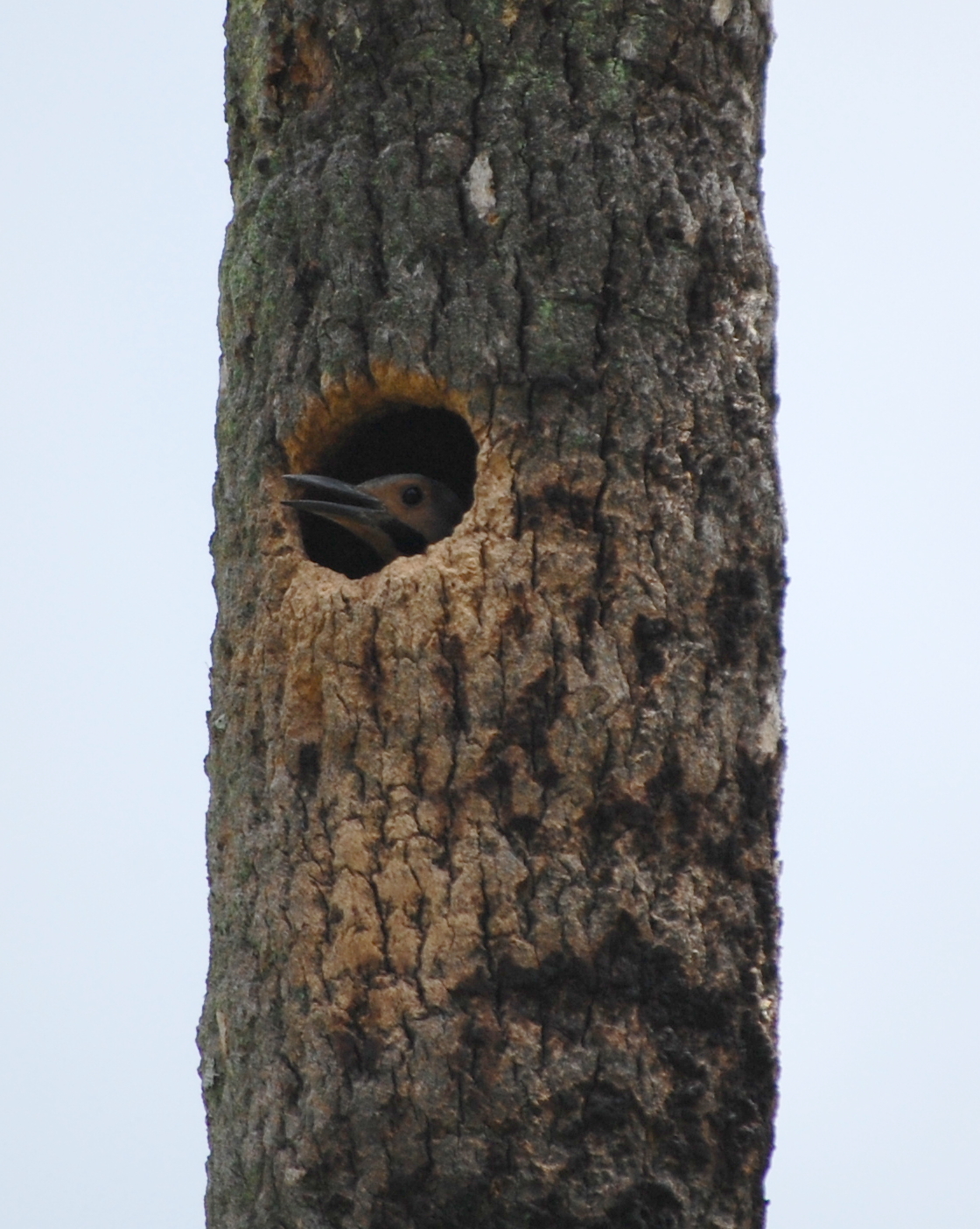
Later on during the hike, I came across another cavity and noticed a tiny head at the opening. It was early afternoon and the sun was bright behind it, so I had difficulty telling what it was. I took several photos, then enhanced them to make the bird a bit brighter. The dark spot at the base of the mouth, and lack of a dark patch around the eye, told me that this was a northern flicker (Colaptes auratus). This is why we biologists always take so many photos. Sometimes you can use them to find out a lot more about what you were looking at when conditions weren’t perfect. The genus is from the Greek kolaptes meaning “chiseller”. The species name is the Latin auratus, meaning “ornamented with gold”. There are several subspecies, including Colaptes auratus auratus, the southern yellow-shafted flicker which does have yellow coloring on the underwing. Although northern flickers nest in tree cavities like other woodpeckers, they will often be seen foraging on the ground, as ants are a large part of their diet.
In this photo, you’ll notice how some of the bark is sort of grey, whereas some other parts look light brown. Again, I enhanced this photo to show the bird. In the original, the grey parts of the bark are actually black because this tree was recently burned. In Florida, fire is a big part of certain habitats. Fires are actually started on purpose to manage these areas properly. It burns off the underbrush and removes exotic vegetation. Some plants even have cones that are opened by fire, or seed pods that are cracked open by the intense heat. While uncontrolled forest fires are never good for the environment or surrounding residential areas, prescribed burns, such as the one in this park, are absolutely essential for maintaining certain Floridian ecosystems.
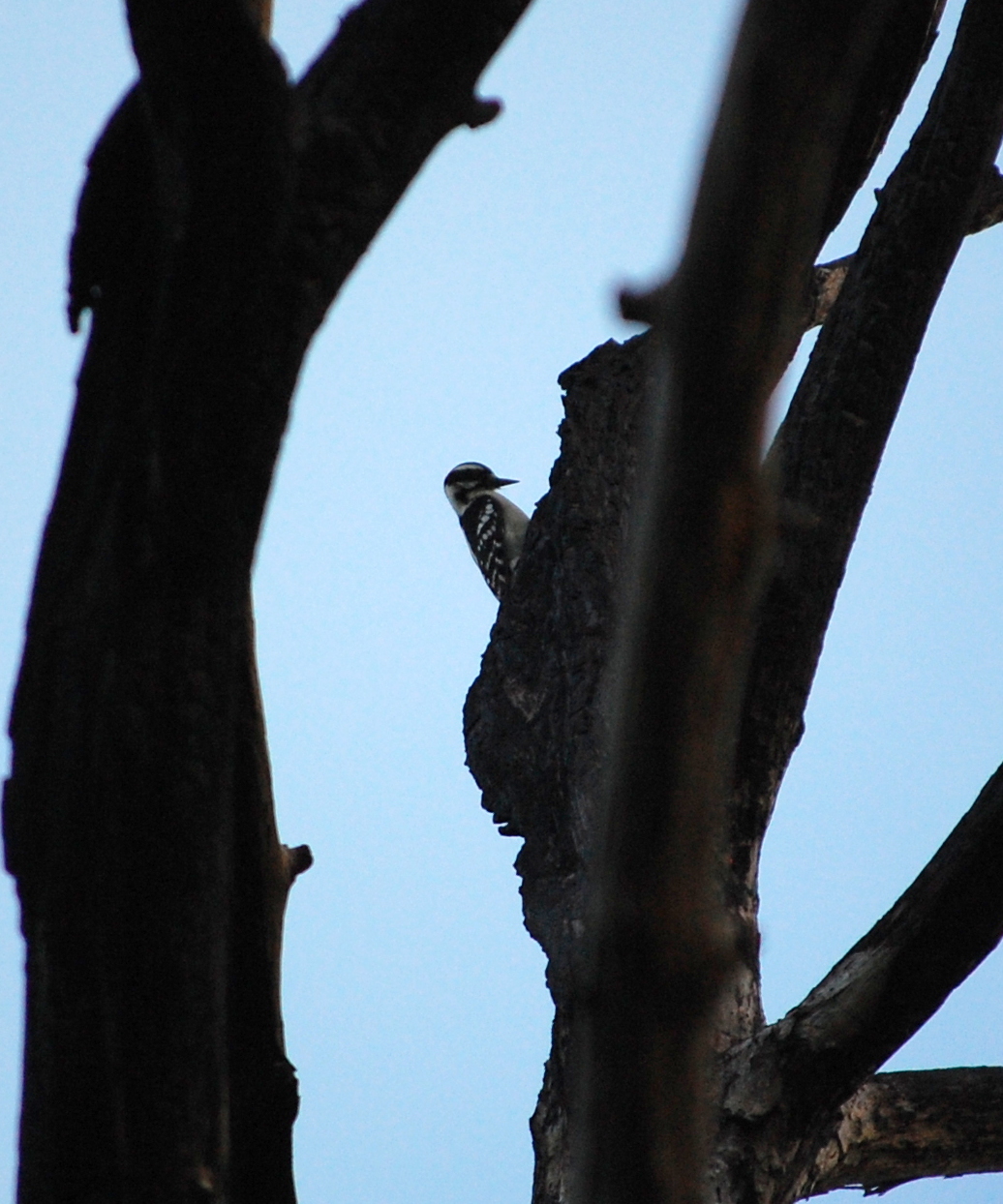
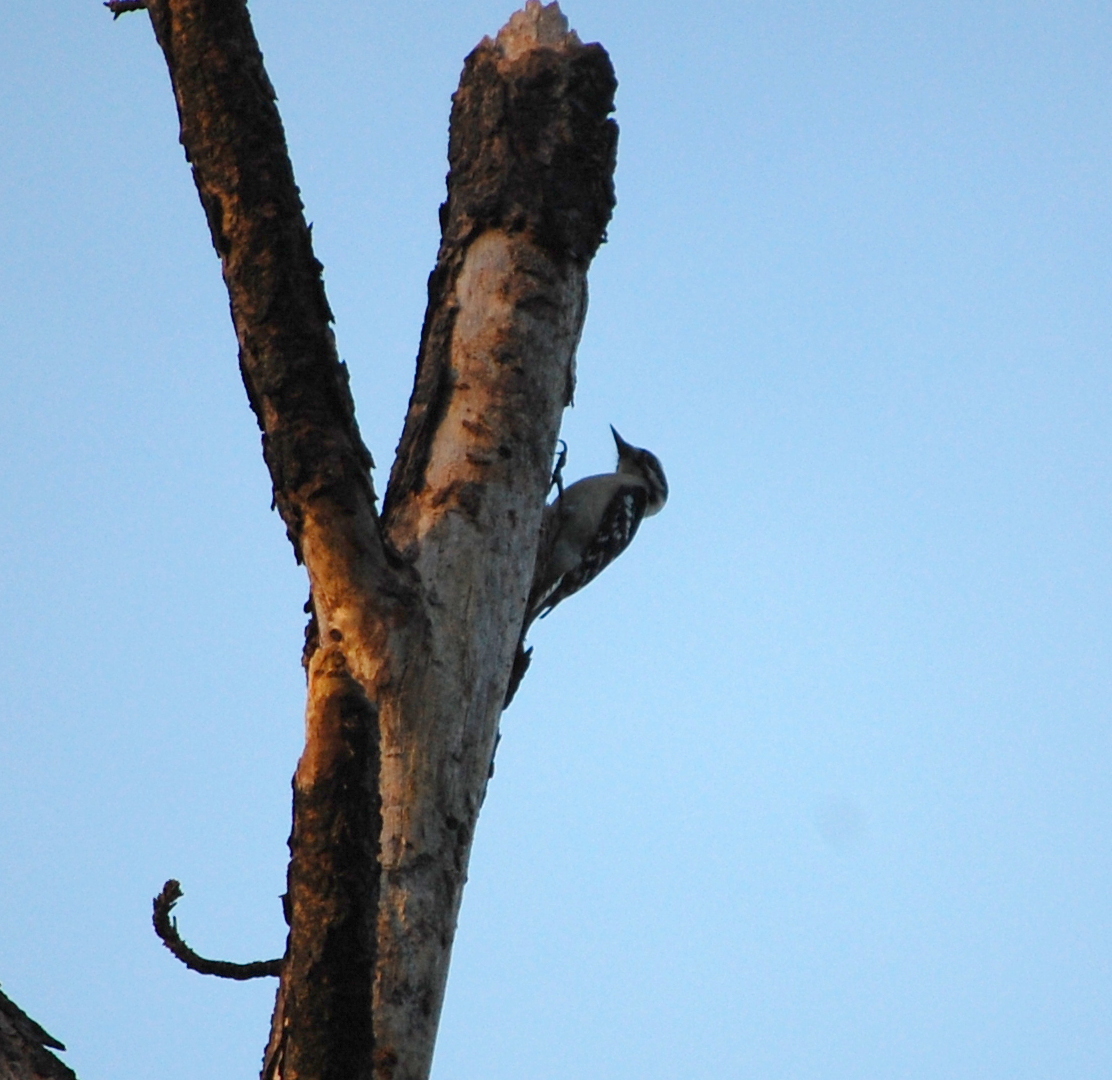
While the northern flicker was easily distinguished when the photo was enhanced, there are two species that can be a bit tricky. They are the downy and hairy woodpeckers. This is another time when photography can be a big help. The markings are nearly identical. The first way to tell them apart is that the downy is quite a bit smaller. However, unless you see both birds quite frequently, or see them together, this can be a difficult way to tell them apart. Another thing to look for is the tail. The sides of the hairy’s tail is all white, whereas the downy has a couple spots. The final way to tell them apart can be difficult in the field, but easy if you get the right shot – the bill size. The hairy woodpecker has a much longer bill than that of the downy, which is only about one-third the length of its head. That is how I identified this one as the downy woodpecker (Dryobates pubescens).
The genus Dryobates is a combination of the Greek druos meaning “woodland” and bates meaning “walker”. The species name is the Latin pubescens meaning pubescent which, in the world of zoology, means “covered in short hairs” or “downy”. One of the interesting things about this species is that the males forage more on small branches and stems, whereas the females forage on larger branches and trunks. However, researchers have found that, when males are removed from a community, the females switch to feeding on the smaller stems. In this shot, you can see the spots along the side of the tail.
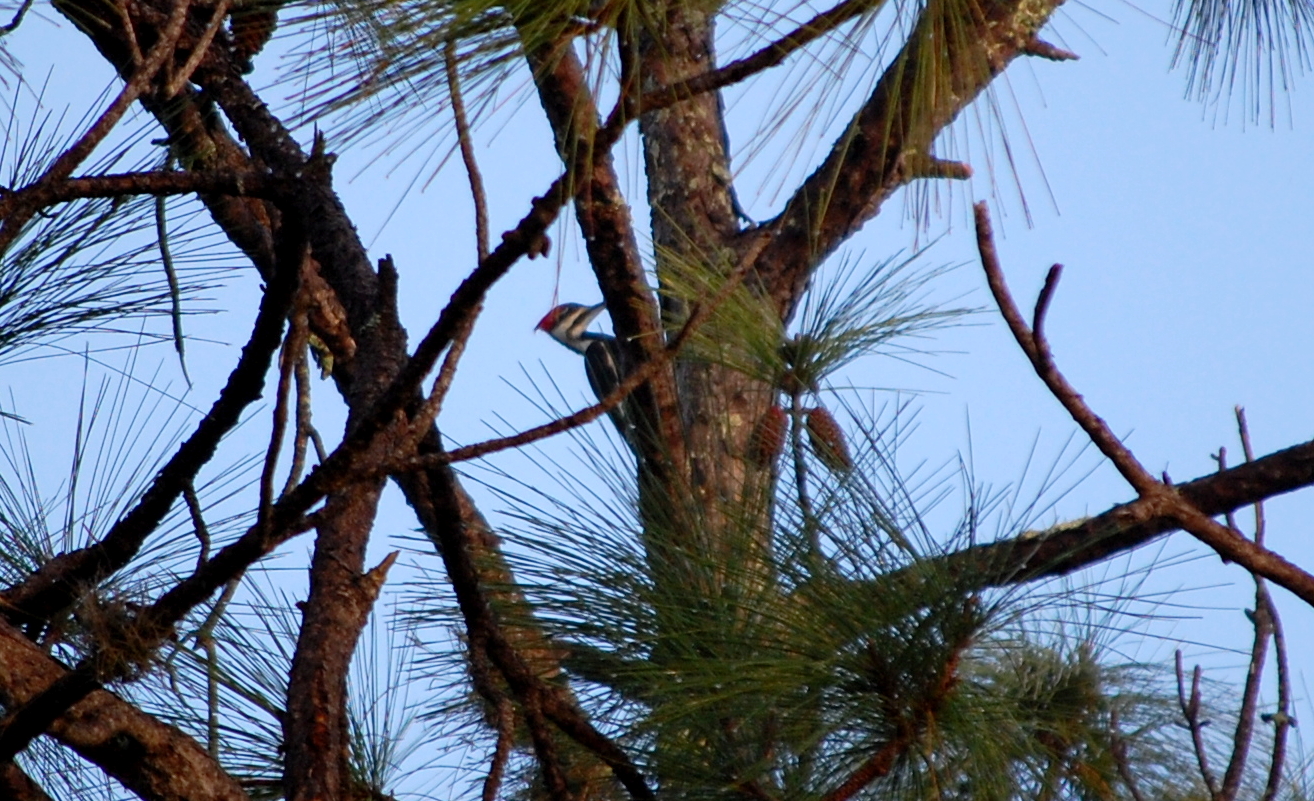
This next photo isn’t great. But I was very excited to finally get a shot of this bird. They are usually seen only briefly, flying swiftly through open areas from one thick forested area to another. This one just happened to land in a tree right above me where I got to admire it’s bright red mohawk. This bird is often mistakenly called the red-headed woodpecker, which is an entirely different species. What you see here is the pileated woodpecker (Dryocopus pileatus). At first, you might notice that the genus name is similar to that of the downy and think that they might have similar root words. They are very close, but not quite identical. This genus is a combination of the Greek drus meaning “tree” and kopos meaning “beater”. The species name is the Latin word for “capped”, due to that red crest. Where other woodpeckers will make small holes that they probe with their long, barbed tongues, pileated woodpeckers excavate large, rectangular cavities to find ants. Some of these cavities are so deep, they’ve been known to topple smaller trees.
 BJ Quinton