Ok, know I said my next post would be about birds in a marine environment. I promise I will get to that. But recently I had the opportunity to work fairly closely with the one wildlife guild that I love more than birds – bats.
You know I have an affinity for wildlife that are often seen as creepy and scary. There is that, but there are many more reasons why these wonderful animals captivate me. First of all, while “fruit bats” also exist, all bats in Florida are insectivores. Not only do they control our mosquito populations, but it just so happens they prefer moths and beetles, many of which are pests to local crops. On top of all this, they are the only true flying mammals (“flying” squirrels actually glide) and they gather information about their surroundings using sonar. I’ll post more about that later. For now, let’s go over some of the negative connotations about these animals that are just wrong.
First of all, you may hear plenty of people talk about how they are “flying rats”. For those who aren’t biologists, there are seven levels used to categorize species. From the lowest to highest specificity, these are kingdom, phylum, class, order, family, genus, and species. The genus and species is what you see me talk about in other posts when it comes to name origins. But, starting at the top, we can see just how separated bats are from rats (although the Old English word for bat is “flittermouse”, literally meaning “fluttering mouse”). They are both in Kingdom Animalia (animals) and in Phylum Chordata (animals with spinal chords). Finally, they are in Class Mammalia, as they are both mammals. That is where the similarities end. To give you an idea, marine mammals are also in these same categories. So really bats are just as related to rats as they are to whales and dolphins.
The next level, order, is where they separate. Rats are rodents and fall into the order Rodentia (which is described in a different post). Bats, however, belong to the class Chiroptera. The order name comes form the Greek cheir meaning “hand” and pteron meaning “wing”. If you look at a bat’s skeleton, you’ll see that the wings are supported by elongated “fingers”, hence the term “hand wing”. These exaggerated extremities also give sort of an illusion as far as the actual size of the animal. Our largest (and also our only federally protected) bat species here in Florida is the Florida bonneted bat (Eumops floridanus). With an over 1.5 foot wingspan, the bat itself is a mere 6.5 inches.
Here are a few other myths about bats that I wish the world knew the truth about. First, everyone assumes that all bats have rabies. While they can carry it, it is simply not true that they all do. In fact, it is estimated that only around 0.1% of wild bats have the virus. However, as it can be deadly, it is highly recommended that bats are never handled by anyone who is not vaccinated for rabies. Even dead bats can pass the virus on to humans. Another myth about bats is that they all drink blood. While there are three species of vampire bat, they all live in Central and South America. The other greater than 1,400 species are either frugivorous (fruit eaters) or insectivorous. One final myth that is so ridiculous I actually find it funny is that bats will fly into your hair and get stuck. This has never actually happened and with good reason. Bats use echolocation to find their food. They would be able to tell from quite a good distance that a human is more of a threat than a food item and would never get that close. It turns out this myth was started in order to keep young girls from wandering outdoors at night.
Now that we got the negative connotations straightened out, I thought I’d write about one of the most interesting features of bats – their echolocation. Not all bats use this. Larger bats have well developed eyes and can see quite well. The smaller bats, known as microbats, have poor eyesight (although they aren’t completely blind – another myth) and use echolocation to gather information about their surroundings. This is an interesting feat in and of itself. However, the more you look into it, the more amazing it truly is. First of all, the sounds are mostly too high for humans to hear it. Our Florida bonneted bat does have a frequency low enough that you can hear it. But you really have to know it’s there and be listening very carefully. If you’ve ever gone under a bridge, you may have heard some squeaks and clicks coming from the bats living in the joints. However, these are communicative in nature and not echolocations.
Besides the high frequency, one of the things that makes these echolocations so amazing is how quickly their brains can interpret them. When a bat is foraging and they find a food item, they will hone in on it using what’s known as a “feeding buzz”. They will send out a signal with increasing frequency (in time, not in pitch) until they are so close together that it sounds like a buzz. Here is a sample clip of a feeding buzz. Keep in mind, this had to be slowed down in order for the frequency to be low enough for humans to hear. Based on my work with bat calls, I would say this is slowed down to approximately 1/8 to 1/16 of the normal speed, so everything you hear actually happens in less than one second. Imagine having to hear those pulses and interpret them to find your meal.
The world of bats is so vast that it’s hard to give general facts about them. Instead, I thought I would go through and talk about certain species that I find interesting for a variety of reasons. Since many of these bats don’t live here and are incredibly difficult to photograph, I’ll be relying on other sites for most of the photos.
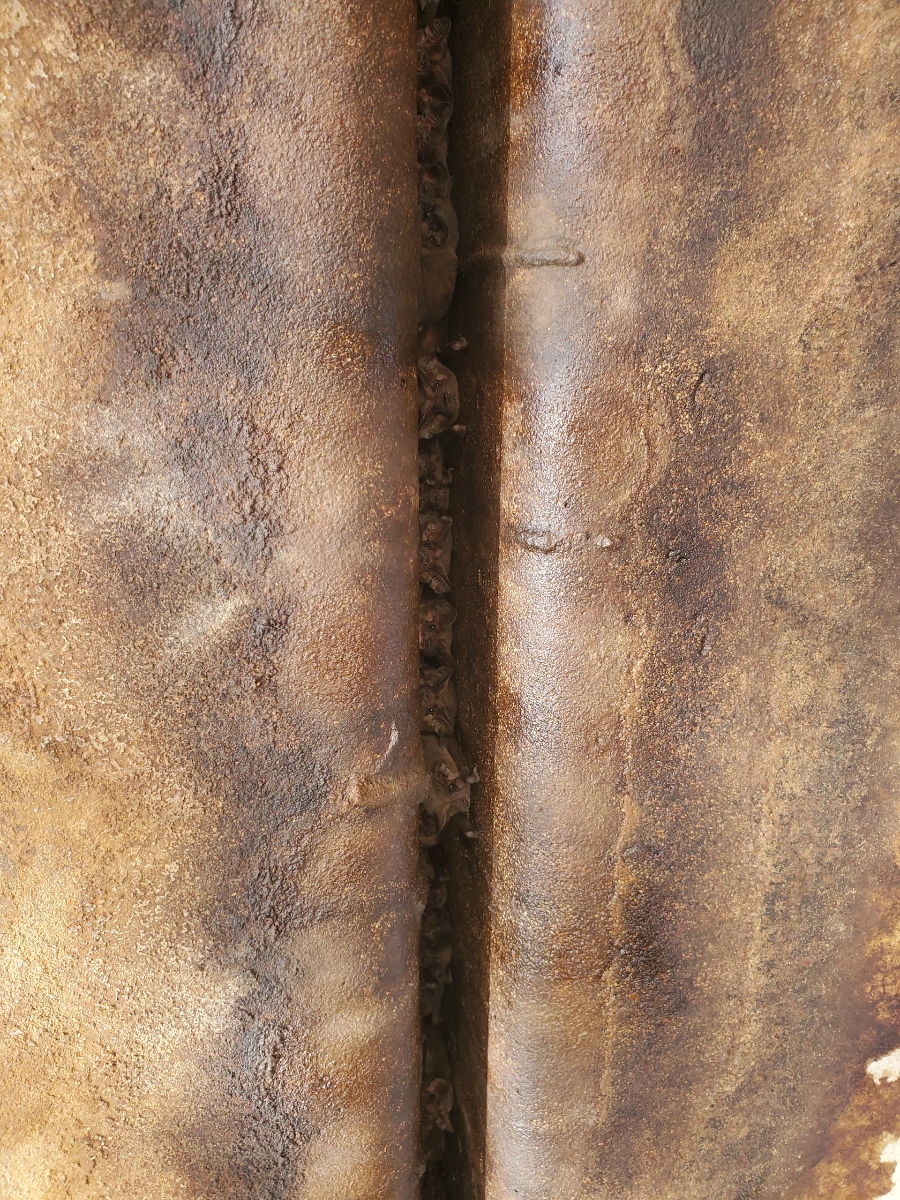
This first one is the one that I have been working with recently. It’s known as the Mexican or Brazilian free-tailed bat (Tadarida brasiliensis). The origin of the genus name is largely unknown. However, the species name comes from the fact that the first one collected for description (known as the holotype) was collected in Brazil. This species is one of the most prolific mammals in North America, living in bridges and other structures by the thousands, if not millions. The photo below shows how close together they can live, but we observed them in even much higher concentrations than this. I just took this as a photo opportunity since some sunlight was reflecting off the water and made them so visible. Usually, we would shine a light into the joint to be able to tell where they are. However, we try not to do that more often than we need to so we minimize disturbance to their daily routines.
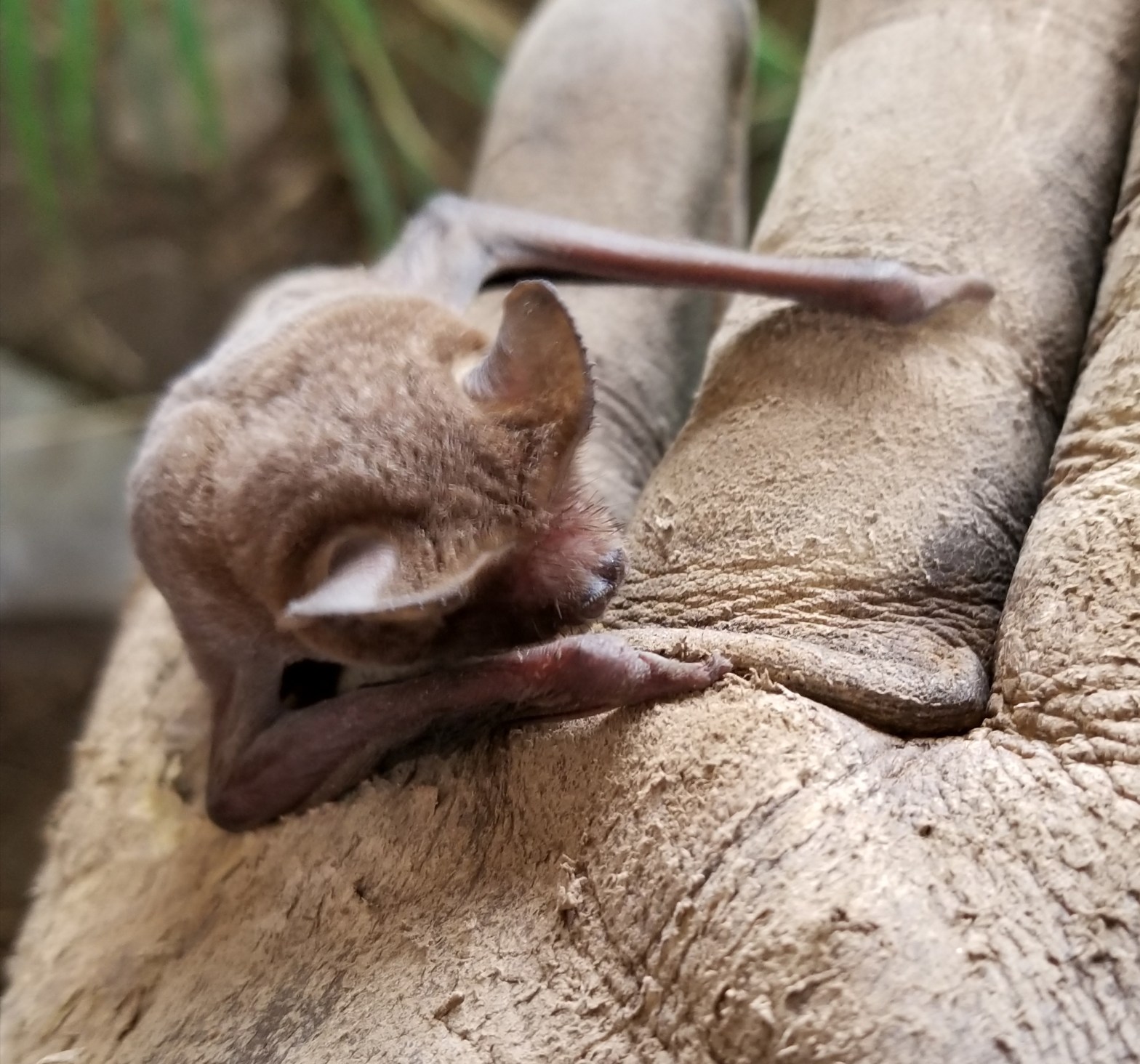
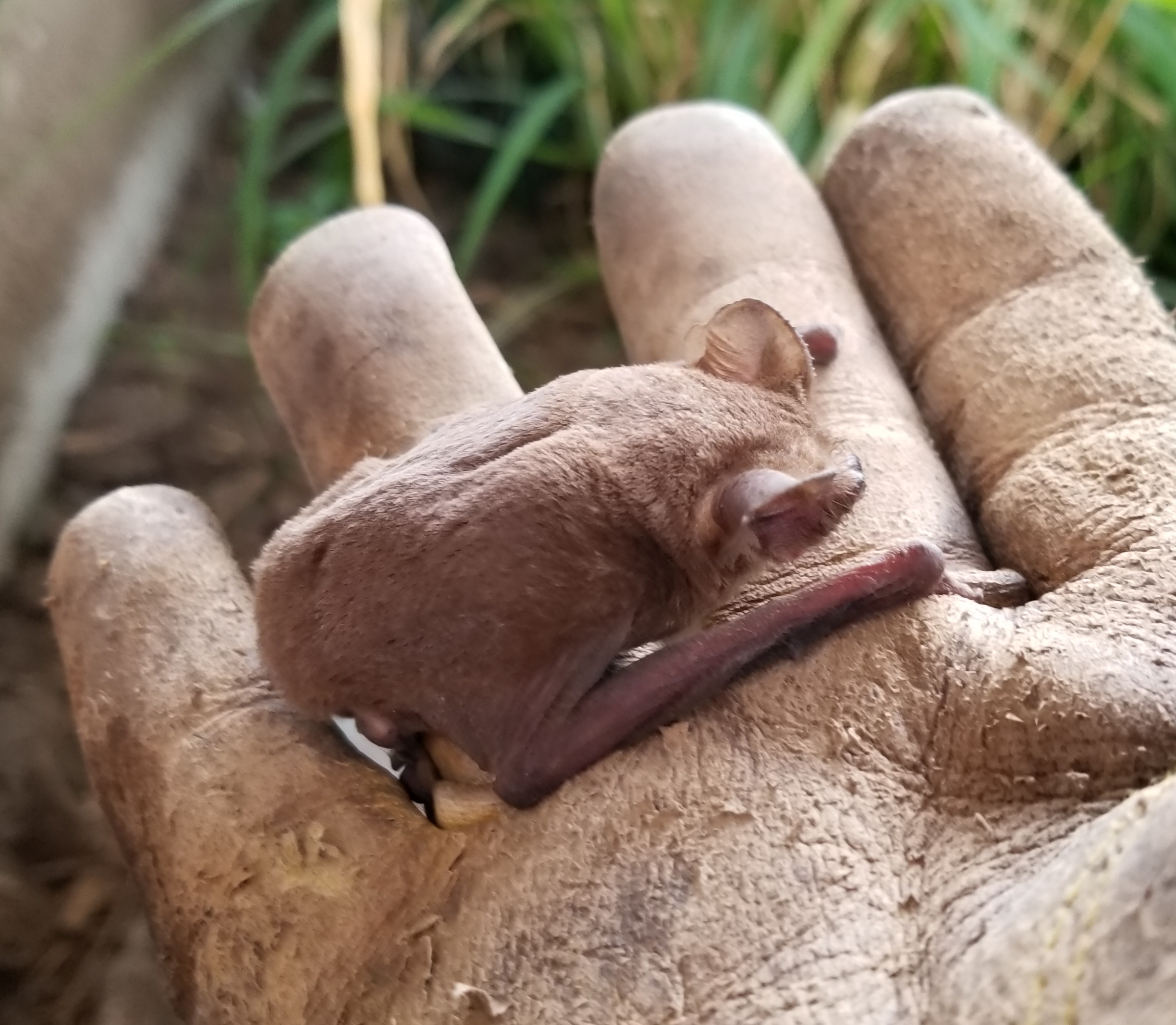
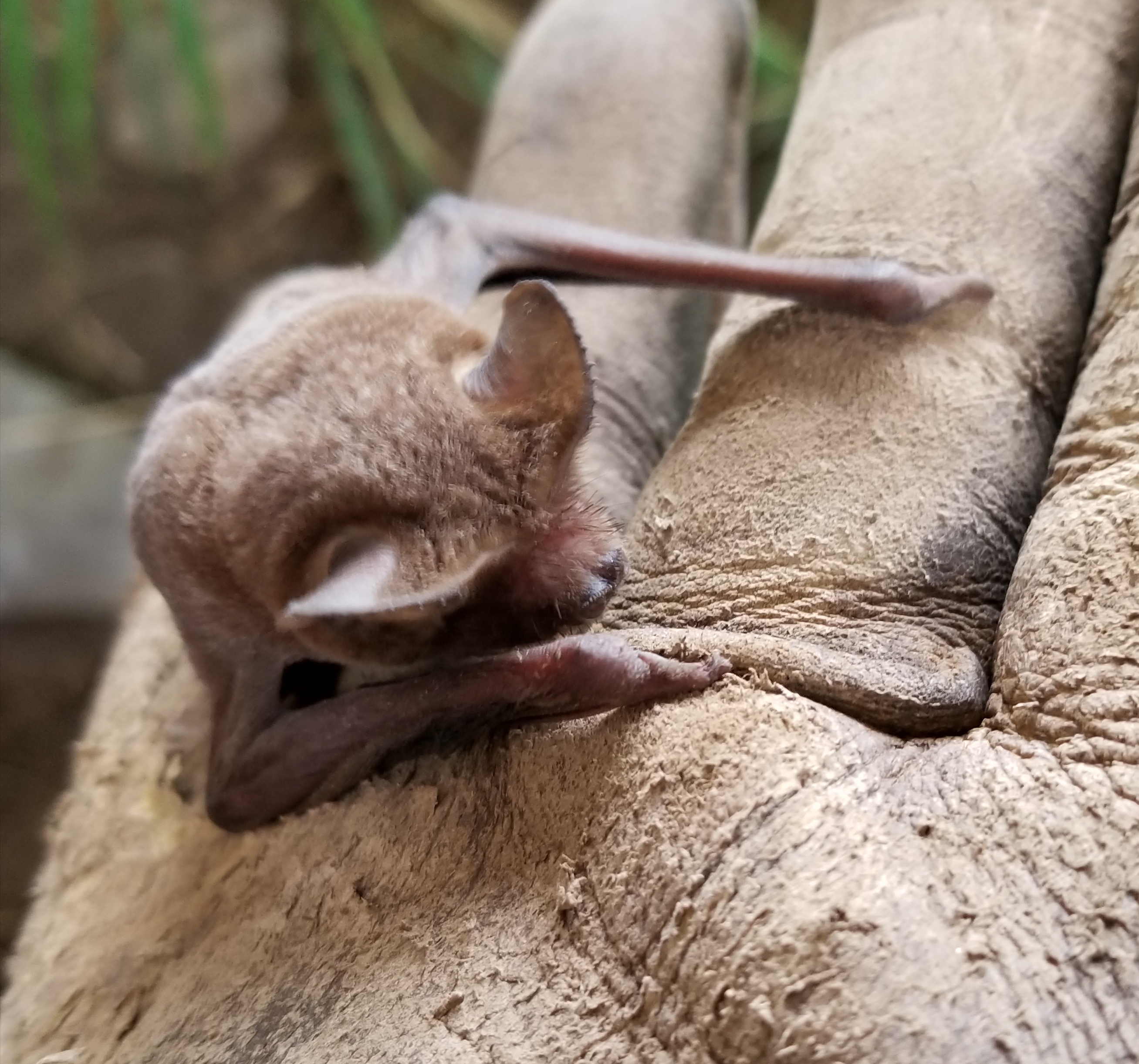
As always, it is not recommended that these animals are ever handled for any reason, for both your safety and theirs. However, there are some very rare instances where we may need to move them to a safer area, which is why these photos were captured. This bat was only handled for a very short time before moved to a safe area. These photos were taken to give the unique perspective that also shows how small they really are. They are about 3.5 inches long and weigh less than half an ounce.
If you are wondering why we are trying to look at them in the first place, it is for their protection. All bats, regardless of species, are protected in Florida. Any time a bridge is being replaced, or if work is being done that might disturb them, we put things in place to exclude them. That is, they will be able to leave, but won’t be able to get back into the bridge and will have to roost elsewhere. There are some “trade secrets” when it comes to that, so I can’t mention anything specific. But we do have to shine a light sometimes to see where they are so we know how to safely install the materials.
While we were out there, I was hoping to get some footage of the bats leaving the bridge. I was lucky enough to catch one on a game camera. When I slowed the footage down, what I saw was very interesting. I’m not sure what I expected – maybe for them to sort of fall out and then catch themselves to start flying. What I saw was far more interesting. It is a little hard to see but, if you look closely at the center of the video, you will see a pair of glowing eyes pop out. After that, it digs its claws in and gives itself a little push start before flying away. This video is slowed down to 1/4 speed so, again, it’s amazing how all of this happens in such a short amount of time. Their regular flights are impressive as well. They have the fastest horizontal speed of any animal, having had their ground speed clocked at over 100 MPH.
A few more quick facts about this species before I move on to some of my other favorites (which I’ll do by category). I mentioned that these bats can inhabit bridges in the thousands, if not millions. They are so numerous at the Congress Avenue Bridge in Austin, Texas that it is a huge tourist attraction and even has its own festival. These bats can only be seen during summer months as they migrate to Central and South America in the winter. However, our populations in Florida live here year-round. I’ve seen conflicting numbers as far as life span. However, most sources I found indicate a surprisingly long life expectancy for such a small animal – up to 18 years.
One final thing I’ll mention about this species is probably something you’ve been asking yourself while reading about them. What’s the whole “free-tailed” thing all about? Just as birds have tail feathers, bats have a tail membrane that goes between their legs, also known as a “uropatagium”. For most bats, the tail is completely within this membrane. In free-tailed bats, the tail extends past the uropatagium. So it is “free” outside of the membrane. I didn’t get a photo of this because they are almost always oriented face down.
Now that I’ve gone on about the Mexican free-tailed bat, I thought I would mention some other ones that I find interesting for one reason or another. With so many different species, it was pretty easy to find ones to fit into different “categories”. Again, this will be a very wordy post with not many photos other than those with a link. But hopefully the facts are interesting.
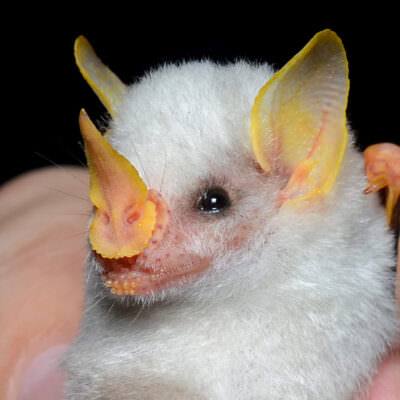
Cutest – Honduran white bat (Ectophylla alba)
I thought I would get this one out of the way because, yes, I realize as a biologist that I shouldn’t be calling something “cute”. However, sometimes it just has to be said. Besides, if describing something as cute gets people’s interest and maybe gives them that connection that may motivate them to learn more and maybe even support a species, it is worthwhile. This particular species can be found in Costa Rica, Panama, Nicaragua, and of course Honduras. The genus name comes from the ancient Greek ektos meaning “out” and phullon meaning “leaf”. This is a reference to the leaf-like nose. The species name is from the Latin albus meaning “white”.
I call this the cutest because they look like little white cotton balls when roosting. Their roosting habits could also possibly make this the most interesting bat in this post. They are known as “tent-making” bats. They roost under large leaves in the banana family. They will chew on either side of the leaf’s main vein, causing the sides of the leaf to collapse, creating a sort of tent that they use for shelter. Another interesting fact about this species has to do with their yellow coloring on the ears and nose. This is the result of concentrated carotenoids that they get from their food. This is also where flamingos and other birds get their red or pink coloration. However, this bat is the only mammal known to have this trait.
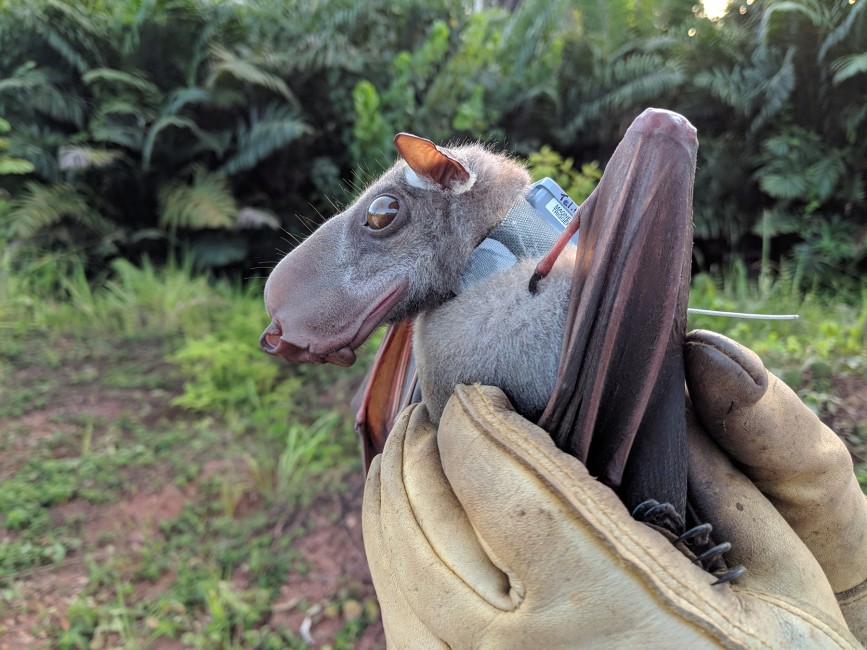
Scariest – Hammer-headed bat (Hypsignathus monstrosus)
When I first saw a photo of this bat, I immediately started researching to make sure it wasn’t photoshopped. Between its large size, bugged out eyes, and moose-like face, I thought for sure it wasn’t real. The myth debunking site Snopes.com even had a post about it. But this bat can, in fact, be found in some central portions of Africa. It’s physical appearance is so shocking, the species name is actually Latin for “having monster-like qualities”. The genus comes from the ancient Greek hupsos meaning “high” and gnathos meaning “jaw”. This is in reference to their deeply arched mouths.
Despite the scary look, this bat is a frugivore, having a specialized tongue for extracting juice. They are sometimes viewed as pests, not only for their destruction of fruit crops, but also for the loud honking noises the males let out at night. They are able to produce such sounds thanks to an extremely enlarged larynx (so large, it actually displaces other internal organs) and large resonating chambers, which contributes to the large head.
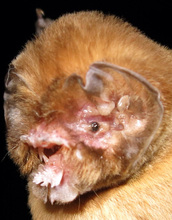
Weirdest – Antillean ghost-faced bat (Mormoops blainvillei)
This is another one that I almost thought wasn’t real when I first saw it. There are a couple different ghost-faced bats and they are all pretty strange, with faces that basically look like they’ve exploded. But, to me, the Antillean one is the most bizarre. I didn’t want to have an “ugliest” category for the opposite reason I had for using “cutest”. However, if I had had that category, this would certainly be the winner. Between the ears taking up so much of the face that the eyes are basically inside them, the almost nonexistent nose, and odd flappy lips on the underside of the mouth, I had to link several different photos just to try to help comprehend the absolutely bizarre nature of this bat’s face. Even the artist’s rendition looks like a concept drawing for something from Star Wars.
But, again, this is indeed a real creature which can be found in the Caribbean in places such as the Dominican Republic, Puerto Rico, Jamaica, Cuba, and Haiti. I couldn’t find much about the scientific name, but I have my own theory. I mentioned the Florida bonneted bat before with the genus Eumops. The Greek eu means “true” and mops is the Malayan word for “bat”. There is also a character in Greek mythology called Mormo, whose name was used by mothers and nurses to scare children in behaving properly. The name itself even means “hideous ones” or “fearful ones”. Given the grotesque nature of this genus, I don’t think it is much of a stretch to think that this may be the origin.
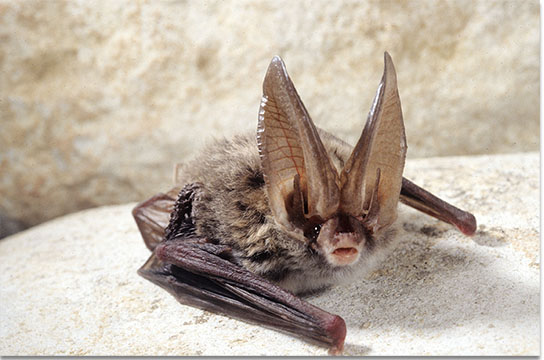
Funniest – Rafinesque’s big-eared bat (Corynorhinus rafinesquii)
I picked this one as the funniest for two reasons. First of all, like all the big-eared bats, it is just simply funny looking. Of course big ears are important for an animal that uses echolocation. But the sheer length makes them just look comical. The second reason this particular big eared bat is funny, for a completely immature reason, is the size of the testicles. They are the largest in proportion to body size of any other mammal. Specifically, more than 8% of the body mass is in the testes. To put that in perspective, that would be like a 200 pound human man having testicles weighing over 16 pounds. I couldn’t find much on the reason for this other than a study that was done that showed that, in bat communities where females mate with more than one male, testicle size is not only increased, but there is an inverse correlation to brain size. So, where the larger reproductive organs may enhance mating, their is a sacrifice made when it comes to intelligence.
But anyway, back to the more family friendly facts. The genus name, strangely enough, does not reference the ears, but rather the nose. It literally translates to “club-nosed”. The species name is likely a tribute to the 19th century French biologist Constantine Samuel Rafinesque-Schmaltz. We have the priviledge of having these guys right here in Florida as their range includes the southeastern United States.
If reading this has inspired you to want to learn more or get involved in conservation efforts, feel free to visit the links below.
 BJ Quinton