With all the different guilds that I’ve covered so far, my posts will likely shift to individual experiences that have helped me gain experience and learn more about different species. I had one of these opportunities last week with an interesting interaction that we hope had a happy ending.
During a routine inspection of one of our bridge bat exclusions, which occurred when it was a bit colder than previously, we had the opportunity to not only see the behavior of the bats change based on the temperature, but also to hopefully help a couple of individuals we found along the way. I say “hopefully” because this wasn’t a rehabilitation attempt. We don’t know what happened after our actions. We can only hope for the best.
Exclusions are restricted to occur during warmer temperatures (lows >50 degrees F). We were just within this requirement and were doing repairs to existing exclusionary devices. This gave us a unique perspective on their behavior since all of our other work was done during warmer temperatures. When we drove the boat under the first span, we noticed one immediate difference – the silence. They are usually very chatty, producing clicking and squeaking sounds as soon as we arrive. They were also huddled together very tightly. I didn’t take a photo because I figured the cold was stressful enough. But, if you picture their usual concentration that I’ve shown before as people standing shoulder to shoulder, imagine them being cheek to cheek.
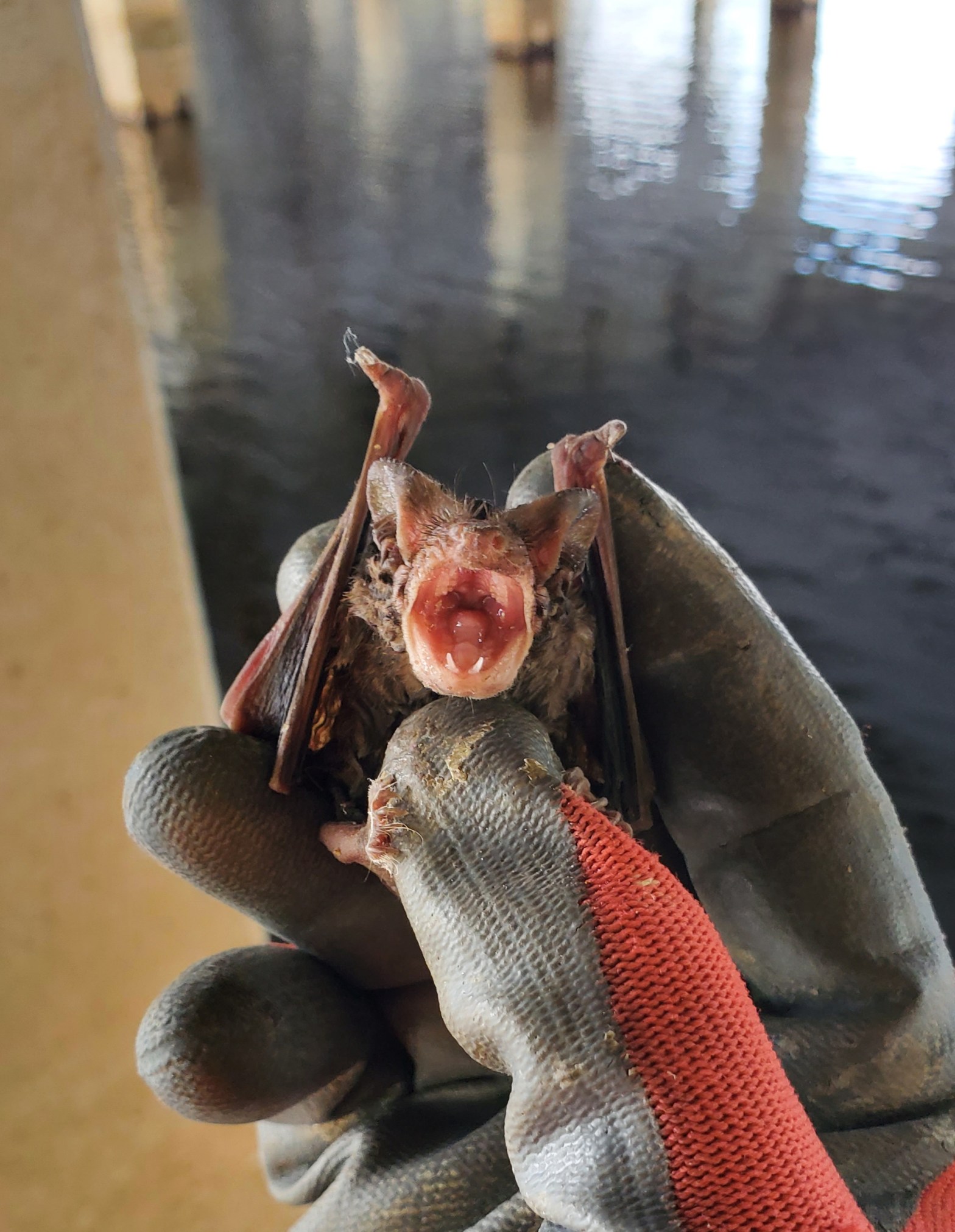
As if that wasn’t unexpected enough, we came across not just one, but two bats that had somehow fallen into the water and started crawling back up the piles. We didn’t see this occur, so we could only assume that’s what had happened. These photos are only from the first one. I had honestly thought this individual had passed as it was not moving at all and looked shriveled. These bats use their “thumb” claws to grip tiny holes in the concrete. Since this sort of anchors them in place, it is possible that it could have died in this position but still been held in place. It was motionless when we approached, but moved slightly when I touched it, letting us know it was alive. The shriveled look was due to the wet fur. It appeared to have crawled up as far as it could but succumbed to the cold and was just barely hanging on. In fact, this particular one didn’t put up much of a fight at all.

The only thing it did do was open its mouth (although it passed on any opportunity to actually bite me). My assumption is that, with the physical exhaustion it experienced, when the fight-or-flight kicked in, it knew it couldn’t choose “flight” due to the exhaustion. So it chose “fight”, despite that not being much of an option either, and was hoping to intimidate me. I know the photo looks like I’m squeezing it to death. However, I assure you it was totally safe the entire time. As always, I have to include the disclaimer that you should never handle a bat yourself. Not only do we wear gloves thick enough that their little teeth cant penetrate them, we are also vaccinated for rabies (even though it is estimated that <1% of bats even carry the disease) and have an understanding of their delicate anatomy that allows us to handle them without harm. In fact, if you look at the feet, you can see it is actually holding on to my thumb – not actually trying to fight against me.
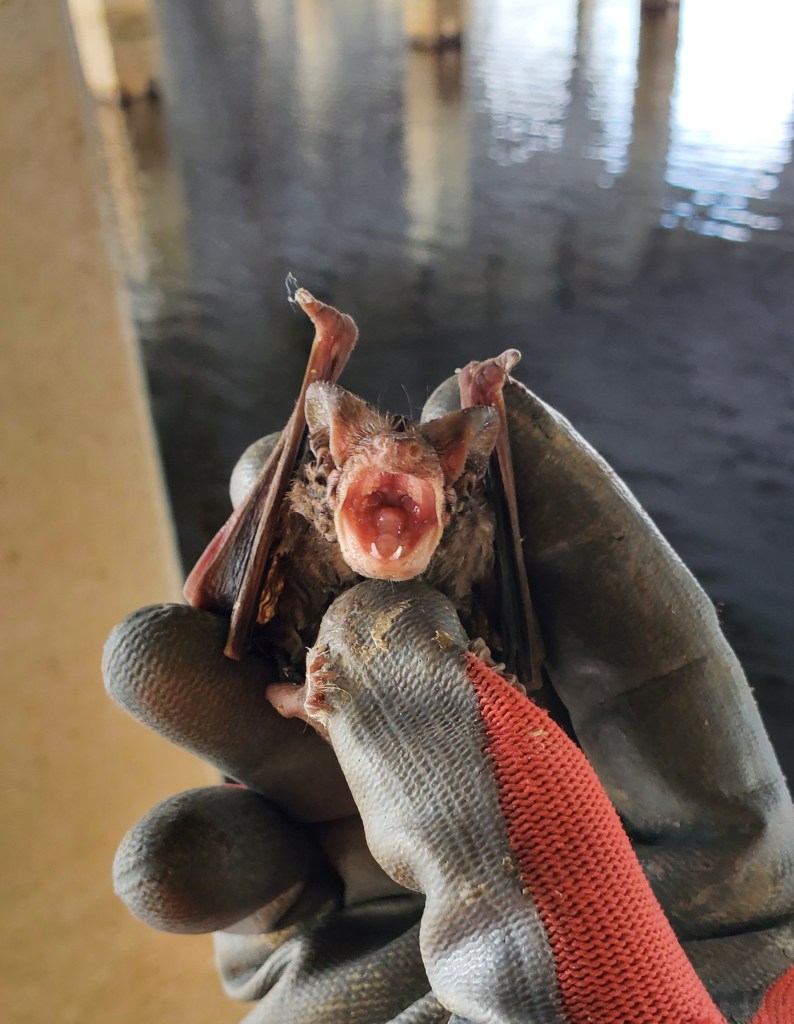
Despite being lethargic, when placed near a bridge joint, this bat did (with a little convincing) crawl up inside. We put it in an area with a good concentration of other individuals so it could cuddle up with the others and get warm.
The other one we found was in a little better shape. It was actually shivering (the first one was exhausted past this stage). If you think about when people, or even our pets, shiver you can picture a sort of exaggerated shaking. However, in the world of bats, everything is in fast forward. When I recovered the bat and put it up in the joint (this one moved much faster), it felt more like a buzz than a shiver. Imagine the rapid vibration that comes with a ringing cell phone. That’s how it felt.
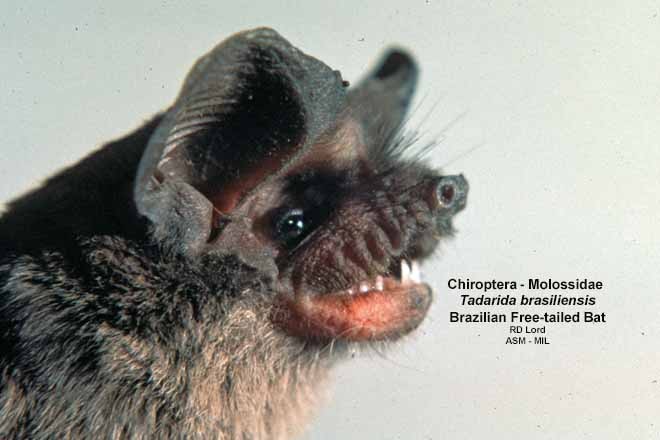
Lets go back to the first one though. The photo of the open mouth gives us a unique perspective on something that a lot of people don’t know about – the “dental formula”. This part can get very confusing, so I will do my best to describe it as simply as possible. All animals, humans and bats included, are bilaterally symmetrical on the outside. That is to say that, anatomically, we have the same parts on one side of our bodies as the other. This includes in our mouths. Biologists describe teeth as a dental formula, counting teeth on the top and bottom parts of one side of our mouths based on the tooth type. For example, humans are rather simple. We have four incisors, two canines, four premolars, and six molars (assuming you have your wisdom teeth) on both the top and bottom jaws. So, on both jaws, on one side, you would have two incisors, one canine, two premolars, and three molars.
Dental formulas are written as the number of each type of tooth on one side of the mouth, separating the top and bottom jaw by a line. This line is usually horizontal, but the format of this site doesn’t allow that, so I’ll just use a slash. So the dental formula for a human would be as follows:
2:1:2:3/2:1:2:3
For the Mexican free-tailed bat, the formula is as follows:
1:1:1:3/3:1:2:3
So the top jaw has two incisors, two canines, two premolars, and six molars. This is very similar to ours, but we have two extra incisors. The bottom jaw gets a little weird. They have six incisors (although this actually ranges from four to six), two canines, four premolars, and six molars. So they actually have six more teeth on the bottom jaw than the top.
Looking at the skull of this species, it gets even more interesting. Not only are those six incisors on the bottom jaw squeezed into a very small space between the canines, but the top jaw also curves upward toward the front. I remember reading something (although I don’t recall where) that mentioned the distinctive wrinkly top lip is designed to stretch. So I wonder if it maybe stretches upward, creating an even more impressive gape than can be seen in the photo above. This video shows a bat of a different species catching prey (complete with audio so you can hear the feeding buzz). You can see how the uropatagium is used like a little scoop to guide the prey to the mouth. You can imagine having to find your food (a moving target) in the dark using sounds to tell where it is. I’m sure having a large mouth to guide it would be very beneficial!
This post is an example of why I love writing about these things. Not only do I learn things along the way but, even as I write, I realize things that I still don’t know and would love to learn more about. That’s why I’ll continue to learn and share along the way.
 BJ Quinton