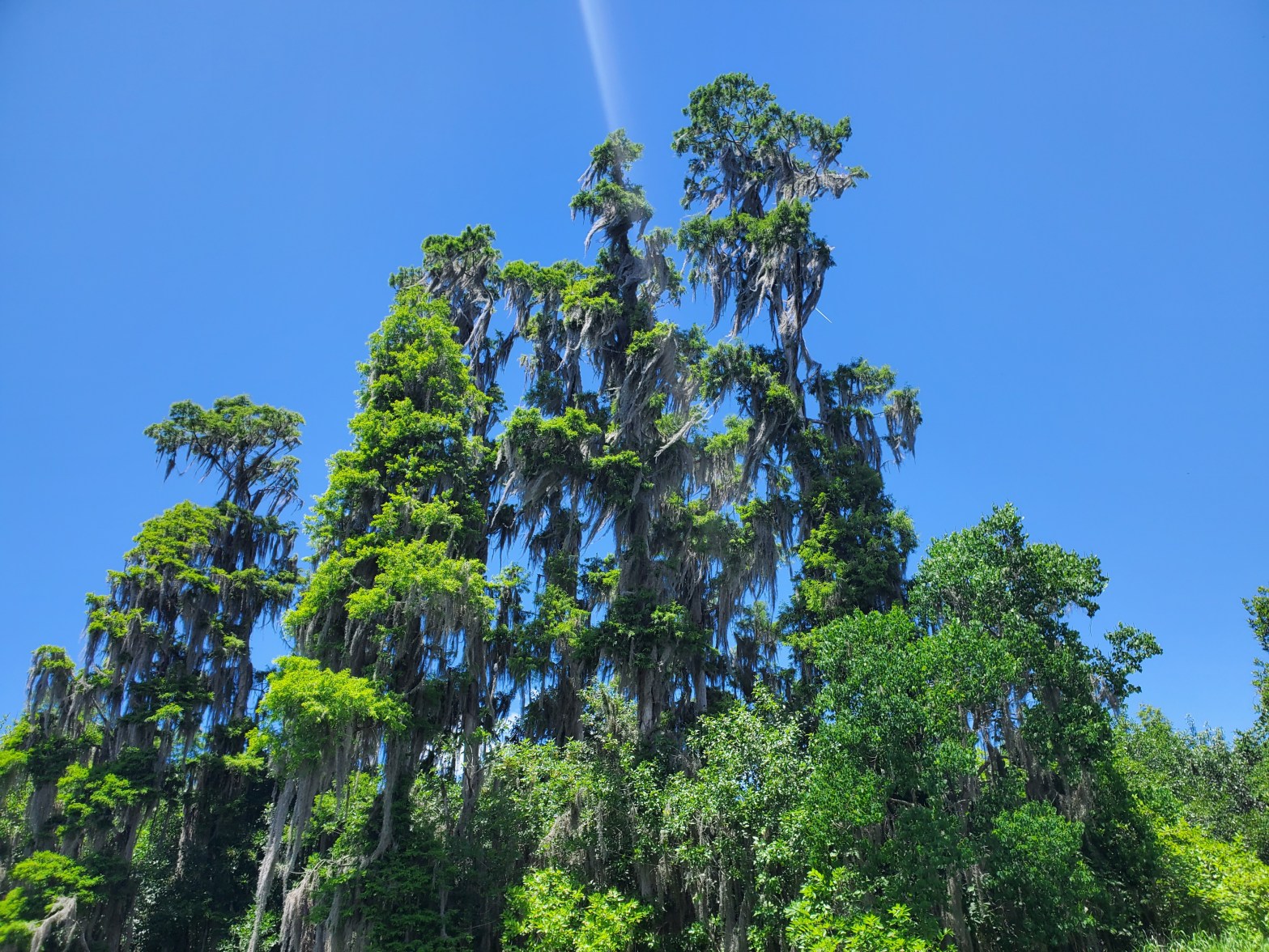
Anyone familiar with my site knows that I typically write about various wildlife species. This post will be a little different. I had the opportunity to do some work on the Peace River recently. While some wildlife will be discussed, of course, the river itself has some very interesting scenery and some rich history behind it. Florida is known for it’s many cities such as Miami, Daytona Beach, and Tampa where I currently reside. When people think of Florida, they usually picture beaches. While these shorelines are naturally occurring, most are lined with hotels, condos, bars, etc. In fact, it can sometimes seem like quite a task to find a natural area in Florida. There are some springs and other small places where Florida can be viewed in its natural state. However, I have yet to see somewhere that holds so much history in one place as I did on the Peace River. Aside from being a place of beautiful scenery, the Peace River is also a valuable part of Florida’s ecosystem. It starts just north of Bartow and extends 106 miles all the way to Charlotte Harbor. The fresh water it provides is vital to keeping the salinity of Charlotte Harbor suitable for the many listed species that live there.
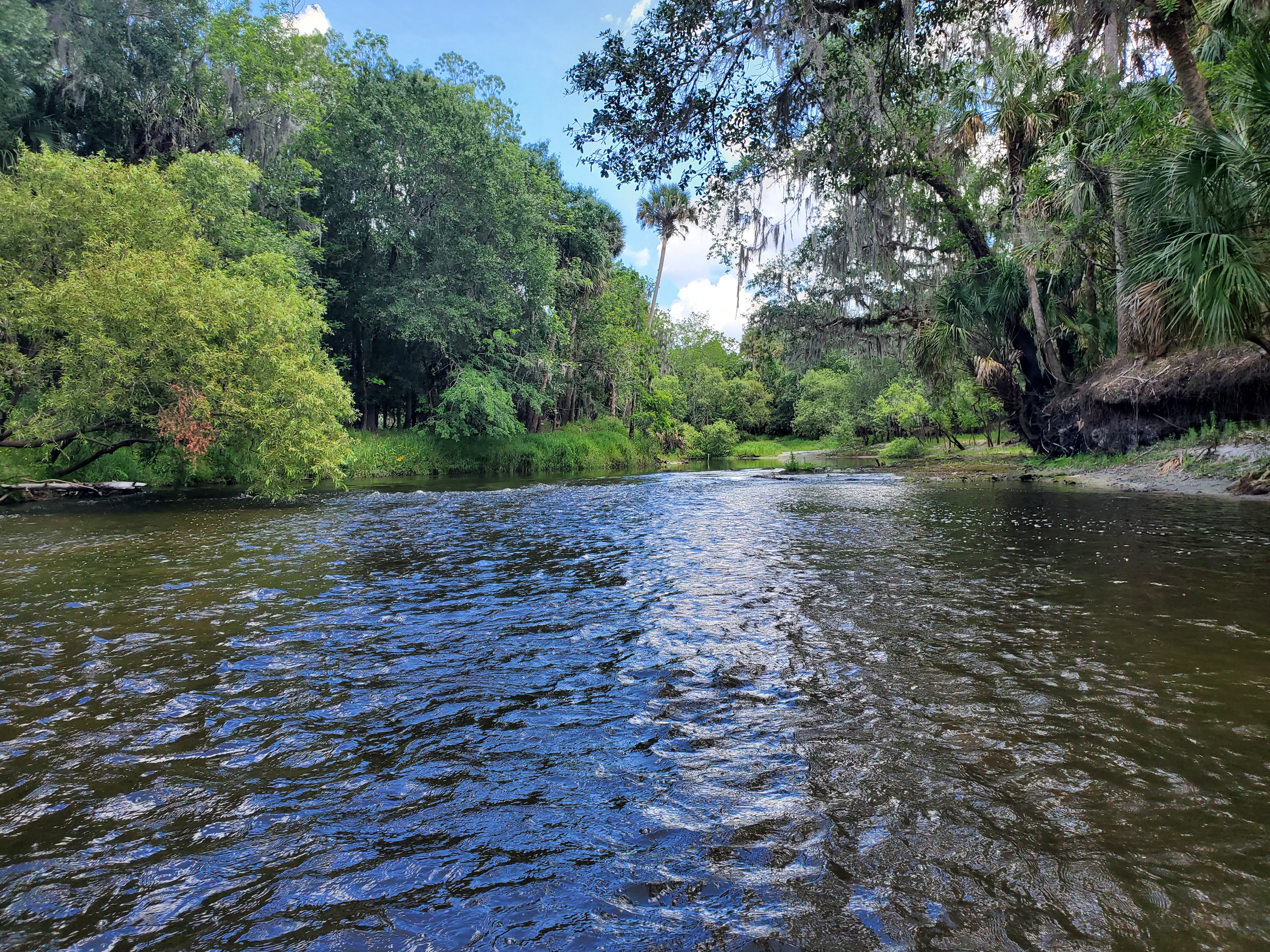
The name goes back as far as the 16th century when Spanish charts labeled it as “Rio de la Paz”, literally translating to River of Peace. It is aptly named, with the areas that we visited being far from heavily developed areas. The quiet in the air mixed with the babbling sounds of the water crossing the many shoals along the way was very soothing (the fact that I didn’t have cellular service through most of it was an added bonus). We used only a kayak and a johnboat with an electric motor, so we didn’t add much noise while we were out there.
You don’t have to look very far or very hard to see recent evidence of Florida’s natural history. What really stood out to me were the cypress trees. There are two species of cypress in Florida – the bald and the pond cypress. While the two species are easily distinguished by their different leaves, they are so similar in other ways that some botanists consider them variations of the same species. The bald cypress (Taxodium distichum) gets its name from the way it sheds its leaves very early in the fall. Those who consider the pond cypress a unique species would give it the scientific name Taxodium ascendens. When treated as a variation of the bald cypress, it goes by the name Taxodium distichum var. imbricatum.
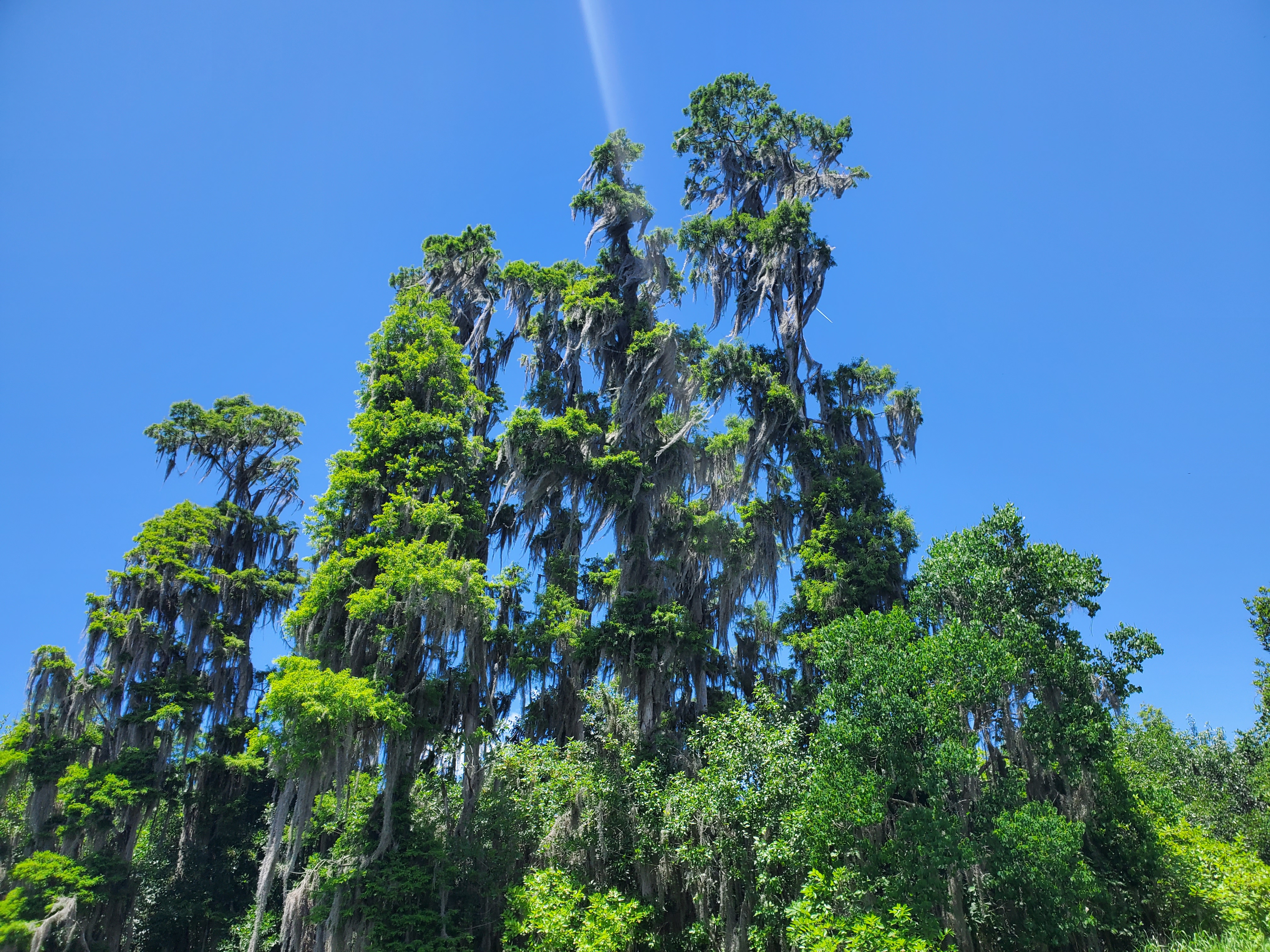
The genus comes from the Latin taxus meaning “yew”, another type of tree similar to cypress, and the Greek eidos meaning “similar to”. The species name for the bald cypress, distichum, means “two-ranked” and refers to the leaves which grow in two rows. As far as I can tell, the species name of ascendens for the pond cypress is derived from the Latin ad meaning “up” and scando meaning “climb”, perhaps a reference to these trees reaching nearly 60 feet. The variation imbricatum is a Latin term meaning “tiled”. My best guess for this one is that the fruit sort of looks tiled. But this is strictly a guess on my part as I have yet to find anything stating this.
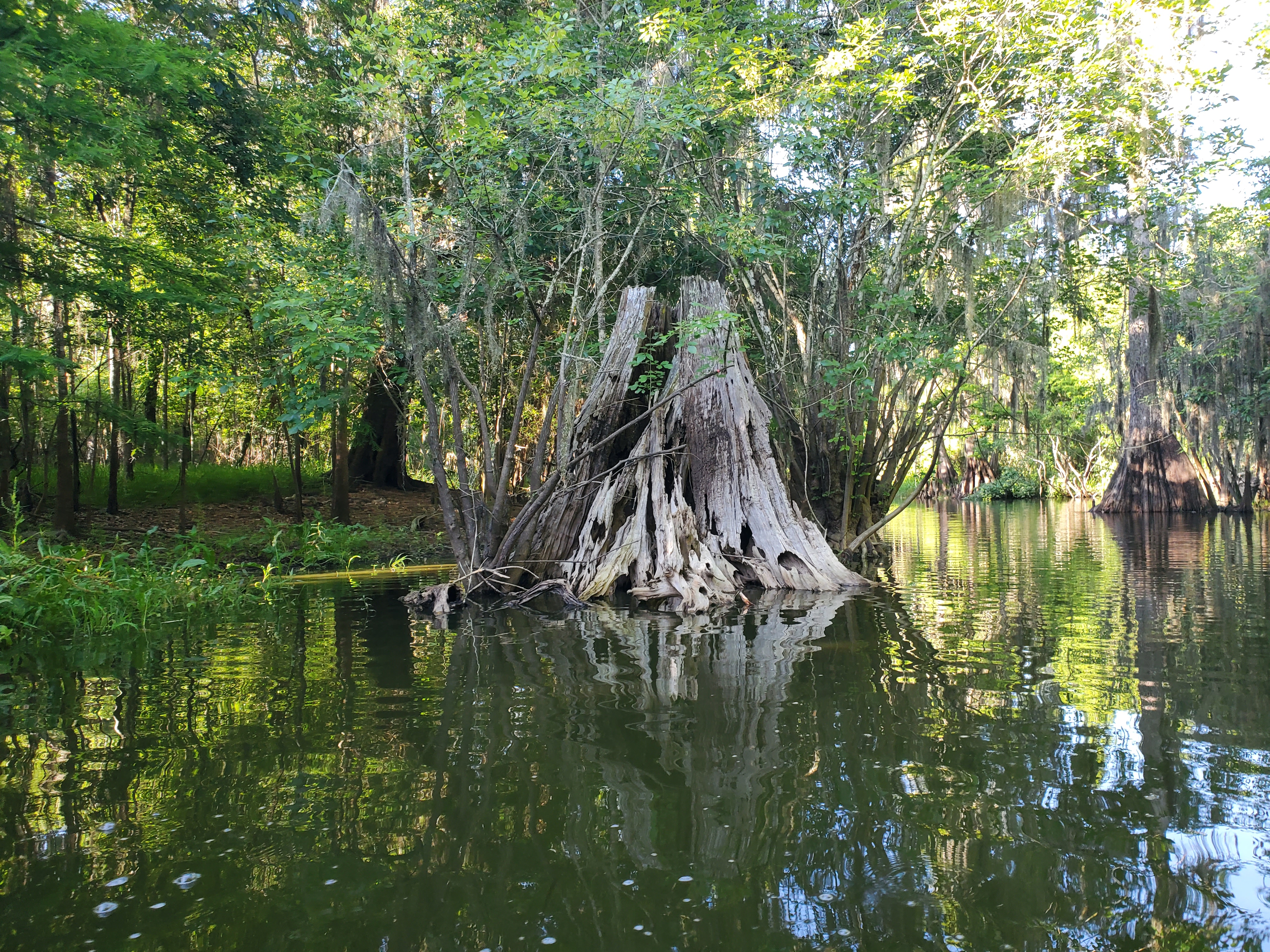
While the river is lined with plenty of these large, thriving trees, there are also remnants of the buttressed portions of trees that stood many years before. Seeing large living trees next to dead portions of equally large size, it is easy to see the rich natural history of this area.
I mentioned before that the Peace River holds much of Florida’s natural history and that the “recent” history is obvious. However, there are some areas where its prehistoric history can also be observed. Looking at the lush vegetation and fresh water, it’s easy to imagine it always looking this way. However, Florida has had a very diverse natural history from the days so dry that the Gulf of Mexico was a prairie that connected Florida to Mexico, to the days where the entire peninsula was underwater. The latter is evident just in the tourist attractions on the river.
A quick search for fossil hunting on the Peace River will show a variety of sites that cater to those looking to collect some prehistoric treasures. There are certain laws about collecting fossils in Florida. However, one type that is always legal to acquire (and is a popular one on the Peace River) is sharks’ teeth. That’s right – sharks’ teeth . . . in a freshwater river . . . in the middle of the state. I’ve found them just offshore in Venice Beach which isn’t very surprising. But it’s very eye-opening that they can be found in the middle of a giant peninsula. A coworker of mine also found what he and some of our fossil savvy colleagues believe to be the rib of a dugong – a relative of the manatee that now lives only in the Indian and southwestern Pacific Oceans. Again, it was very surreal to be on the river thinking that dugongs and sharks – including the megalodon – used to live in the area. My personal fossil-like finding was limited to an impression of a shell in the limestone shoreline.
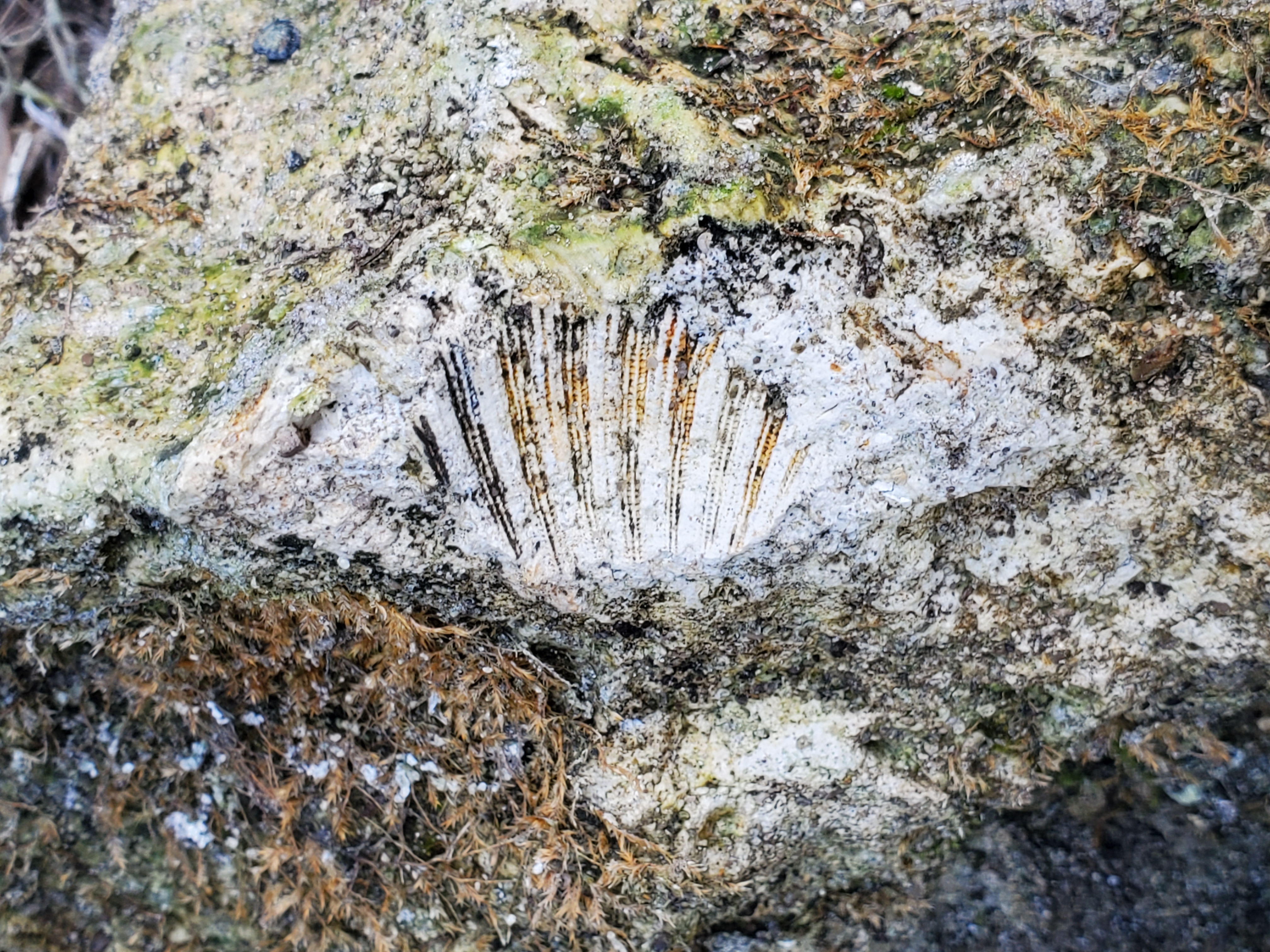
The limestone shoreline was another attribute of the river that was very unique. I didn’t have my phone handy in the areas where it was extremely obvious. But there were plenty of areas that had such a feature. I’m sure there is a very good explanation of how water began running through the soft limestone bedrock, eroding it away to form the river we see today. However, I am by no means a geologist, so I will stay in my lane and move on to the wildlife, starting with some tadpoles I saw utilizing one of the many warm water pockets formed by voids in the limestone.
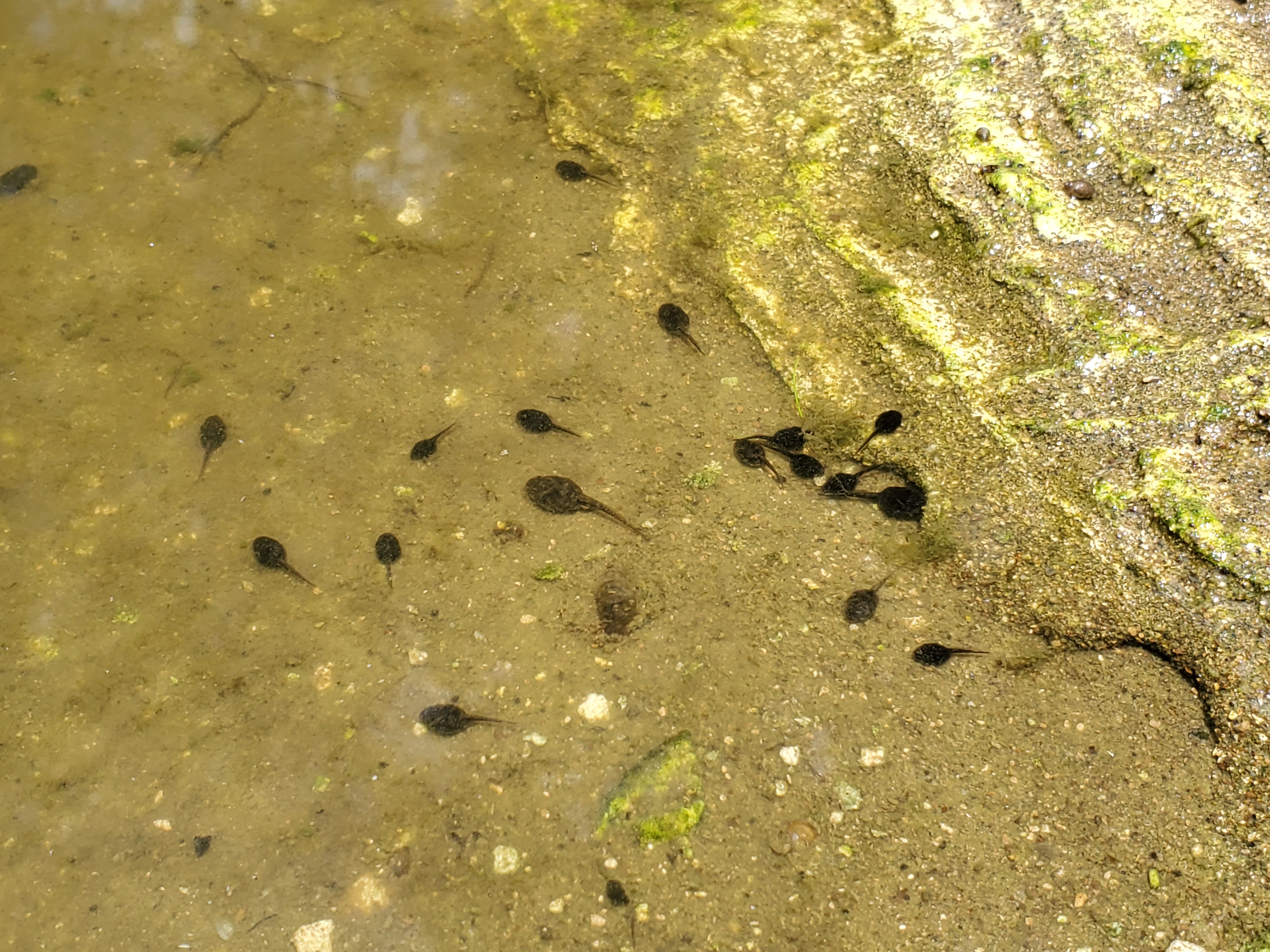
The name “tadpole” comes from the Middle English words tadde meaning “toad” and pol meaning “head”. My grandmother always refers to them as “pollywogs” which is derived from the pol for “head” and wiglen which means “to wiggle”. I don’t know enough about tadpole identification (and wouldn’t want to disturb them anyway) to be able to tell if there were different species here. However, I would guess that there are based on the different sizes. You can see one in particular in the middle of the photo that is quite a bit larger than the others. I think this might be a different species for a couple of reasons. First, it is my experience that tadpoles actually shrink as they mature. In fact, there is a frog known as the paradoxical or shrinking frog whose tadpoles are nearly a foot long but will shrink to a mere two to three inches. Secondly, I didn’t see any signs of limbs indicating that tadpole is in roughly the same stage of development as the smaller ones.
The limestone shorelines are extremely slippery. When available, I would constantly grab or lean onto the cypress trees for extra support. I learned very quickly to look before a put my hand down as there were often spiders on the trunks. Some were a little easier to see than others. This first one I had a hard time identifying. I honed in on the cephalothorax being large when compared with the abdomen and the coloration appearing to be a dark base with lighter markings. The best I could come up with was that this may be a canopy jumping spider (Phidippus otiosus). I’ll continue writing as if that’s what this is although, if a spider expert were to write me and tell me I’m wrong, I certainly wouldn’t be offended.
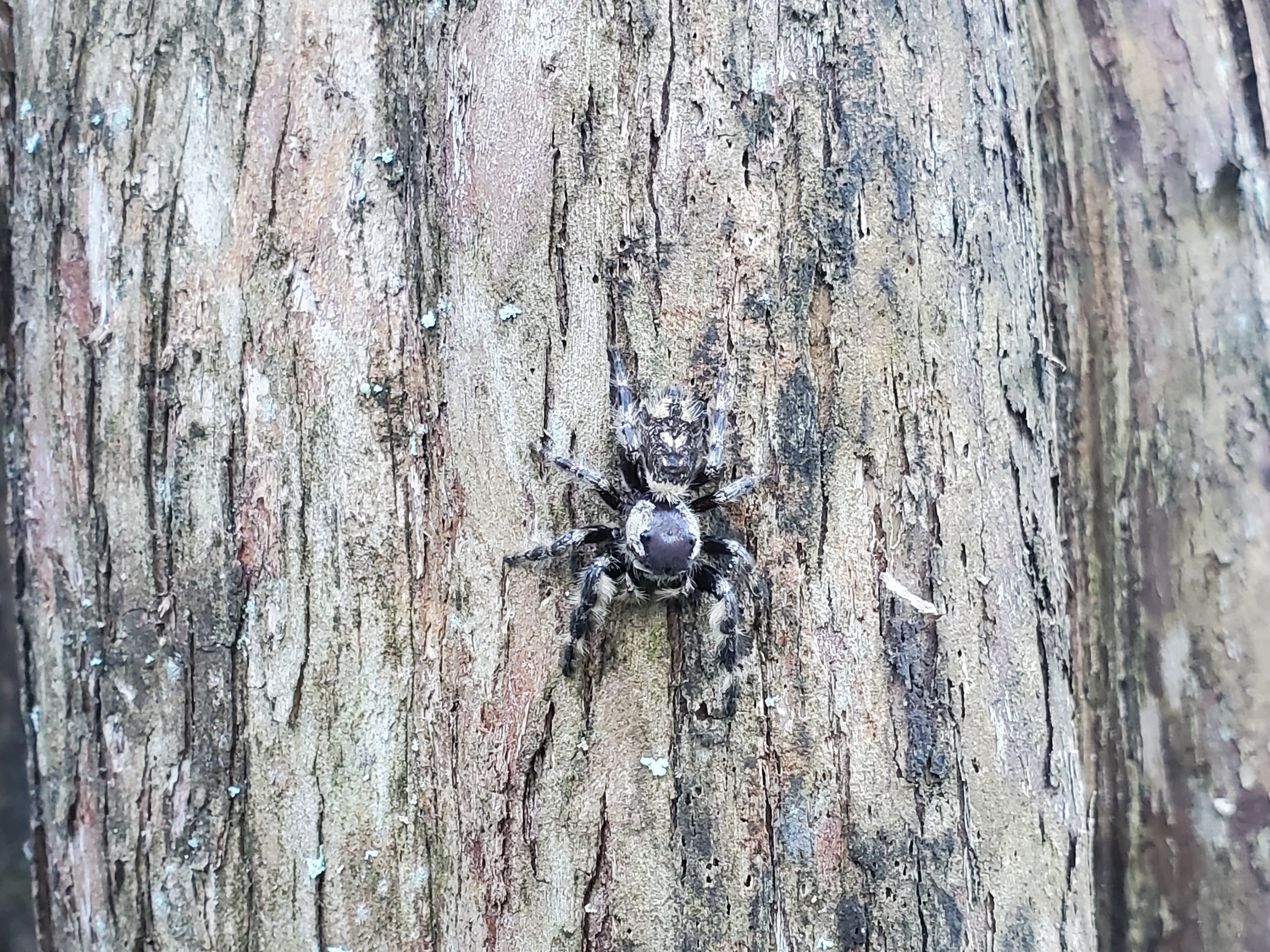
The scientific name for this one is one of the weirdest I’ve come to learn about. The genus is an Ancient Greek word that literally means “one who saves horses”. The species name is derived from the Latin otium meaning “peace” or “quiet”. and the suffix -osus meaning “full of” or “prone to”. So the full name basically refers to someone who is peaceful and saves horses. I do think it is nice to see such a lovely name attached to an animal that is, in fact, rather peaceful when you just sit back and watch it in its natural environment. I’m still not sure, however, how it saves horses.
The next spider was nearly invisible. I was thankful I looked before I put my hand down on this guy. I say that not for my sake, as many of the spiders here in Florida are not very venomous and wouldn’t hurt more than a bee sting, but for its sake so I didn’t harm it. Again, not being a spider expert, I did my best to identify it and I think it may by a white-banded fishing spider (Dolomedes albineus).
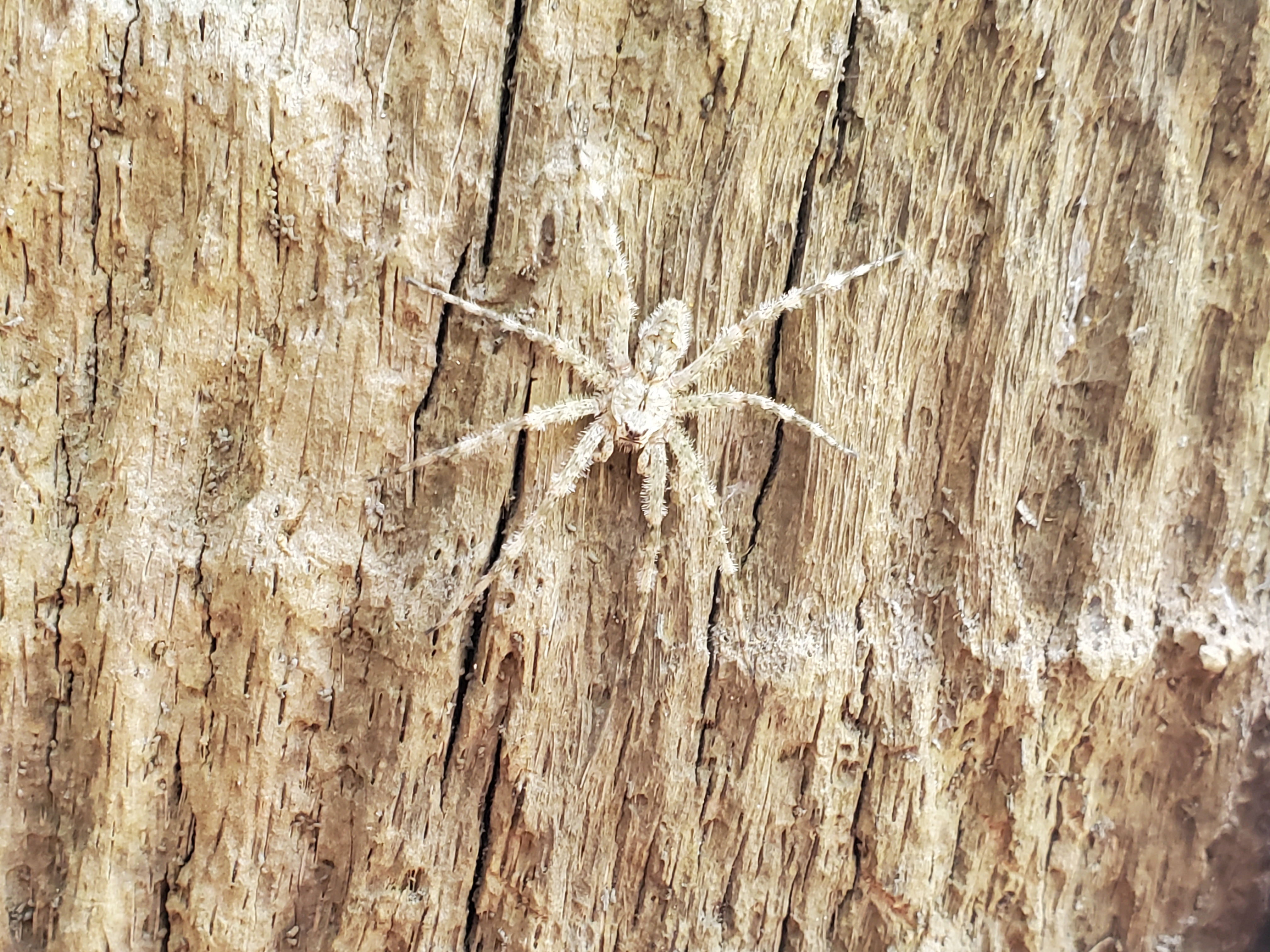
The most interesting thing about this spider is that it really does “fish” for tadpoles and aquatic invertebrates. It is able to walk on the surface of the water thanks to specialized hairs and is able to dive while hunting by trapping air bubbles in its abdomen. I couldn’t find the English spelling of the Greek word δολομήδης from which the genus name is derived. It does, however, translate to “deceitful” likely based on its hunting technique of hiding until it senses the ripples on the water of nearby potential prey. I presume the species name comes from the Latin albus meaning “white”.
This next bug was very easy to spot. Usually found on green vegetation, this one somehow became stranded on some old cypress driftwood. It’s bright green showed very easily against the drab brown background. Despite being very conspicuous, it did a behavior I had never seen before but that I presume is some sort of tactic to make it look like part of a plant. It was crawling around normally as in the first photo. However, after I approached more closely, it raised the front of its body up, tucked its front legs under the head, and stayed perfectly motionless for several minutes. As far as the species, based on the lack of black stripes and the blue spike, I think this might have been a tomato hornworm (Manduca quinquemaculata), the larva of the five-spotted hawkmoth. The closely related tobacco hornworm (Manduca sexta) would have black accents on the yellow lines across the body and would have a red spike at the tail end.
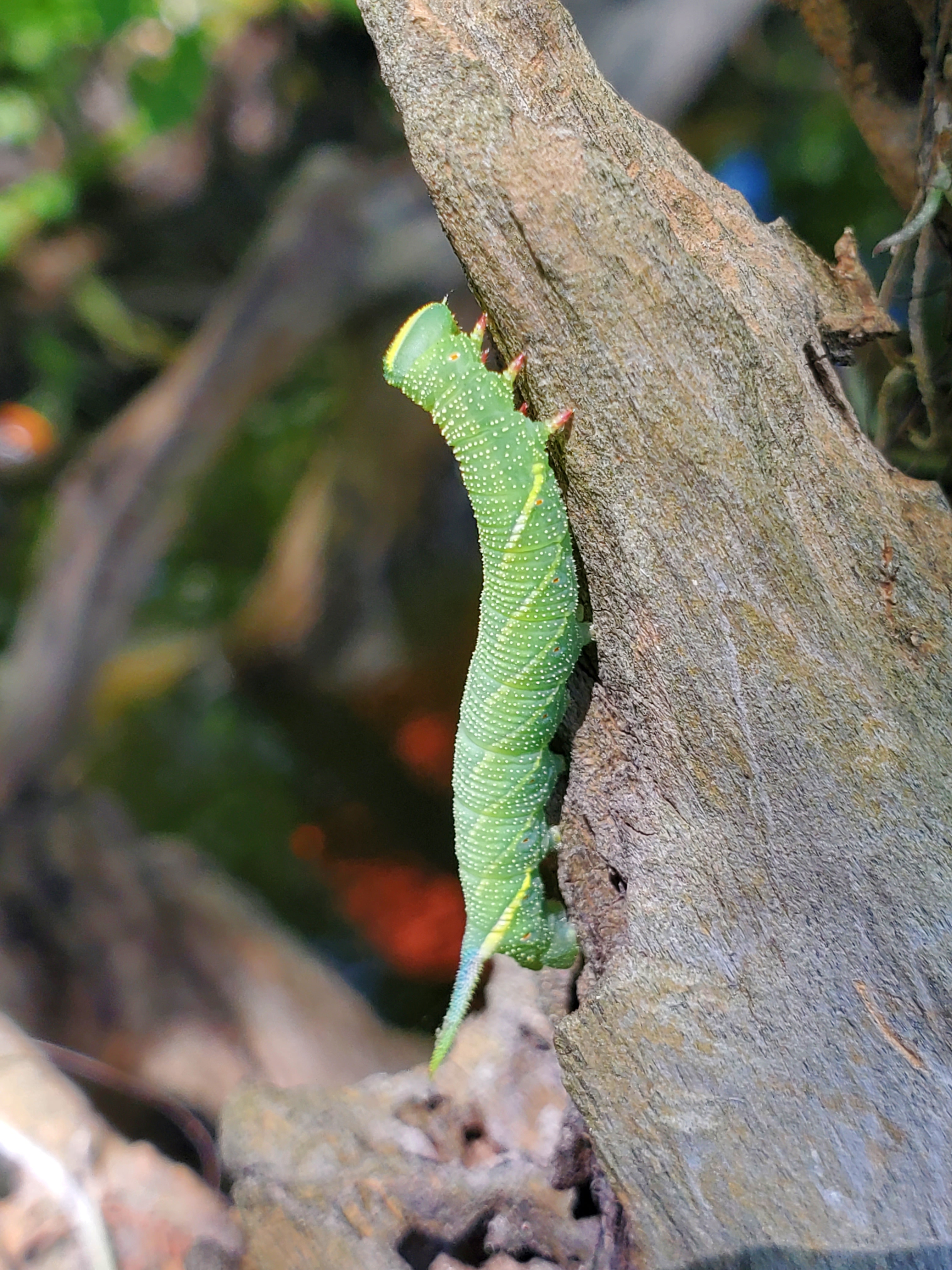
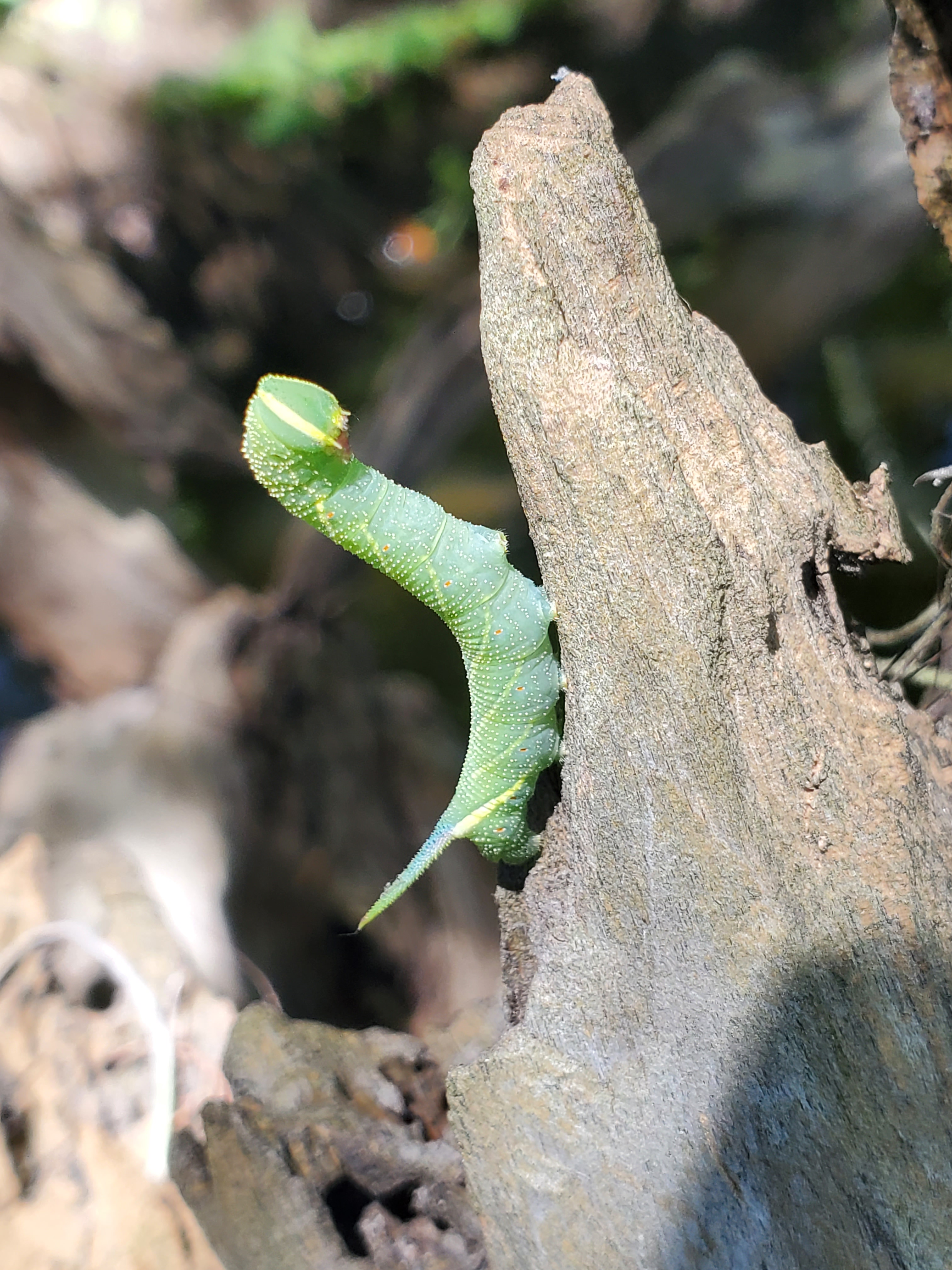
I wasn’t able to find anything on the origin of the genus name. However, as I was looking into it, I found out that the species of this genus are what’s known as a “model species”, meaning they are used to study certain aspects of biology. In this case, they are used to study aspects of microbiology. The species name comes from the Latin quinque meaning “five” and maculata meaning “markings”. This refers to the five markings on the abdomen of the adult moth. Likewise, the species name for the tobacco hornworm is the Latin word for “sixth”, as that adult moth has six abdominal markings.
This next one was very odd for several reasons. I’ve seen lots of caterpillars, but never one of this dark green and brown color. I tried looking it up on my own and it was a dead end. I enlisted the help of my supervisor who is somewhat of an insect expert. Even she was stumped for a while but eventually came to the conclusion that this is likely the caterpillar of a large yellow underwing moth (Noctua pronuba).
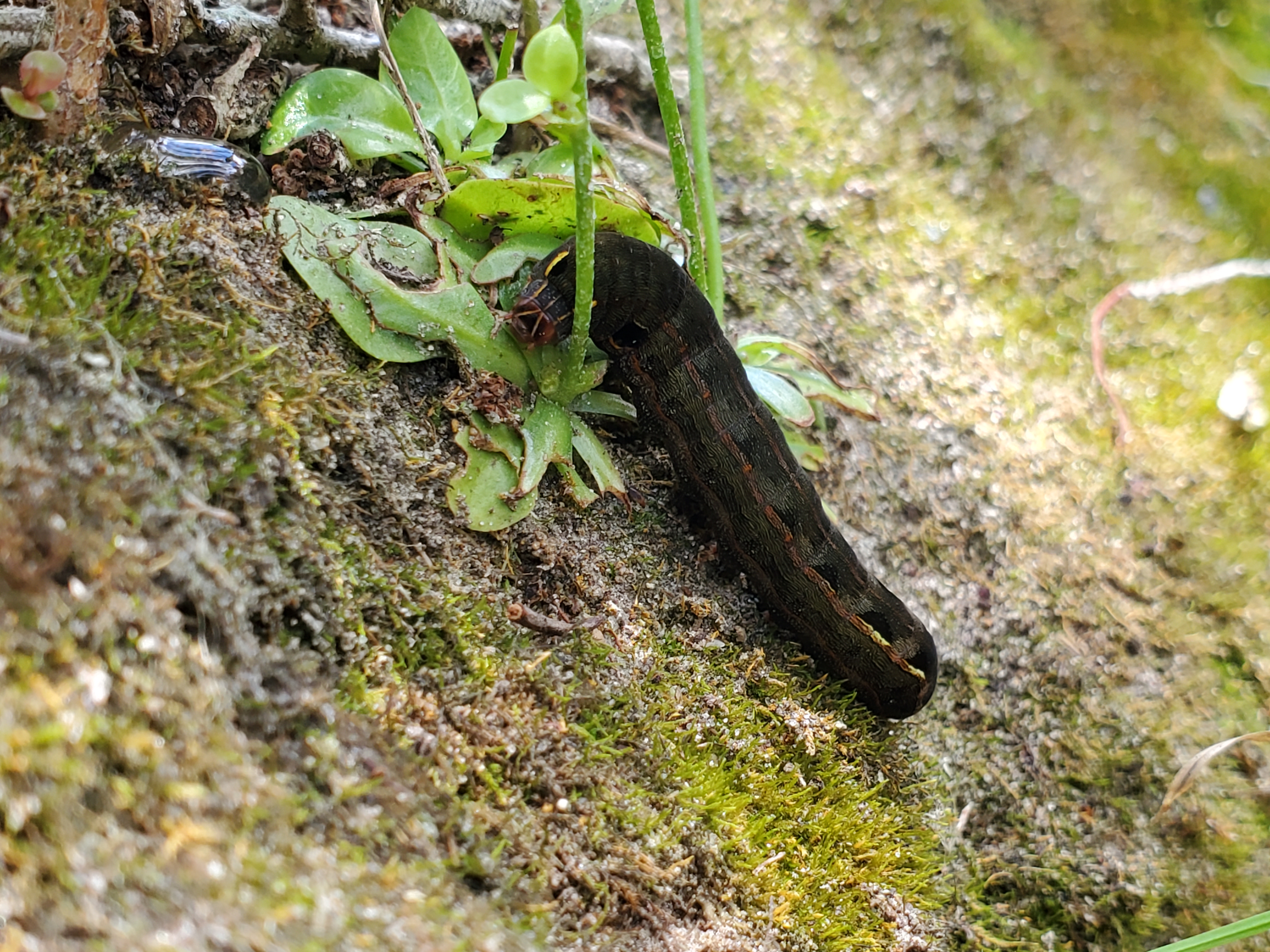
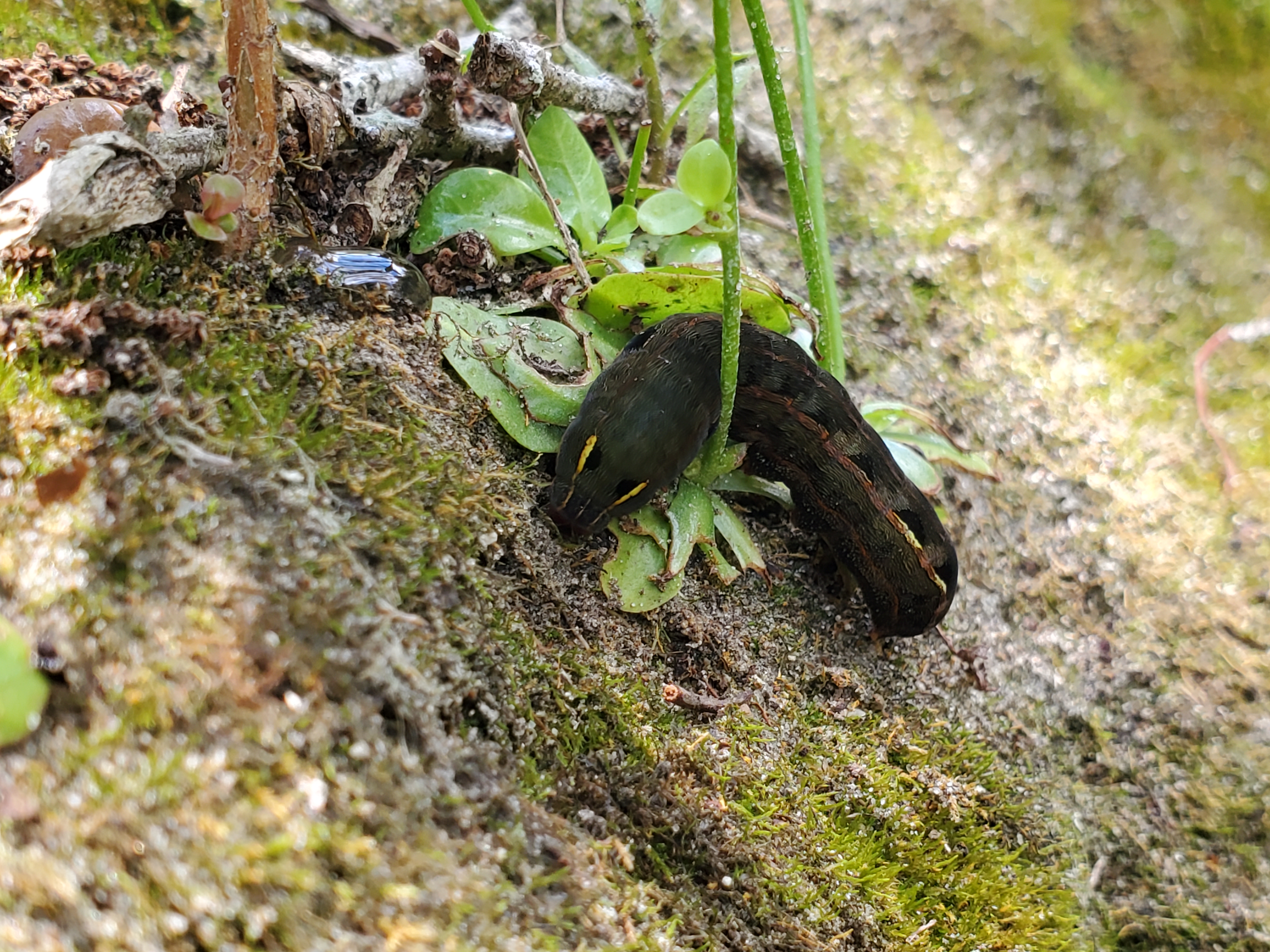
Although I’m not sure why it was chosen, the genus is Latin for “little owl”. The species is also a Latin term and means “for the bride”, an equally confusing origin. With only my phone available, and trying not to slide down the slippery slope, I took as many photos as possible to try to get every detail, including the eye spots which I thought for sure would have been a key feature when it came to identifying this one.
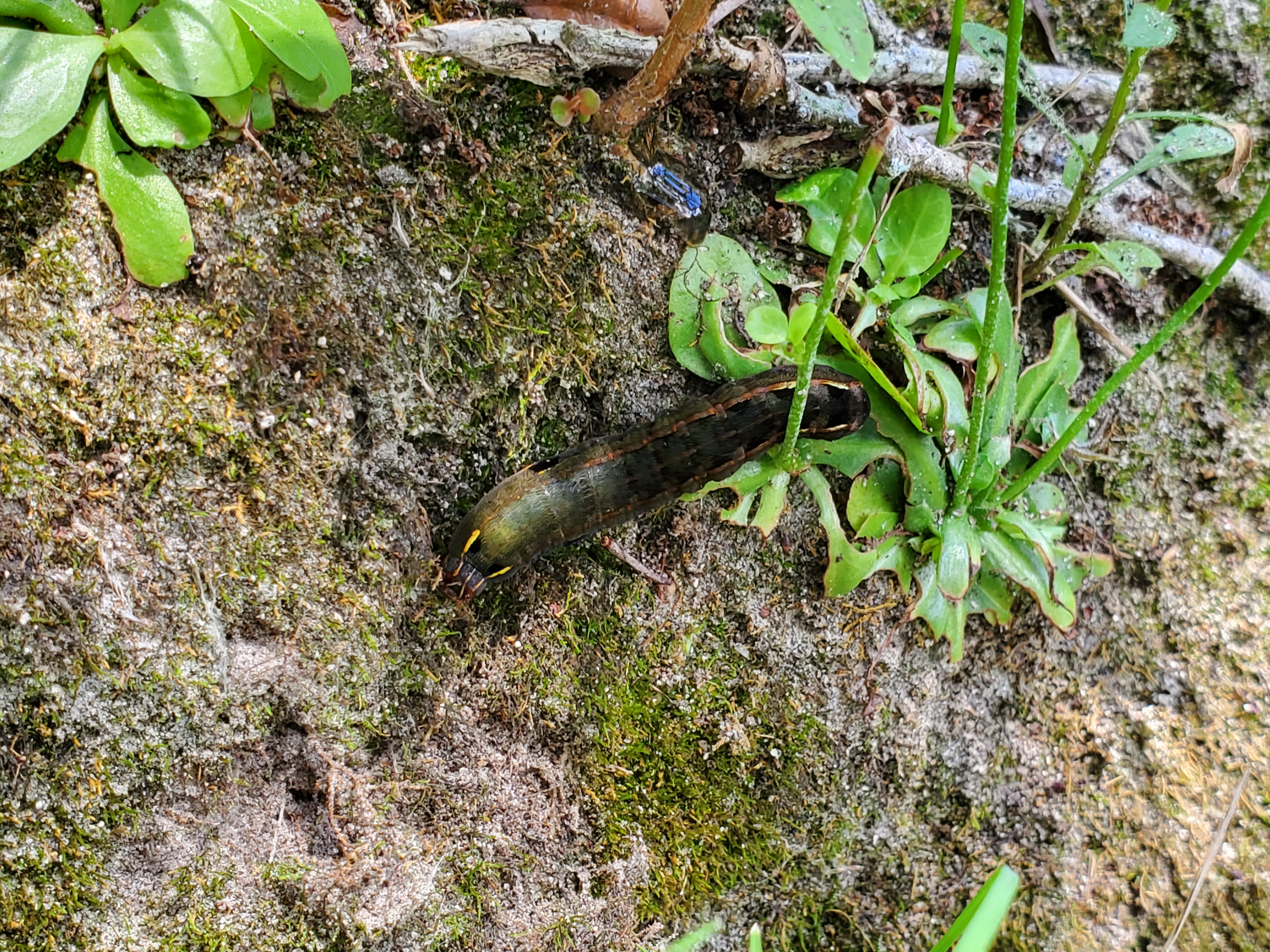
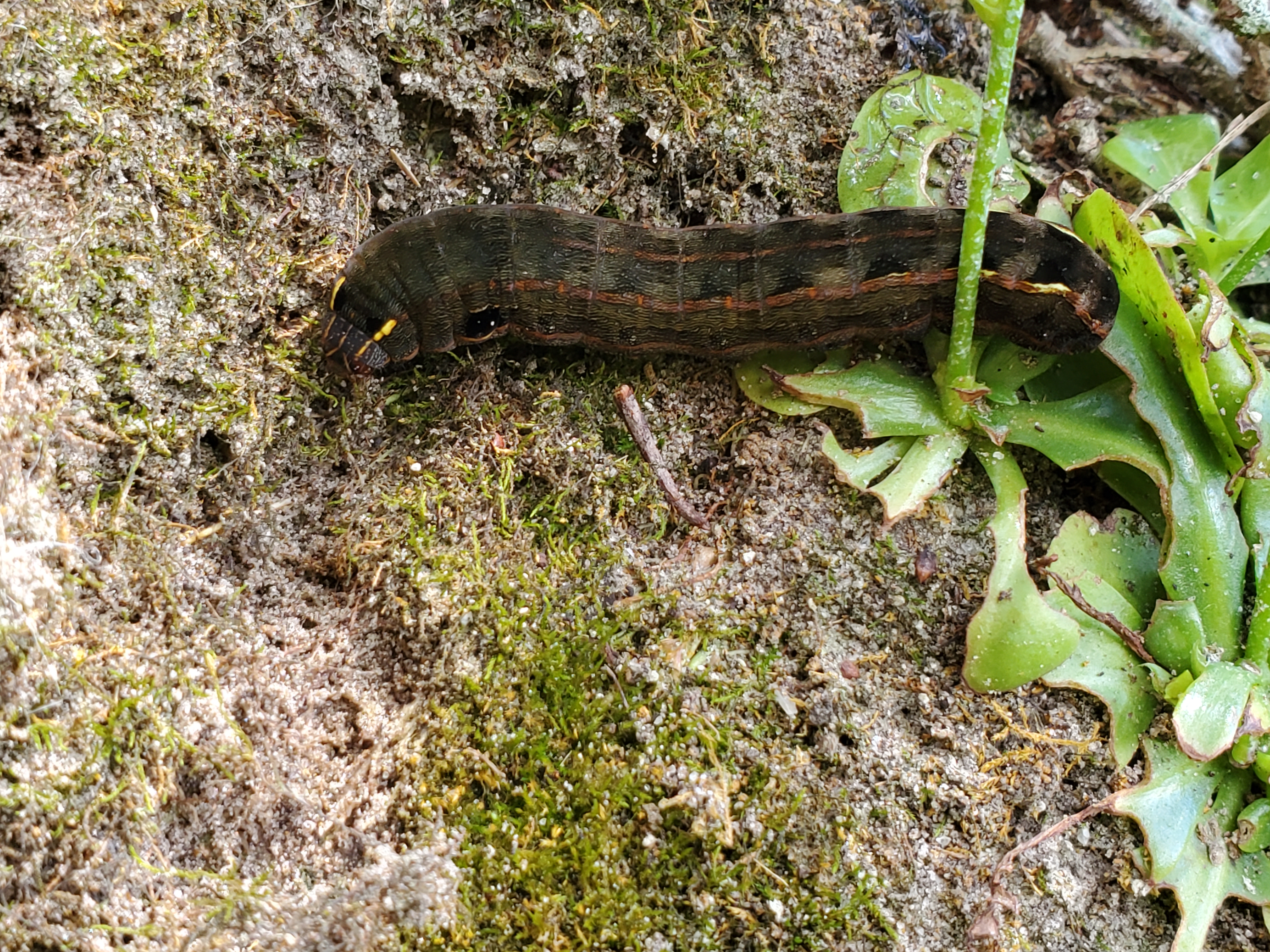
It turns out that the eye spots only occur occasionally. So, when I was focused on that as a key identifier, it didn’t lead me anywhere. Even after the identification (assuming we are correct), it is still very odd that I would have found this guy anywhere near Florida. It is native to the northern parts of Europe and Asia. It has been introduced to North America, first to Nova Scotia. It has made its way down to the US. However, it has yet to be documented in Florida. Florida has such a wide range of climates that many species found in the northern parts of the state tend to disappear further to the south. Since this was in the southern portion of the state (Florida is generally divided into north and south by State Road 50), I would find it very odd that it was found here and hasn’t been at least documented to the north. I’ve submitted the photos to bugguide.net to see if I can get a more definitive answer in case we are mistaken.
This next one is another one that I had trouble identifying due to its young age and lack of developed wings. However, my bug expert informed me that this is a round-headed katydid. I did some research and, from what I could find, there are two species in Florida that are very hard to tell apart without hearing their calls. However, based on the location, I believe this is a Florida false katydid (Amblycorypha floridana) as the other species, the oblong-winged katydid (Amblycorypha oblongifolia) is usually only found in the panhandle. Ordinarily I would prefer to photograph something in its natural environment rather than the finger of a coworker. However, this strong jumper leapt into the vegetation and immediately disappeared seconds after this.
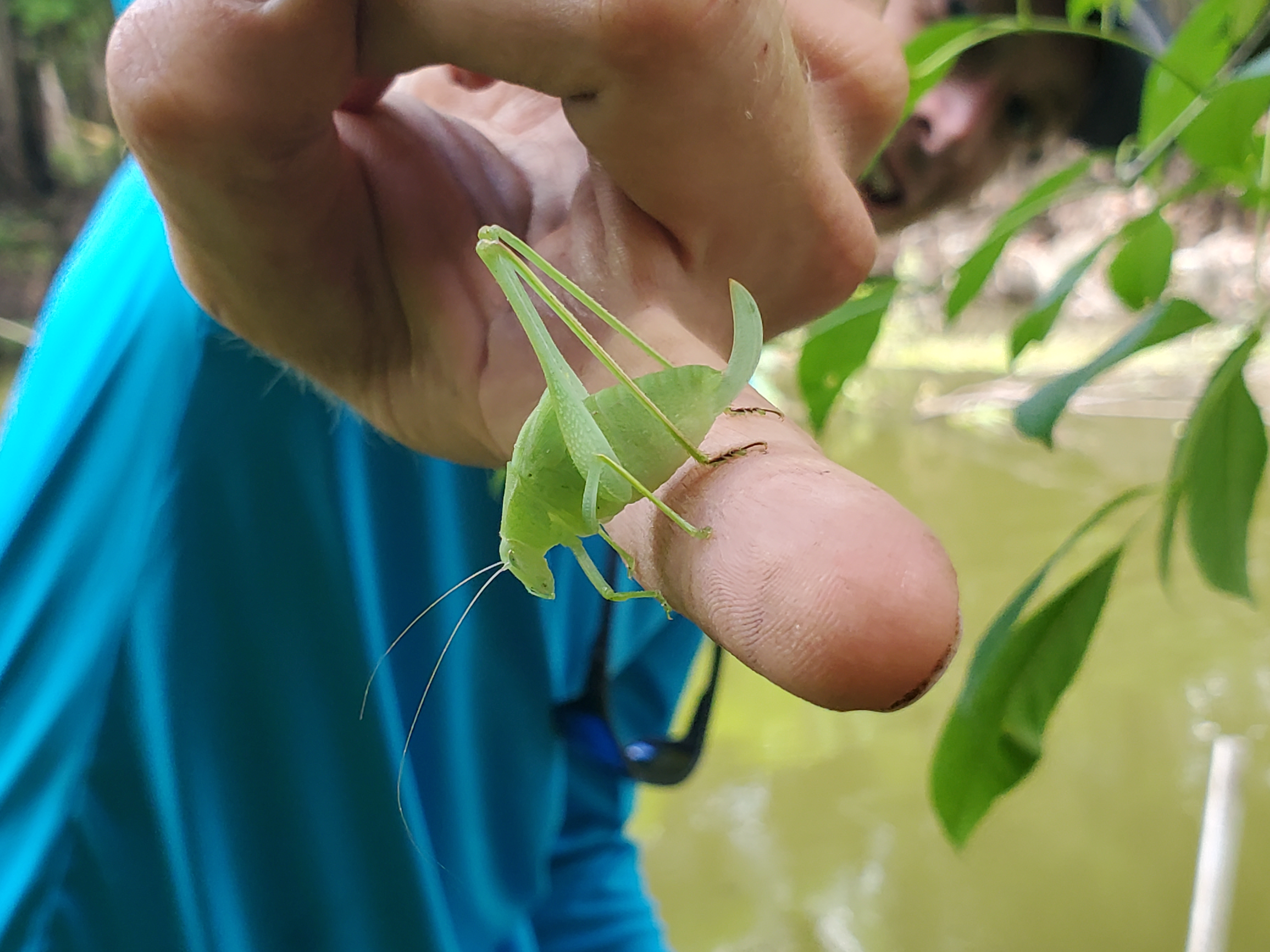
I couldn’t find much information regarding the scientific name, but I would presume the species name is attributed to this species covering more of the state than the other. The adult form looks more like you would expect when you hear the term katydid. So why is it a “false” katydid? Well, it’s not really. It is actually a true katydid but gets the name from the calls, producing more of a ticking sound than the “katy-did” sounds that are typical of other species.
I felt very fortunate to be able to work in this area that is still very much unaltered by humans. Recent events have made the world seem like a very ugly place. Part of my purpose of writing these is to hopefully inspire those that don’t get out and see nature very often to unplug from the rest of the world and do just that. If you are in the Central Florida area, I highly recommend getting out there and trying one of the many tours that are available, including swamp buggy tours which is something I have yet to experience myself.
 BJ Quinton