Ordinarily, I try to persuade people to unplug once in a while. So much time in our lives is spent behind a screen. From being on a computer at work to staring at our phones during downtime, people rarely just stop and look around to see what’s going on in the world around them. And, before I go any further, yes, I do realize the irony of saying that in a blog.
However, during a bird survey the other day, I had the chance to use some screen time to get a better understanding and a higher appreciation for nature. I pulled up to a site and parked in a parking lot. Almost immediately, a bird started attacking itself in my rearview mirror. I watched it for a while, amused at how it thought another bird was moving in on its territory. When I realized it was doing it repeatedly, I decided to try something out. My cell phone has a slow motion and, in this case, “super” slow motion option. What I found when watching it made me realize the crazy fast world in which some birds live.
First, a little about the bird itself. This is a palm warbler (Setophaga palmarum). The genus is a combination of the Greek ses meaning “moth” and phagos meaning “eating”. The species name is clearly a reference to the “palm” in the common name. However, they aren’t just found in areas with palms. It just so happens that they were first named on the Carribean island of Hispaniola, which has a lot of palms.
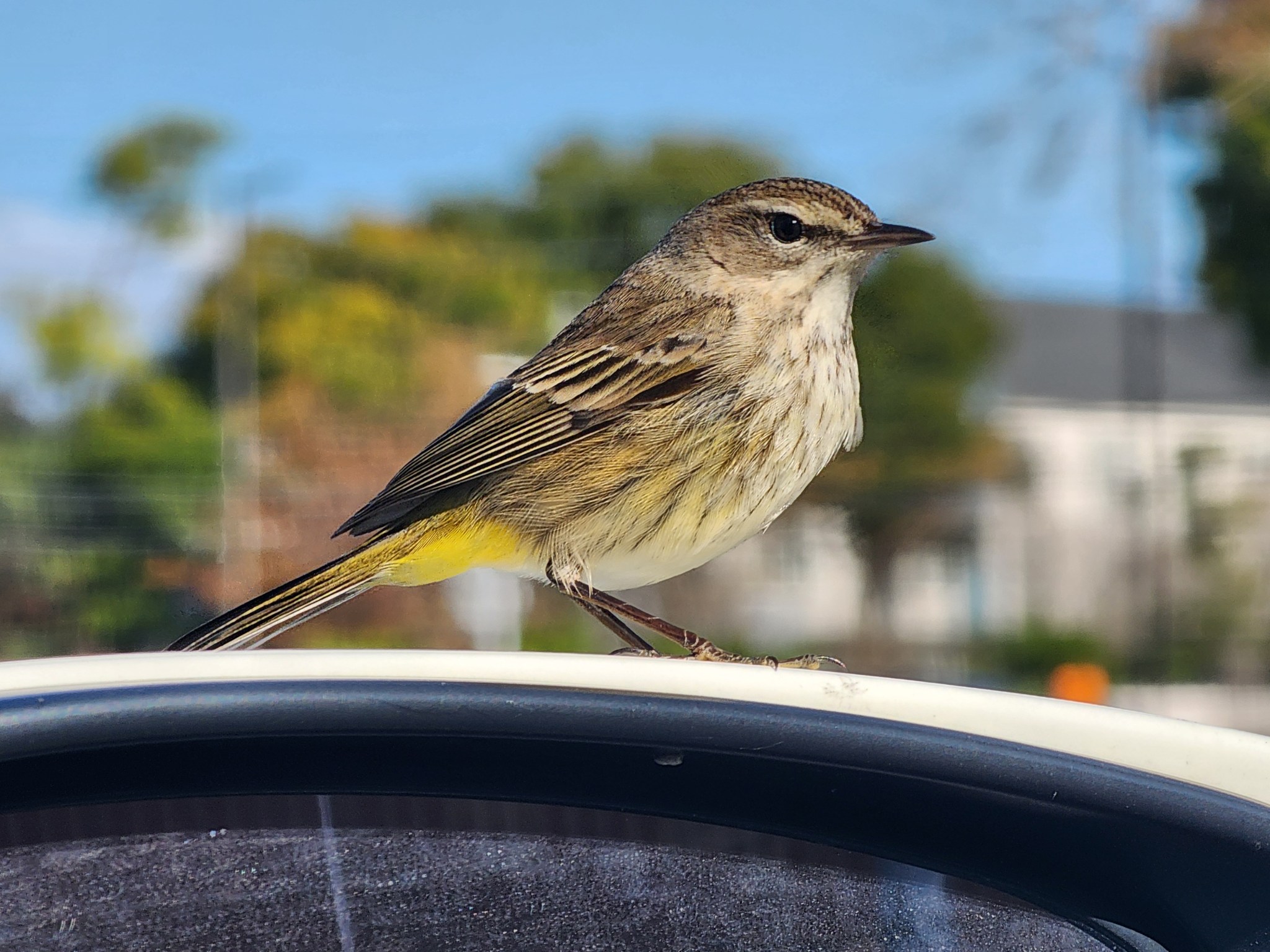
The following video shows what I saw several times while observing this guy. Clearly it was attracted to the mirror. I figured it was just running into it, then correcting itself to fly up to the top of the mirror. At this regular speed, it doesn’t look like there’s much to see.
The following series of videos show a much more interesting story. A quick disclaimer – these were recorded separately from the above and do not represent a slowed down version of it. A couple of interesting things can be seen here. First is just the mechanics of flight in birds. You can see the way the primary feathers spread during downward strokes of the wings, allowing them to sort of “swim” through the air. Even the tail will spread as it bobs up and down, controlling the angle of the body and helping slam on the brakes as it approaches the mirror. Then, of course, you can see the attacks as it tries to make contact with both the beak and the feet.
As an added bonus, I was also able to capture it taking off from the mirror. These were actually hard to get because the super slow motion only captures about one second in time. So I had to be lucky with the timing with which I pressed record. I did get lucky with this one. First, much like the bats that I shared before, a slowed down look shows that there is an initial push that you don’t usually notice. This is followed by a couple of flaps to get some momentum and lift. Surprisingly, after this, the bird then tucks its wings and lets gravity take over. This happens so fast, that I didn’t notice the tucking of the wings in real time.
So, again, I always encourage everyone to unplug and get out once in a while. However, if you do have the opportunity to film something happening extraordinarily fast and can slow it down, you just might find something fascinating and learn something while you’re at it!
 BJ Quinton