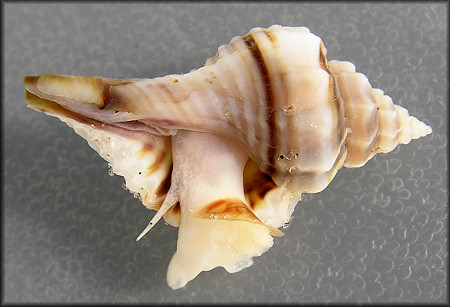
To quote Monty Python…and now for something completely different. Shells in a wildlife blog? Well hold on, John Cleese, it’s not so different after all. Seashells are more than just something she sells down by the seashore or something that adorned toilet seats in the 80s. What many people don’t think about, or maybe don’t even realize, is that every shell you see at the beach is a remnant of what used to be a living creature. There are two main categories of these animals, which is one of the reasons I called this “Part 1” (besides the fact I hope to continue collecting and learning about different shells in the future). One of these is a group known as gastropods, a term meaning “stomach foot”, that will be the subject of my next post. This one will explore the other group, the bivalves.
The term “bivalve” comes from the Latin bi, meaning “two”, and valvae, meaning “leaves of a door” (“leaf” being an older term for the door itself). Bivalves include clams, oysters, mussels, etc., which house the living part of the organism between two similar shells. So, when you find a single bivalve seashell, that is actually just one half of the exoskeleton of the animal. What follows are some photos of shells I have collected during shorebird surveys and just out on my own. What I hope is that showing these shells as remnants of living things will create an elevated appreciation for both them and the animals they came from.
I’ll start off with some of the larger ones that we find here in Florida. For the larger ones, I used a penny as a scale. Most of the other ones are much smaller and vary in size, as can be seen by the varying detail in the background. This first one is known as the Atlantic giant cockle (Dinocardium robustum).

I really went down a rabbit hole trying to learn where the scientific name came from for this one. From what I can gather, dino is from the Latin deinós meaning “something large and terrifyingly great”. Cardium seems to have the same root as cardio, referring to the heart. This is likely due to its large size (my example is actually rather small but most larger ones are broken upon reaching the shore) and the two shells forming a heart shape when viewed from the side. The species name likely also refers to the large size.
Since this species does have such a large shell, it provides a good opportunity to talk about the anatomy as well. You may have noticed that I said earlier that bivalves are housed within two similar shells. I didn’t say identical because many of them are not identical. In fact, as is the case of this cockle, they actually have a left and a right side. To know which it is, you’ll first have to know some basic anatomy, which becomes a little more obvious when viewing the other side.
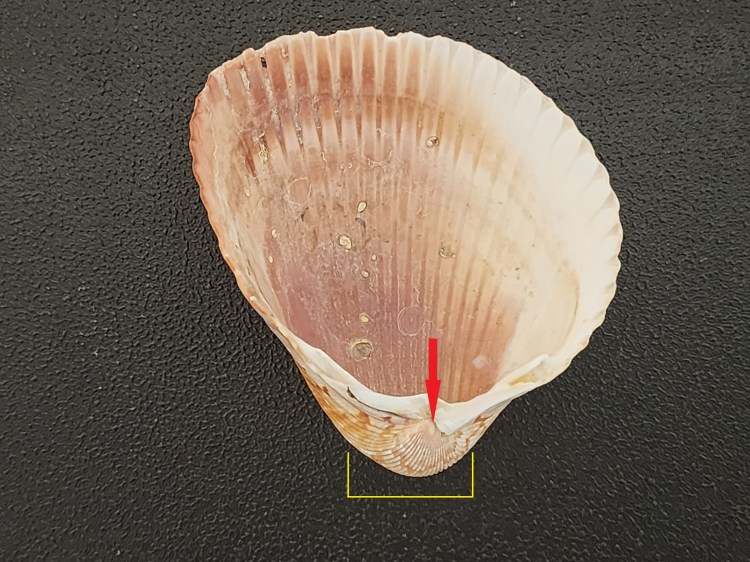
The portion of the shell where the ridges all start to come together (yellow box) is known as the umbo. The endpoint of this umbo (red arrow) is known as the beak. If you had the complete animal, you would rotate it such that the beak was pointing down and away from you. This would tell you which side was the left or right. If you can imagine rotating this one into such a position, you’d see that this would be considered the right side.
Another rather large shell that is very common along the coasts of the southern half of Florida, and popular among beachgoers who like to create sand sculptures, is the stiff pen shell (Atrina rigida).

Researching the scientific name of this one was a bit difficult because Atrina is actually a human name typically given to girls. I did find that this name apparently means “holding wealth”. I presume the species name (much like the common name) refers to its rigid nature. I see so many shells during my walks on the beach that I am very picky which ones I collect. I always try to get the most flawless specimens I can. You see this one is cracked and has some remnant barnacles. This is actually the nicest one I’ve come across so far. The shells may be rigid, but they are very thin and break easily. Furthermore, this species lives with its umbo in the sediment with the rest of the body above, filter feeding with cilia that also pass the water over the gills. It’s also sessile, meaning it’s a great target for barnacles, sponges, and corals to attach to which, in turn, camouflages the animal. Therefore, I’ve found it very rare to find a perfectly clean pen shell.
This next one was a little bit tricky, but I believe it is the southern quahog (Mercenaria campechiensis). Family Guy fans will chuckle now knowing why the citizens of Quahog go to a bar called The Clam.
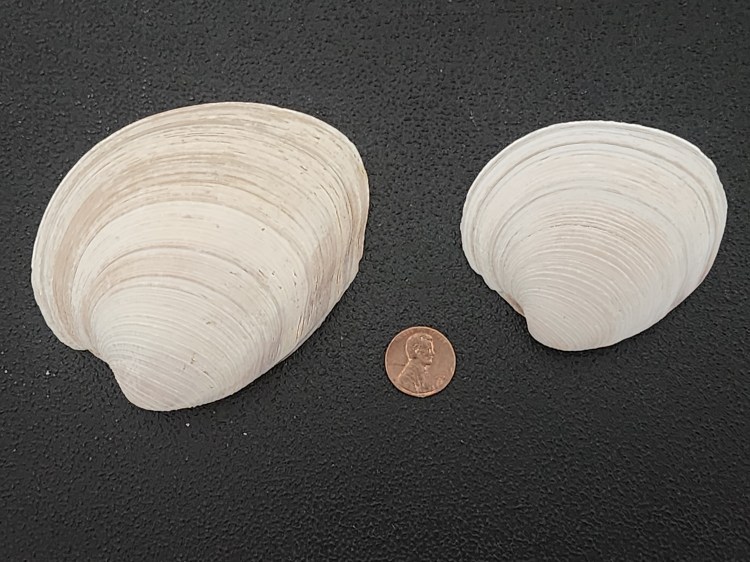
This is another one whose scientific name was difficult to figure out. In fact, I came up empty. When it comes to the genus, an absolute guess would be that is related to a “mercenary” as someone that does work solely for money and quahog pearls being very rare and expensive. The pearls of quahogs are formed differently than those from, say, an oyster. The interior lining of an oyster shell is made of something called nacre. When a foreign object gets in, the oyster will protect its body by secreting nacre around the object, giving it a smooth covering eventually forming a pearl. Pearls of quahogs are not considered real pearls because they are not made of nacre. The process is similar, but only around 1 in 5,000 quahogs will produce one, making them very rare. Quahogs also have a purple tint along the edges of the interior of their shells (something that may have bleached out of mine, unless I misidentified them) which is believed to be something that binds to the calcium carbonate of the shells, making them stronger in these areas. The resulting pearls will sometimes have this purple color as well.
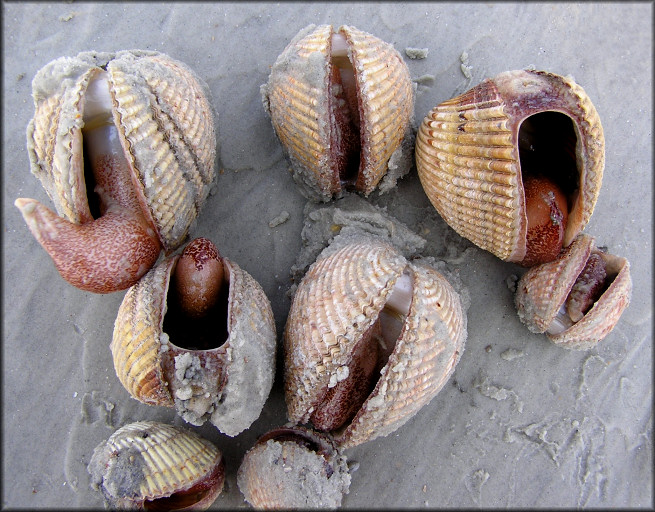
From here on, the shells are smaller but, in my opinion, get a little more interesting. I’ll start with another much smaller cockle. This is the Florida prickly cockle (Trachycardium egmontianum). This photo below has three right shells and one left.
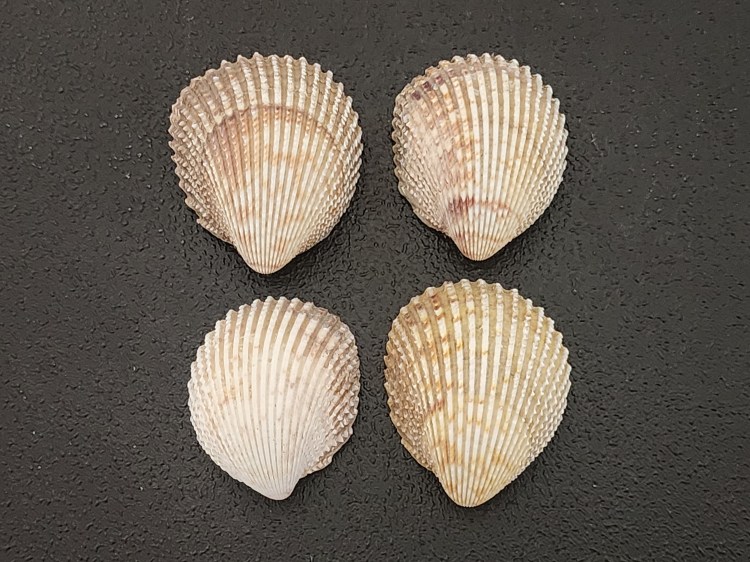
This is another one where the origin of the scientific name remains a mystery. However, we do have an Egmont Key here in Florida, so I wonder if that may be where these were first discovered. I see a lot of these in great condition since the shell is so hard. I imagine they get the name prickly cockle from the ridges along the ribs, visible on the edges of the shells in the photo.
This next one I believe to be a transverse ark (Anadara transversa).
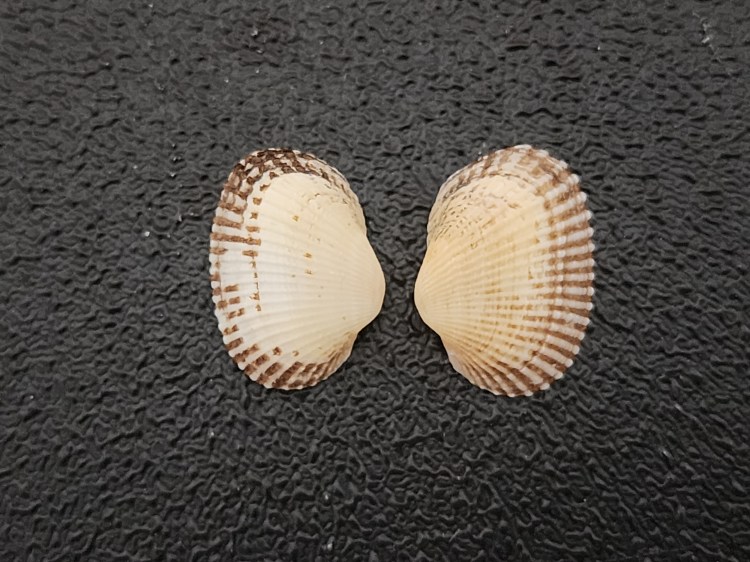
Here you can clearly see the left and right halves as this was actually still intact when I initially found it. However, the hinge was very weak, and it broke apart by the time I got it home. The brown portions are remnants of something called a periostracum, an organic coating that protects the animal’s shell from corrosion.
This next one is pretty easily identifiable as a type of Venus clam known as the calico clam (Megapitaria maculata).
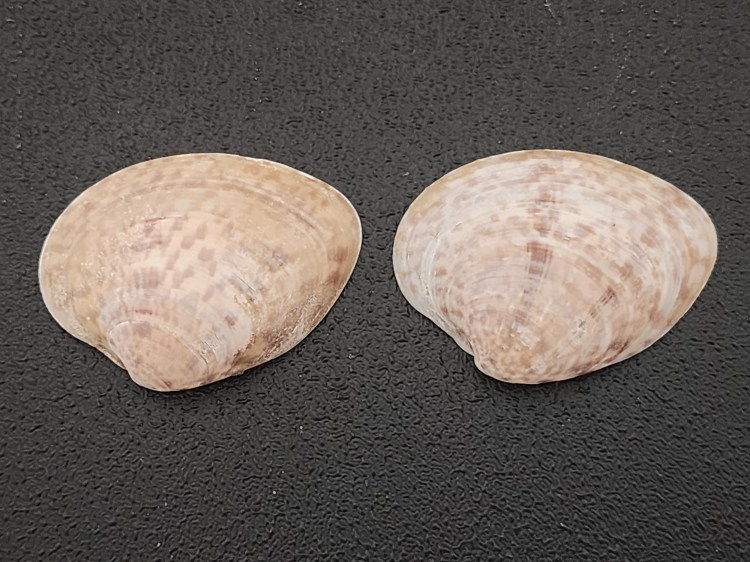
One thing I’m finding as I learn about these species is that there isn’t a whole lot of information out there. The calico clam is no different. The only somewhat interesting fact I found is that they have been protected from harvesting in Bermuda since the 1970s.
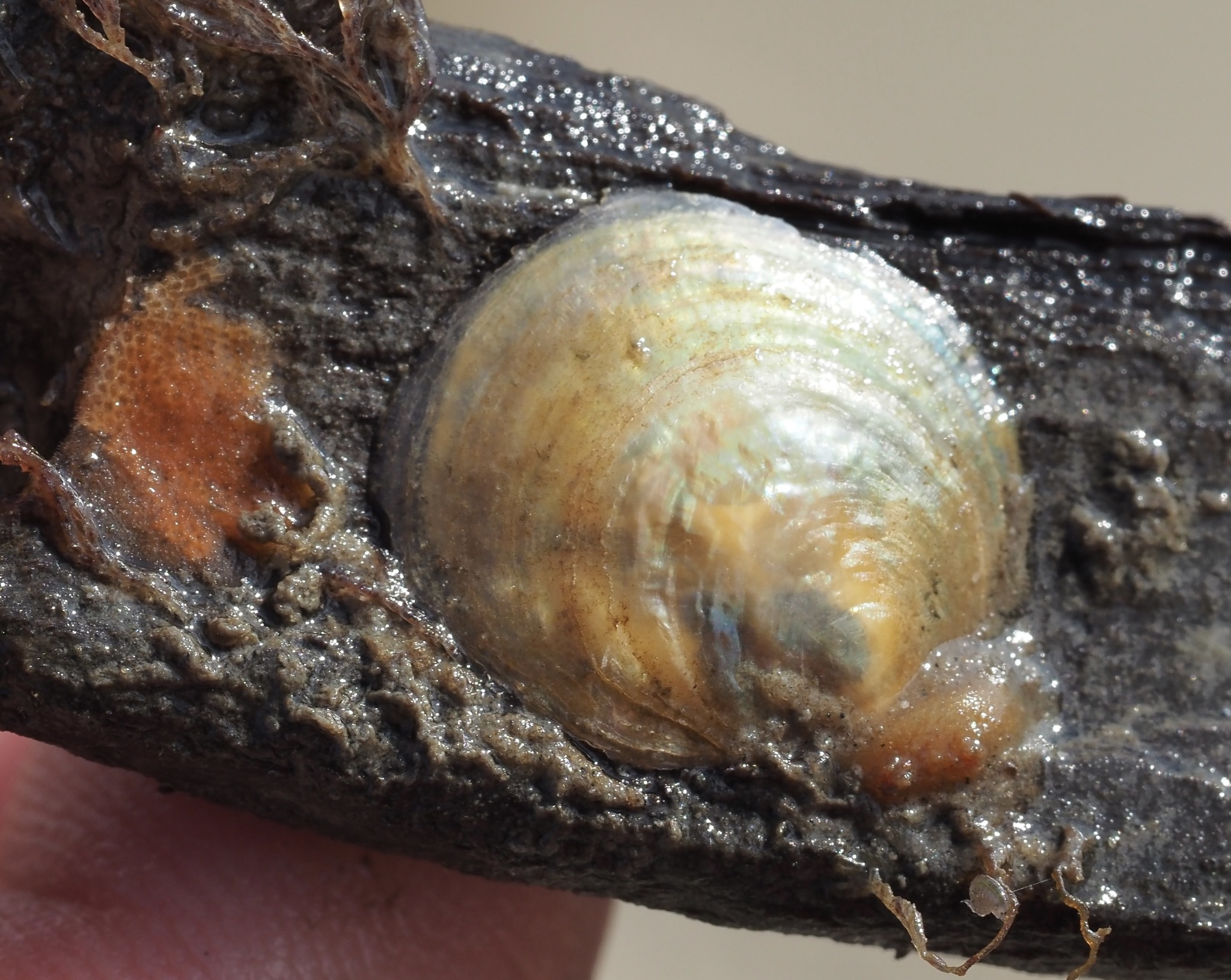
These next shells are very different from most. Sometimes I even mistake them for pieces of plastic. These are common jingle shells (Anomia ephippium).

Unlike other bivalves with similar, yet mirrored shells, the two shells of jingle shells are different in shape and function. The top shell is convex and moves to produce the cilia for filter feeding. The bottom shell is concave and functions as the base which anchors to the hard substrate upon which the animal will live its entire life. I don’t know if it is related to the genus name or not, but I did learn that anomia is a condition where someone recognizes people or objects but does not remember their names.
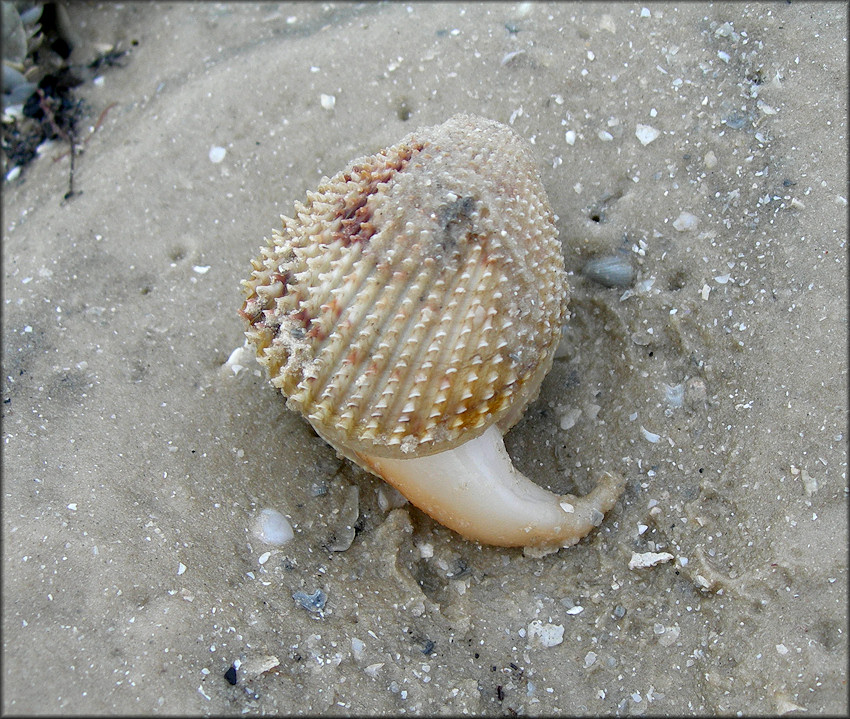
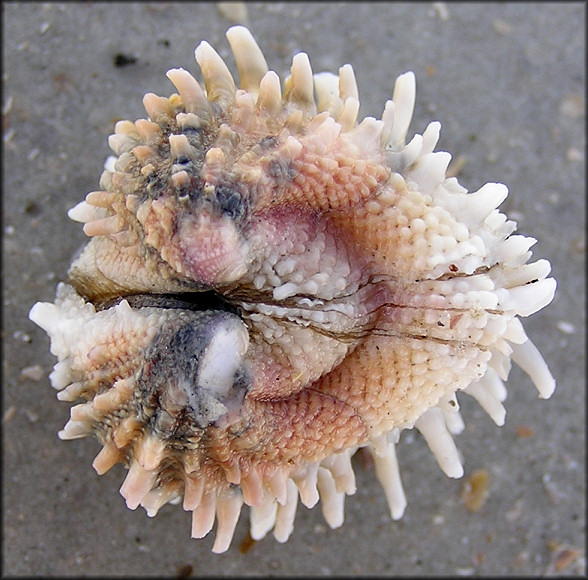
The next few shells are some of my favorites as they are very unique and sometimes rare. This first one is known as the Florida spiny jewelbox (Arcinella cornuta).

I was very lucky to get one of these that was still together and still had the mostly prominent spines. Most of them I find look like the two at the bottom, worn down from the journey to the shore. This particular bivalve is part sessile and free-living, attaching itself to a hard substrate as a juvenile, then breaking free as an adult.
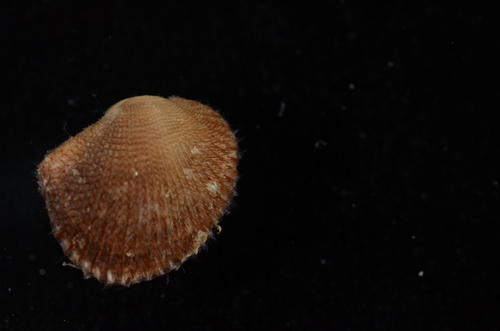
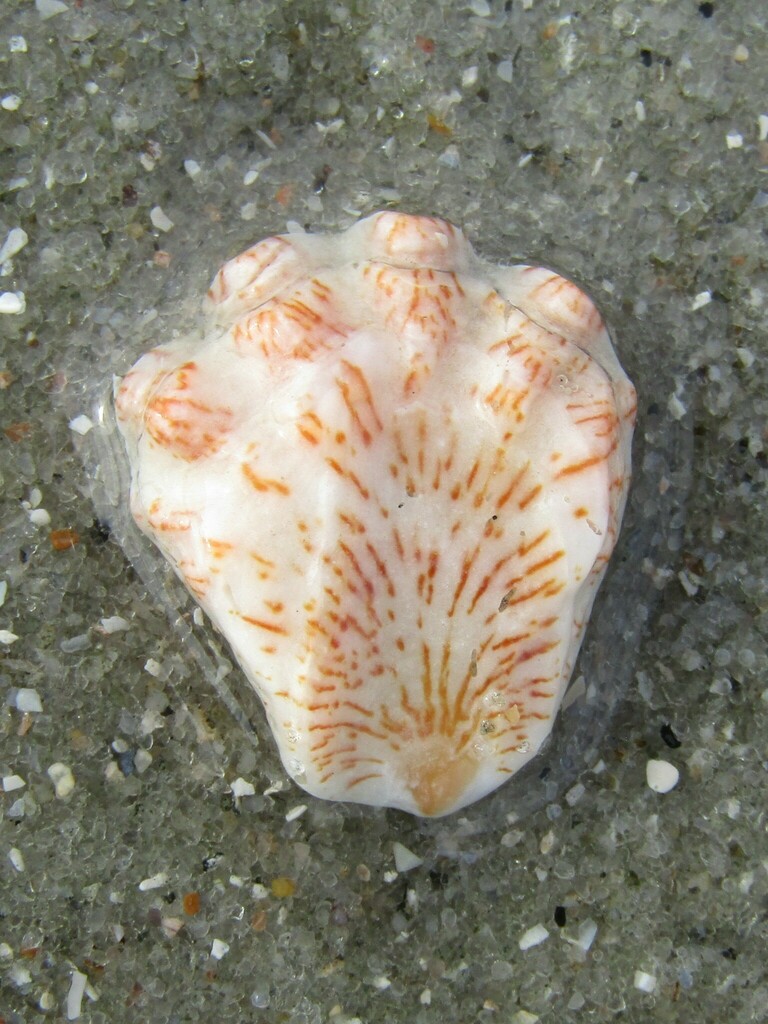
This next shell is a favorite but can be hard to find as it is rather small and flat, so it’s easily overlooked. This is the Atlantic kitten paw (Plicatula gibbosa).

Like the jingle shell, this is a sessile species that lives its life attached to hard substrate. The shells you find, as in this case, are usually the top shell, as the bottom shell remains on the object to which it was anchored. However, if you are lucky enough to find a bottom shell, one interesting thing is that the kitten paw shell grows around the host object. That means you can sometimes see impressions of the object and might be able to determine what it was.
This last one is probably my favorite. I’ve seen very few of them during my times on the beach and was very excited to find this one in perfect shape. This is known as the turkey wing, or zebra arc (Arca zebra).
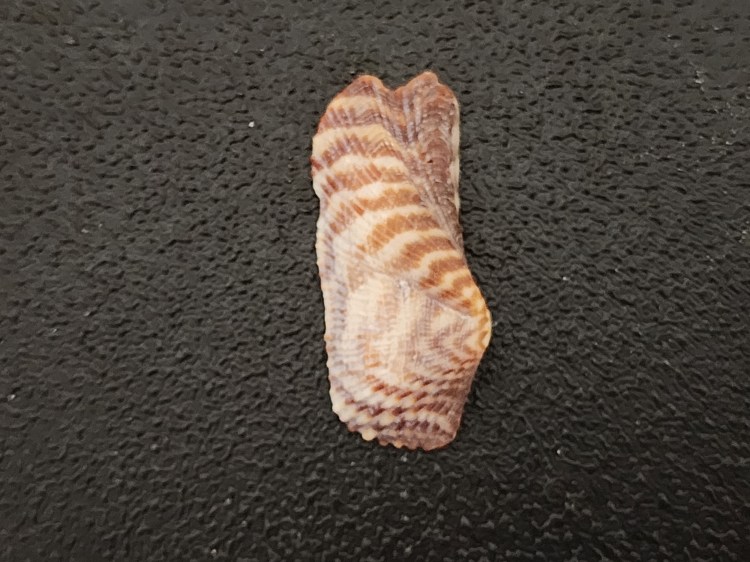
The “zebra” portion of both the common and scientific names clearly comes from the striping on the shell. It is also said that the complete animal resembles Noah’s ark. This species has a unique reproductive life, exhibiting protandric, systematic hermaphroditism. Basically, what that means is that they all start out as male and take on female forms later in life.
One final thing I’d like to point out which can make shelling even more interesting is how you can sometimes tell how the animal was preyed upon from clues on the shell. Below are four shells with different markings indicating what animal preyed upon them. The first three look similar but, upon closer inspection, are slightly different.
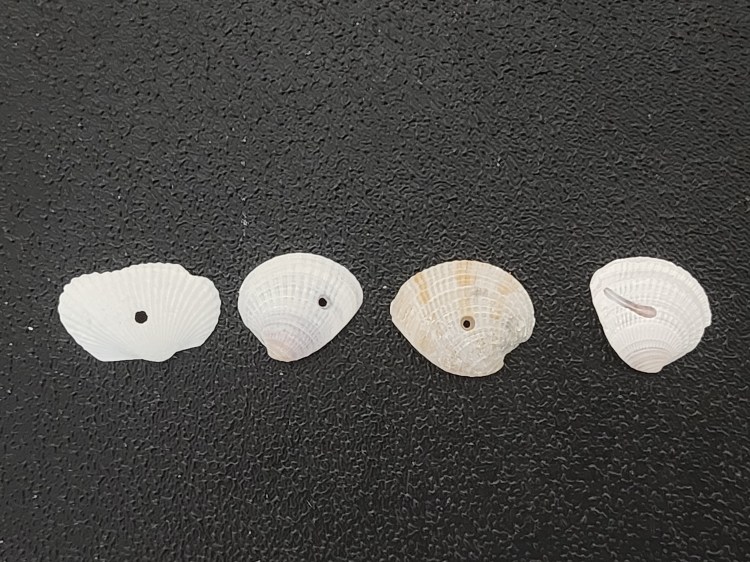
The first one had just a basic hole in it. There was no beveling or anything like that. Just a simple hole, as if it were dilled.
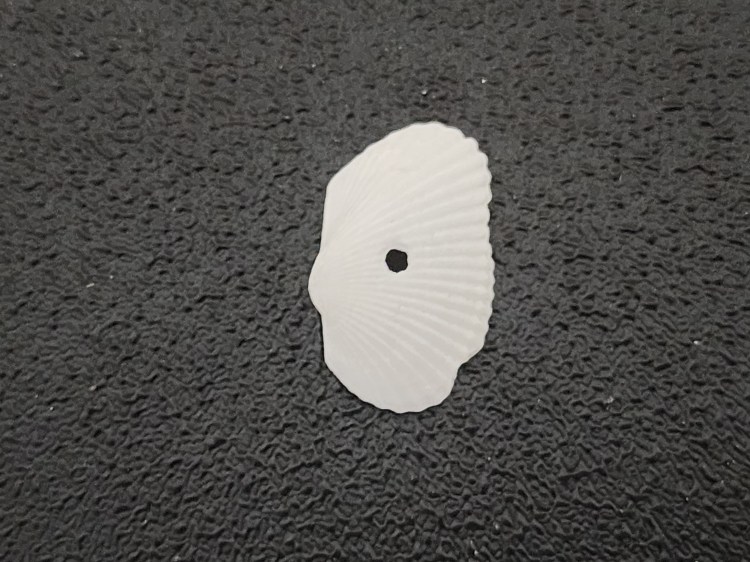
This was likely the work of an oyster drill (Urosalpinx cinerea). As the name suggests, this predatory snail drills through the shell and consumes the animal inside.
The next hole looks similar, but the hole is beveled rather than straight.
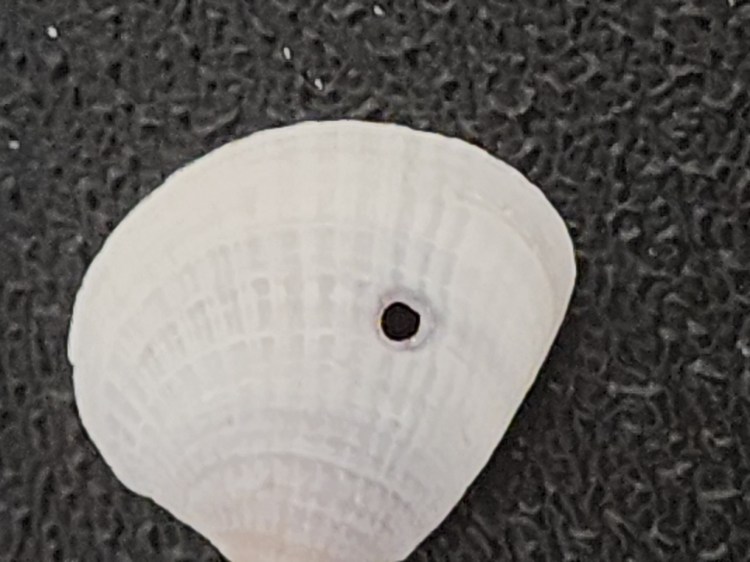
This was likely caused by the thick-lipped drill (Eupleura caudata). Like the oyster drill, it secretes enzymes onto the shell to soften it, then uses the radula (a structure of tiny teeth) to drill into it.
The hole in this next photo may be hard to differentiate from the last one. However, rather than being beveled, this hole is countersunk with two rings of distinct diameter.

This indicates predation from a shark eye snail (Neverita duplicata).
Finally, this next relic is less predatory and more parasitic. This shell has grooves created from a blister worm.
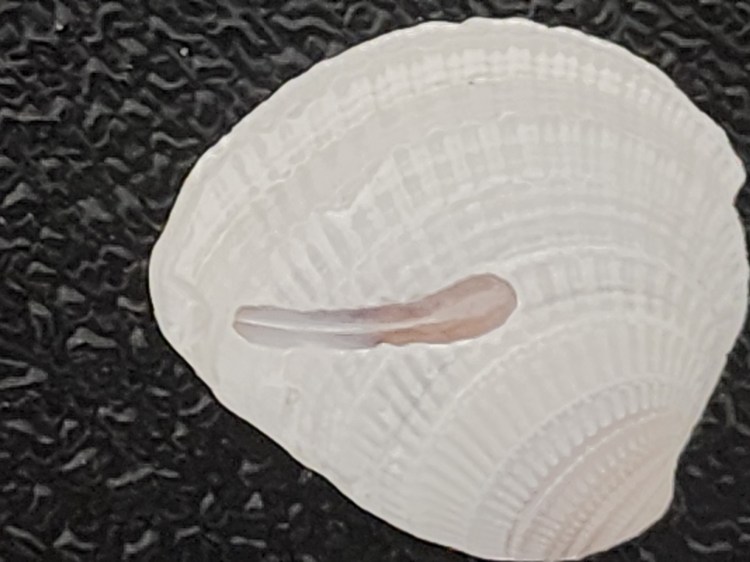
While usually you might think of a parasite using the host for food, the worm is not actually eating the calcium carbonate in the shell as it has little nutritional value. What it’s done is bore into the shell as a living space. It creates tunnels in the shell, then extends tentacles out of the tunnel to feed.
Admittedly, I have a lot to learn when it comes to mollusks. But through shell collecting and researching the species from which they came, I feel I’m well on my way. I’m excited to start the next segment on gastropods soon!
 BJ Quinton