UPDATE: The investigation concluded that a malfunction in the system, such as a small crack in the piping of the filtration system, caused a “super saturation event”. Think of a home aquarium. Aeration stones or flowing water help keep the oxygen levels in the water at an acceptable level. The various aquaria at the zoo, including Stingray Bay, also have mechanisms in place to maintain a certain oxygen level. This is especially important for rays because elasmobranchs absorb oxygen differently and are more sensitive to changes in oxygen concentrations. When more aeration gets into the system, oxygen levels climb to unacceptable levels.
From my volunteer experience, I can tell you that the system in the Bay was routinely inspected and water quality was checked to the manufacturer’s recommendations. It was an unfortunate event that was in no way the fault of the zoo or its employees. From what I’ve read, they are completely overhauling the habitat, including a more fail-safe filtration system, to ensure these beautiful animals can continue to be the amazing ambassadors they were prior to this tragedy.
ORIGINAL POST:
Just over a week ago, at the local zoo where I used to work and volunteer, there was a tragedy that hit me pretty hard personally. When I first volunteered there, I had an interest in reptiles so I volunteered for the herps/aquatics department. One of the first areas I worked at was Stingray Bay, an interactive exhibit with several ray species that visitors can touch and feed. I learned so much about them and fell in love immediately. To further my connection to them, it was during my time volunteering that we had our first successful breeding within the bay. While I never had the experience of watching them be born, I was there for literally the first hours of their lives. I fed them their first bites of food. I marked them for identification. I clipped their barbs. They were like an extension of my family.
This past Thursday, all twelve rays suddenly died. When I say suddenly, it was reported that the timeline between normal activity and when they realized they were all dead was less than one hour. They are investigating, but no cause has been found at the time of this post. The fact that the news story isn’t getting much attention is one of the reasons I even do this blog. If the rhinos or tigers, larger more exciting animals known as “charismatic megafauna”, suddenly died, it would be a bigger news story. But, since they are not as cute and cuddly or grand, they don’t get the publicity. It’s something that bothers me, but I also understand why it happens.
It is unlikely that any of these rays were the ones that I raised. The average lifespan is around 18 years and it’s been about that long since I volunteered there. However, I’ve still always felt a strong connection to the ray species and to the Stingray Bay exhibit. I’ve seen these animals be incredible ambassadors for their species. I remember people coming in thinking they are disgusting, scary creatures. I would spend a little time with them, have them get the courage to touch one or two, and tell them a few interesting facts. By the time they leave, they are talking about how amazing they are, they are buying plush toys and shirts, and, most importantly, they say how they can’t wait to learn more and may even get involved in conservation. This sort of thing rarely happens when you just tell someone about an animal. Having that hands-on experience is the key and it’s why I’ve always been an advocate for educational animal exhibits.
Sadly, at least for now, this incredible experience is not available for the public. This sad event inspired me to write a post about stingrays. Many people think they know what stingrays are all about and are actually quite mistaken on many fronts. I only post photos that I myself have taken and I haven’t been able to find any of mine. So, unfortunately, this will be a wordy post. But hopefully the interesting facts and links will make it worth the read.
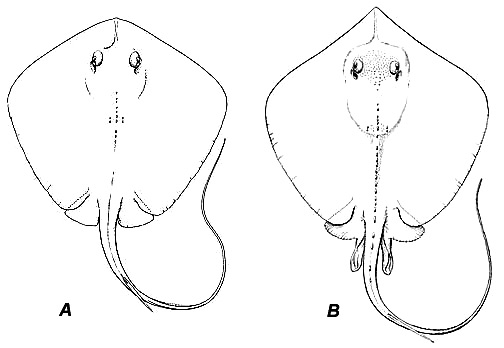
First, a few things about stingrays in general. First of all, they are elasmobranchs, meaning they have a skeletal system made of cartilage, rather than bone. They are also ovoviviparous. This can be a bit hard to understand. Viviparous species, like humans, grow their young within a womb and they are born live. Oviparous species, such as birds, lay eggs which are incubated outside the body and hatch later. Ovoviviparous species, such as rays, sharks, and some reptiles, have eggs that actually hatch within the body and the young are born live. They are also sexually dimorphic. Like sharks, the males can be distinguished from the females by presence of claspers. In the link, A is the female and B is the male. The claspers are the extra appendages near the pelvic fins.
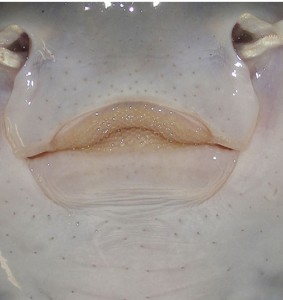
Another trait they have in common with sharks is a set of really interesting sensing organs known as ampullae of Lorenzini, named for Stefano Lorenzini who discovered them in 1678. You can actually see these as small pores on the head and around the mouth, which is on the underside of the body, to many people’s surprise. These receptors can sense the small electrical impulses from muscle movements of potential prey hidden under the sediment. While we are on the subject of the mouth, another surprising trait is their teeth. Many visitors expressed concern about being bitten when feeding them. However, the “teeth” are basically just plates, more designed to crush soft prey than rip flesh from bone.
One of the more interesting things about stingrays is how they breathe. Fish breathe by opening their mouths to pull in water which is then passed across gills that are held in slits on the sides of their heads. Stingrays’ gills are on the underside of their bodies. The biggest problem this presents for them is that they spend so much time with their undersides against the sediment floor when feeding or burying themselves to hide from predators. They combat this with a large opening behind the eye known as the spiracle. This opening opens and closes, bringing water into the side of the head, across the gills, and out through the gill slits under the body.
Finally, to the relief of many of the visitors I had the pleasure of talking to, the stinger is not at the tip of the tail, but rather at the base, or sometimes a little further down on the tail. So they are not going to be able to whip the tail around to get you. The barb is a bony structure that houses the toxins in groves that are held in place by a skin covering. Since there are no nerves in the barb, we were able to clip them like toenails to keep visitors safe with no harm to the ray.
Of the five ray species found in Florida, there were three in Stingray Bay. I’ll start with the one that is the most prevalent. It’s also the one that I raised as newborns and was the subject of my first tattoo – the cownose ray (Rhinoptera bonasus). The genus is a combination of the Greek rhinos meaning “nose” and pteron meaning “wing”. This makes sense since they basically look like a big nose with wings. The species name is the Greek word for “bison”, though I’m not sure how that one applies. This species has a feature that actually perpetuates a misunderstanding about them. They have flaps near their mouths called cephalic lobes that can be extended to help aid in suction as they feed on one of their favorite prey species – oysters. They extend these lobes when visitors feed them at zoos as well. From above, this can look like a mouth opening, giving people the illusion that the mouth is in the front of the head.
A much larger species in the southern stingray (Hypanus americanus). I struggled to find any information on the genus name, but the species name is no doubt a reference to it being found in the Americas, specifically throughout the Gulf of Mexico, the Caribbean, and along most of the eastern shore of South America. This species is especially important for the double-crested cormorant, a bird I will be sure to write more about later. When southern stingrays feed in shallow waters, they disturb the substrate and, in addition to their own prey items, will expose other fish species. Cormorants will often follow southern stingrays as they feed to catch these exposed prey.
The third stingray species that could be found in Stingray Bay is the Atlantic stingray (Dasyatis sabina). The genus name is a combination of the Greek dasýs meaning “rough” and batís meaning “skate”. While they look similar to the southern stingray with the round body, one of the biggest differences with this species is size. Where the southern stingray can grow to a width of almost five feet, the Atlantic stingray only grows to a width of just over nine inches. Atlantic stingrays also avoid shallow waters, preferring depths of at least six feet when close to shore.
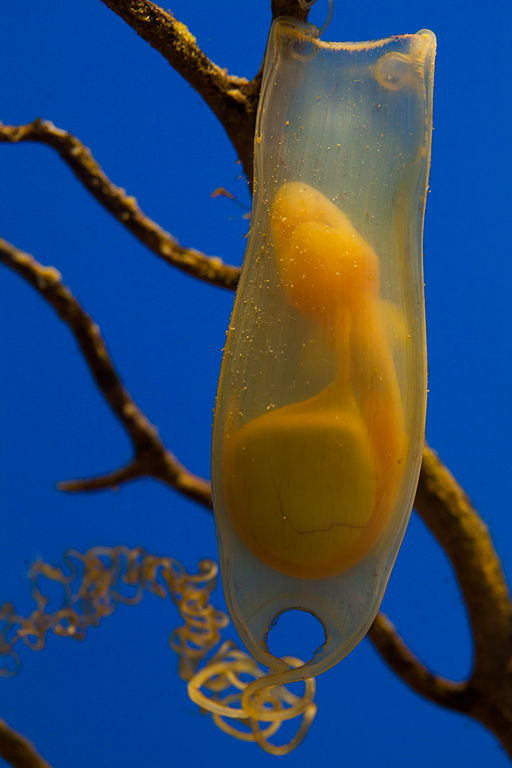
I couldn’t find anything regarding the species name, but the fact that the genus refers to skates is the perfect opportunity to answer a question I’ve been asked quite frequently. What is the difference between a skate and a ray? There are a couple of differences when it comes to the tail. First, the skate has more of a thick, rigid tail in contrast to the whip-like tail of the ray. Also, skates lack the venomous barb. The biggest difference, however, is that skates are in fact oviparous, laying eggs in a sack known as a “mermaid’s purse“. Sometimes these sacks are transparent and you can actually see the young developing inside.
While the news at the zoo was heartbreaking, I am hopeful that there might be some opportunity here. Hopefully the investigation will shed some light on the cause of the tragedy, and they can remedy the situation and get the bay back up and running again. I also hope that, when the time comes to reopen, there is some good publicity to make this attraction more popular than ever. I can’t think of another interactive exhibit that promotes as much change in visitors’ perception on a species. People think giraffes are amazing before being able to feed them. Lorikeets are beautiful birds even before they flock around you for their share of nectar. I always loved the stingray exhibit for its amazing ability to take visitors that are either apathetic or scared of these animals and have them leave with as much appreciation for them as I have.